




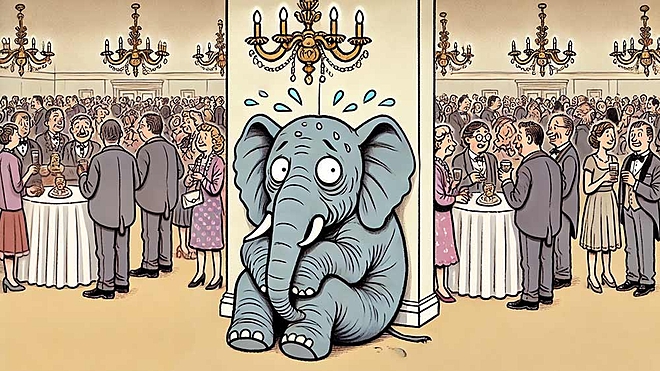
 AI-generated image

A few days back, on a popular Q&A website, I came across what might be called the quintessential beginners' question about investing. A young person who started earning an income a few years ago now finds that he has enough money to save but does not know where to begin. Unlike a passive saver who waits for someone to come and pitch something, he has done his basic homework.
He knows that he wants to invest for the long term. He knows that long-term means 10 to 15 years, and not the one year that tax law says it is. He knows that equity is the asset class into which his investments must flow--he has no illusions that fixed income can generate returns that can beat inflation by any margin worth talking about. He has also done enough research to know what his options are for such an investment.
Suggested read: The best path to prosperity
His list of options includes actively-managed equity mutual funds, equity funds with passive portfolios like index funds and ETFs, and direct investments in equities for which he will research and select the stocks himself. However, he's not very sure which of these will best suit the purpose, which is what he's asking the community on the website. As is usual in discussions on the internet, there are a large number of answers which cover a full range of arguments, some serious, some flippant, some wise and some unwise.
Within the answers given, all bases are covered. Between them, even the serious, well-reasoned answers collectively pitch for all the options that there are on his list. People have given well-reasoned answers for active mutual funds, ETFs, index funds, and equities, as well as a few variations for good measure. Really, it's no different from asking the internet about which phone, car or camera to buy.
So what should this young man (and countless others like him) do? Which investment option is the best one? The answer to that is that the question itself is asking the wrong thing. Each and every one of these asset types can fulfil the purpose. The choice is to be made mostly on the basis of who and what the investor is, rather than on any inherent superiority of the asset type itself.
Could he get the returns he wants by researching and investing directly in equities himself? Sure, there are obviously lots of people who do that. But it means a considerable learning period, time and money spent on researching stocks, and a temperament that suits constant monitoring while managing one's emotions during periods of volatility.
Suggested read: The old dilemma: stocks or mutual funds?
As for ETFs and index funds, they are best suited for someone who is satisfied that they will earn what the equity markets will broadly gain. They don't want to get into the race to try and earn more than the indices, and would rather not try that and take the risk of earning less. Anyone who wants the returns of equity would generally not take the 'this much and no more' attitude that passive funds represent, which is more suited to an institutional attitude to investing.
Suggested read: ETFs or index funds: Which to choose for wealth creation?
Equity mutual funds offer a chance of doing better than the markets and thus better than ETFs and index funds. There is an oft-repeated belief that index funds and ETFs generally do better than active funds. From the studies that I have seen, this is generally true in the US, which is also the source of this belief. However, in India, where I and my team at Value Research have looked at this issue continuously for more than two decades, this is simply not true. Depending on the period and the phase of the markets, over the long term, a majority--sometimes big and sometimes small--of actively managed equity mutual funds do better than the markets. If an investor uses a modicum of care in choosing an actively managed fund, then his money can earn a lot more.
So we see that such a question is actually a variation on the story about the elephant and the blind men. It's important to have a broad perspective on what different options actually represent rather than just look for a narrow yes/no on each. To choose one option--or a combination--one needs to understand as much about the ones that are not suitable as the ones that are.
Also read:
For investors, the most important decision
Should one invest directly in shares or through mutual funds?
Ask Value Research 
 New episodes every Friday











 New Process Alert
  Seems like you've uploaded a wrong QR code. Please upload the QR code downloaded from MF Central platform.


