




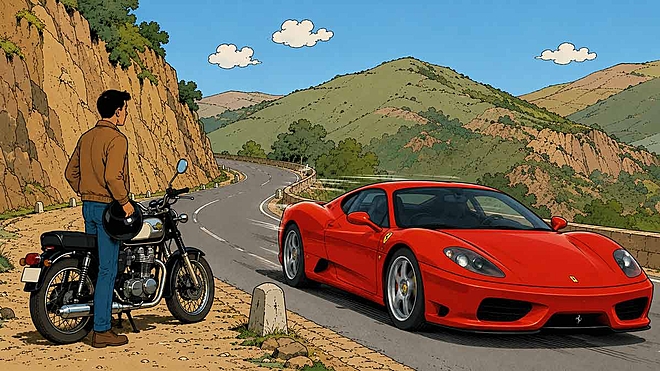
 Anand Kumar/AI-Generated Image


Summary: Should every extra rupee be invested for the future, or is there a point when spending becomes part of a life well lived? This piece explores why the answer depends less on what you buy than on who you've become before buying it.
A software entrepreneur said something recently that was designed to make people like me wince. It did not, and the reason why is the subject of this note.
Somewhere in a recent podcast, the software entrepreneur David Heinemeier Hansson, DHH, as he is normally called, argued that anyone who builds something worthwhile and earns a great deal from it carries a sort of moral obligation to spend some of it on beautiful things, to send some of that fortune to Italy and have its craftsmen build you a Ferrari. There is no shame in wanting to better your material lot, he said, and a world in which nobody ever bought such a car would be a poorer place for everyone, including the millions who only ever admire one from the roadside. We need beautiful Ferraris, and other luxury goods, as he put it, "even if we don't own them."
Hansson is worth listening to here for a reason that is easy to miss. He is not one of those founders who built a company, sold it in a dramatic exit, and now has a fortune that needs to be spent. He runs a software business that has stayed profitable, independent, and deliberately unfashionable for nearly two decades, the sort of enterprise the VC world dismisses sneeringly as a mere 'lifestyle business'. He has never chased hypergrowth, never taken the company public, and ignored the soaring valuations his peers obsessed over. The Ferraris arrived on top of all that refusing.
Reading him, I was reminded of a column I wrote a few years ago about a young man who had just started earning and desperately wanted a motorcycle that cost Rs 2.5 lakh. Everyone had given him the correct, cautious advice, complete with the calculation of how long he would need to save for it. But I argued the opposite, that if he did it sensibly, he would be 30 before he owned the thing, and by then the desire and the joy may have faded. Buy it now, I told him, and break the rule a little because the rule is just a means to an end. So I am not and have never been the columnist who insists that every rupee of pleasure be postponed to some virtuous future.
All this makes the Ferrari case more interesting. What makes DHH’s advice good comes not from extravagance but from 20 years of behaving in a decidedly un-Ferrari manner beforehand. The car is the last scene of a long story that is otherwise all about patience, restraint and the refusal to follow easier, flashier paths. The difficulty is that the car, and his statement about it, is the only part people notice. The car stands in the garage but the discipline that paid for it stays invisible, so the world admires the prize and forgets the hard work.
The motorcyclist and the Ferrari owner are not opposites, though. They are the same person at two ends of a single life, each matching his spending to the stage he has reached. The young man should not defer a modest joy he can comfortably afford because the habit of living is as important as the habit of saving. The older man should not have reached for his reward before he had built the thing that produces it. The mistake in both directions is one and the same: spending that has fallen out of step with where the spender is.
There is something appealing, even so, in DHH’s insistence that beautiful things ought to exist at all, and that somebody must pay for them to be made. A life measured only in the arithmetic of compounding, in which no sum is ever spent because every sum could always grow a little more, has missed the point of having built anything at all. So buy the Ferrari, by all means, on the day you become the person who has earned it. Until then, it’s fine to admire one zooming past, and get on with the un-Ferrari years that are the real work.
Also read: Protect your goals from yourself
Ask Value Research 
 New episodes every Friday









 New Process Alert
  Seems like you've uploaded a wrong QR code. Please upload the QR code downloaded from MF Central platform.


