




 Illustration: Anand Kumar

Summary: Successful investing isn't about suppressing the urge to trade, but about containing it. Here, we explain a simple framework that separates long-term wealth creation from speculative bets, helping investors stay disciplined without ignoring their instincts.
Last month I wrote a column titled ‘Look once a year’, making the case that a fund portfolio, once assembled with care, is best left largely unwatched. The argument travels well beyond funds, and one reader wrote back to prove it. Pankaj Bajaj, one of our Stock Advisor subscribers, said he runs his stock portfolio on precisely that principle, and went on to describe the small system he has built around it. He said he does not even keep his long-term portfolio on a portfolio tracker. He has it on a spreadsheet on his own computer, looks at it once a quarter when results come out and otherwise leaves it alone. That is the whole of his serious investing, and he attends to it four times a year.
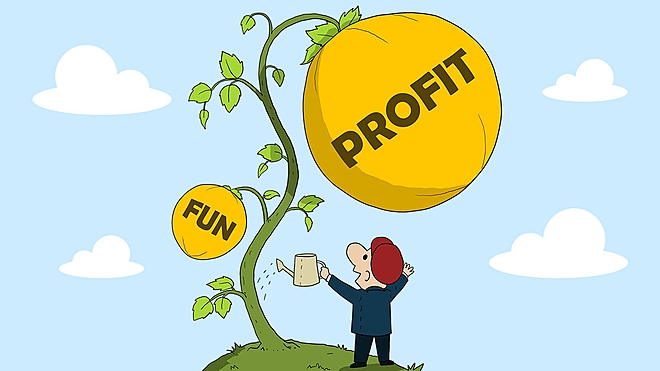
Then he told me about the other part. He is, in his own words, a ‘Market Keeda’: someone who needs something to watch and react to every day or two, some news to chew on and some position to fiddle with. Rather than pretend this side of himself does not exist, he has given it 3 per cent of his money to play with. With that small sum, he trades daily and weekly, satisfies the urge to do something and reacts to every headline he likes, but none of this touches the 97 per cent who are doing the actual work. He ended with a line I have been turning over since: this is again quite simple, but equally difficult to follow.
He is right on both counts, and he has independently arrived at something I first wrote about more than a decade ago. Here is what I have come to believe about people who invest in equities. They are, almost to a person, optimists, and most of them also carry a streak of the gambler. If you had neither of those traits, you would keep your money in an FD (fixed deposit) and never dabble in the stock market. So the urge to bet and to act is part of the same temperament that got them into equities in the first place. The question is not how to kill this instinct, only where to let it out.
Years ago, in a column I wrote in 2013, I called the answer ‘fun money’: a fixed, small slice of your capital that you invest without any pretence of being sensible. You may have a supposed reason for the bet or you may not, and you know in your heart it is mostly a gamble. What matters is that it is walled off and capped, and you are honest about what it is. I recommended it, but I confessed I had never done such a thing myself and I thought that the sort of person drawn to fun money would also be the sort who could not keep the wall standing, and who would let the fun leak into the serious money until there was no difference between them. Bajaj’s email is the reply to that old doubt, from a reader who has kept the wall up and told me how.
His system works because of the system he has built around trading. The cap is hard and small. The two things are in different places, one on a tracker he barely opens and one he watches every day. And the frequencies are set correctly, which is the part almost everyone gets backwards. Most investors watch their serious holdings every single day, flinching at every tick and give their speculative punts no thought at all beyond hope. Bajaj does the opposite. He watches the 3 per cent, where watching does little harm and leaves the 97 per cent alone, where watching does real damage. Staring at a good investment hourly is one of the surest ways to convince yourself to sell it, because in the short run, the price will always give you some reason to sell. Which brings me to where a service like ours fits into all this, and I want to be clear about it.
Value Research Stock Advisor is built to be the 97 per cent. What we offer is the disciplined core that Bajaj keeps his itch well away from. If you are looking for hot tips, quick multibaggers or something to trade on this week’s news, we will be a disappointment, and we say so on our own website.
The way we do that is by rejection before selection. We begin with the entire universe of listed companies and throw most of them out before we admire any of them, and the first filter is governance and quality: a company with the wrong sort of promoter or an unexplained pile of debt is gone before its growth story is ever heard. Only what survives that cull is assessed for its business and its price.
From this, we run three ready-made portfolios (Long-term Growth, Aggressive Growth and Dividend Growth), and every month our team reviews each one and tells you, with reasons, if anything needs to change. All of it costs Rs 9,990 a year. The point of paying someone to properly review your portfolio each month is that it frees you from having to watch it yourself.
When you know a competent process is checking the fundamentals every month and will tell you when something has genuinely changed, you no longer need to open the tracker on a Tuesday afternoon to reassure yourself. You can look once a quarter, as Bajaj does, or once a year, as I had been urging in the first place.
That is why I found the email so satisfying. A subscriber had worked out, on his own, the two things most investing advice never manages to hold together: that the gambler in us is real and needs feeding, and that the way you feed him is by keeping him well away from the money that matters most.
Subscribe to Stock Advisor today
Ask Value Research 
 New episodes every Friday













 New Process Alert
  Seems like you've uploaded a wrong QR code. Please upload the QR code downloaded from MF Central platform.


