




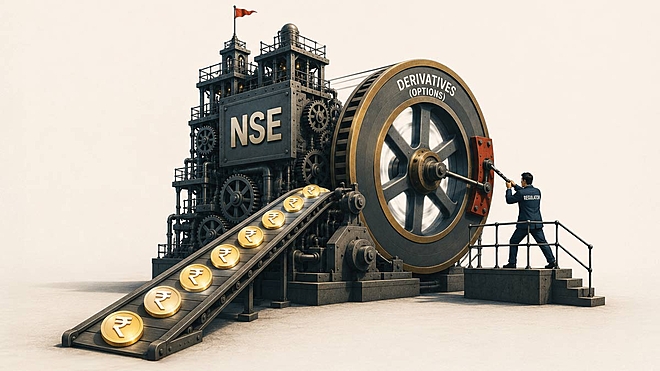
 Yogesh Sharma/AI-generated image
Summary: NSE enters the public market after a decade-long delay as a far larger and more profitable business than it was in 2016. But its growing dependence on derivatives and a tougher regulatory environment mean investors should look beyond the headline numbers before deciding whether to invest.
Summary: NSE enters the public market after a decade-long delay as a far larger and more profitable business than it was in 2016. But its growing dependence on derivatives and a tougher regulatory environment mean investors should look beyond the headline numbers before deciding whether to invest. NSE filed for an IPO in 2016. The sale never happened. A scandal over unfair access to trading froze the plan for years. Then came a decade of waiting. This time, its IPO is expected to be sized at around Rs 30,000 crore, the largest share sale in Indian history. The record-size headlines will skip that decade. This is the part you should read before you decide whether to buy. What stopped it in 2016 The roadblock was co-location. Between 2010 and 2014, certain brokers connected first to a backup server inside NSE’s data centre. That gave them market data milliseconds ahead of everyone else. In high-frequency trading, milliseconds are money. A forensic audit confirmed the pattern. SEBI opened an investigation, and when NSE filed its prospectus in 2016, the case was still wide open, with no end date. That uncertainty was enough for the market regulator to halt the listing. What followed was a decade-long grind through SEBI penalties, tribunal battles, and the Supreme Court. The saga is in

 New episodes every Friday













 New Process Alert
  Seems like you've uploaded a wrong QR code. Please upload the QR code downloaded from MF Central platform.


