




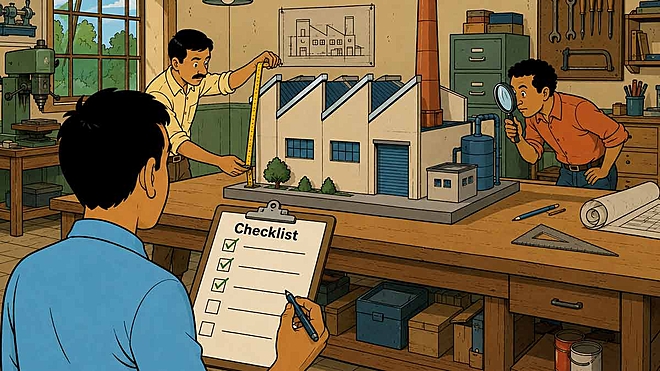
 Anand Kumar/AI-Generated Image


Summary: The biggest investing mistakes rarely come from a lack of knowledge; they come from failing to ask the right questions at the right time. We explain why a simple checklist or framework can be more valuable than conviction when judging stocks and navigating different market situations.
The next time you take a flight, the safest part of the journey will have happened before the aircraft moved. Two pilots will have sat in the cockpit reading a list aloud to each other, one calling out items and the other confirming, in an activity which is absolutely routine. Nothing on the list is difficult, and both have done it hundreds of times. That small ritual is among the main reasons flying is as safe as it is, and I want to make the case that the same principle belongs in your investing.
This exercise of checking whether a list exists dates back to an accident in 1935. The American Army was testing Boeing’s entry for its next long-range bomber. The aircraft took off, climbed a few hundred feet and then fell back to earth, killing its pilot, who happened to be the army’s chief of flight testing. The investigation found nothing wrong with the machine; the pilot had forgotten to release a small mechanism that locks the control surfaces while an aeroplane is on the ground. The army’s response is the interesting part: it did not order more training, because nothing could be added to the training of the man who had just died. A few pilots wrote out that list instead. The technique became a standard in many fields (including surgery) not because it taught anyone anything, but because knowing something and remembering to ask at the right time are different things.
This is the actual case for using a framework in investing. The usual argument is that a framework makes you a better analyst, which I doubt. A framework is something you build when calm and consult when you are not. It settles what counts as evidence before a stock has had the chance to charm you. Judging one company at a time means making that judgement fresh each time, but a framework does something much better.
You can see what happens without one: people rarely fail on the thing they examined. Castrol India passes every quality test anyone could set, and yet, it has gone nowhere for a decade because its market has stopped growing. The investors who piled into momentum names in recent years had growth and price action and no quality underneath, which is why those stocks fell hardest when the mood turned. HDFC Bank is the most instructive: quality and growth both present and sustained for nearly two decades, and anyone who bought at six times book in 2020 has had five flat years. They were not ignorant; they knew the bank intimately. The price had already accounted for everything the bank would deliver, and the question that would have saved them was the dull one nobody thought to ask.
In almost every investing disaster I can think of, three of the four things were right, and they sounded so good that the fourth and fifth were never thought about. This is what a framework is for, and its job is simple: not insight, but completeness. It forces you to ask the dull questions when you feel like focusing only on the interesting ones.
Which is what this issue’s cover story is about. You will be told endlessly that you must first establish what sort of investor you are: aggressive or conservative, growth chaser or safety seeker. It is a comfortable idea and a useless one, because situations do not consult your temperament before they arrive. Every investor will, at some point, be holding something that fell 40 per cent for reasons that may or may not matter, meets a rally with nothing behind it and a dividend that signals strength or confesses a business has run out of uses for cash.
Our cover story sets out five ways of thinking for those five situations. Read them the way those two pilots read their list: not as a comment on your ability, but as something that ensures.
Also read: The great investor theory
Ask Value Research 
 New episodes every Friday









 New Process Alert
  Seems like you've uploaded a wrong QR code. Please upload the QR code downloaded from MF Central platform.


