




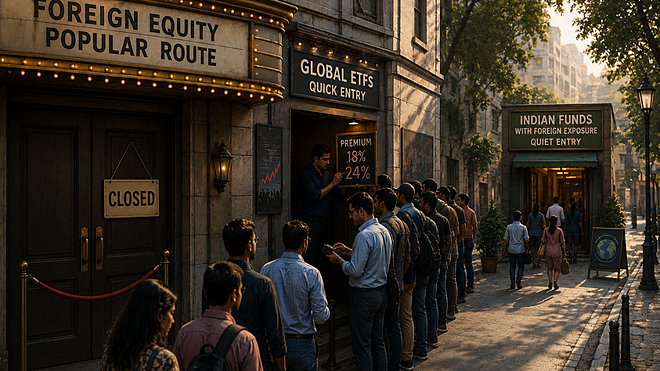
 Ujjal Das/AI-Generated Image

Summary: New SIPs into international mutual funds have largely come to a halt. Yet, several domestic mutual funds still invest a portion of their portfolios overseas. Here, we identify those funds, explain the alternatives available and highlight why global ETFs may currently be more expensive than they appear.
Open the bonnet of Parag Parikh Flexi Cap, one of India's most popular funds, and you will find Alphabet, Meta, Amazon and Microsoft inside it, about a tenth of the fund in US shares. Edelweiss Technology holds Nvidia and Apple. DSP Healthcare owns Illumina, a US gene-sequencing firm. None of these is an international fund. They are ordinary Indian funds that invest a slice abroad, and that slice just became more useful because the usual way to buy foreign equity has largely closed.
On July 23, Baroda BNP Paribas Aqua stopped taking new SIP registrations. It was the last international fund still open; the rest had already closed. India caps how much its funds can invest overseas, and one house after another has hit its limit. Existing SIPs carry on, but starting a new one had become impossible, until now.
From August 3, Baroda Aqua reopens to fresh subscriptions, having freed up a little headroom, though it warns it may suspend again as the limit nears. So the door is ajar, not open, and only at one fund.
So how do you invest abroad now?
Three routes are left. A global exchange-traded fund, or ETF, on the exchange is quick but, as we will see, expensive today. The Liberalised Remittance Scheme lets you send money overseas and buy foreign shares yourself, but brings extra tax hassles and paperwork. Or you can hold a diversified Indian fund that already invests a slice abroad, the route in the table below.
We went through the June 2026 holdings of every equity and hybrid fund and pulled out the diversified ones holding at least 10 per cent in foreign equity.
Diversified funds that hold 10 per cent or more in foreign equity
| Fund | What it invests in | Foreign equity (%) | 1-yr (%) | 3-yr (%) | 5-yr (%) |
|---|---|---|---|---|---|
| Edelweiss Technology | Technology | 26.8 | 8.2 | NA | NA |
| ICICI Prudential Passive Multi-Asset FoF | Multi-asset | 26.6 | 11.3 | 13.2 | NA |
| Franklin India Technology | Technology | 20.5 | −5.0 | 12.7 | 9.8 |
| Kotak Pioneer | Innovation theme | 18.6 | 10.6 | 20.1 | 16.8 |
| DSP Healthcare | Pharma & healthcare | 17.2 | 9.8 | 21.2 | 16.6 |
| Axis Innovation | Innovation theme | 14.9 | 9.2 | 16 | 12.4 |
| DSP Value | Value stocks | 13.1 | 11.6 | 17.5 | 14 |
| DSP Natural Resources & New Energy | Energy & resources | 12.8 | 19.2 | 20.4 | 16.1 |
| SBI Children's (Investment Plan) | Flexi-cap | 12.8 | 18.4 | 22 | 21.4 |
| Invesco India Multi Asset Allocation | Multi-asset | 11.7 | 15.6 | NA | NA |
| SBI Technology Opportunities | Technology | 11.3 | −3.6 | 11.8 | 9.4 |
| DSP Multi Asset Allocation | Multi-asset | 11.2 | 17.9 | NA | NA |
| Parag Parikh Flexi Cap | Flexi-cap | 10.6 | −1.0 | 14 | 13.4 |
| SBI Focused | Flexi-cap (Focused) | 10.4 | 13.6 | 15.9 | 13.9 |
| Motilal Oswal Asset Allocation Passive FoF (Conservative) | Multi-asset | 10.3 | 10 | 13.2 | 11 |
| Returns are for the whole fund, not the foreign part alone, as of July 29 2026. Holdings as of June 30, 2026. | |||||
Read this carefully. That foreign slice is exactly that, a slice: at most a quarter of the fund, and for most 10 to 15 per cent, with the rest invested in India. These are not global funds in disguise, and the returns shown are for the whole fund, not the overseas part alone. Pick one only if the fund itself suits your plan. The foreign exposure is a bonus, not the sole reason to buy.
The ETF route, and why it is dear
If you would rather add foreign equity on purpose, a global ETF is the ready way, but mind the price. An ETF's market price can sit above the value of what it owns, its NAV; that gap is the premium. These ETFs stopped issuing fresh units in 2024, when they reached their separate ceiling of $1 billion, so supply is fixed while demand is not. With the dedicated funds now shut, that demand has fewer places to go, pushing the premium higher still.
Global ETFs: Where the premium stands
| Global ETF | NAV (Rs) | Price (Rs) | Premium now (%) | 52-week average premium (%) | 52-week Premium range (%) | 52-week Avg daily trading (Rs cr) |
|---|---|---|---|---|---|---|
| Motilal Oswal NASDAQ 100 | 254.32 | 315.36 | 24 | 9 | −3.0 to 27.7 | 23.63 |
| Mirae Asset NYSE FANG+ | 154.79 | 191.34 | 23.6 | 19.8 | 11.8 to 30.1 | 5.43 |
| Mirae Asset S&P 500 Top 50 | 62.9 | 77.37 | 23 | 19.4 | 14.5 to 23.7 | 1.65 |
| Motilal Oswal Nasdaq Q50 | 114.64 | 140.71 | 22.7 | 12.7 | −1.7 to 26.4 | 1.44 |
| Mirae Asset Hang Seng TECH | 19.92 | 23.16 | 16.3 | 19.4 | 12.4 to 36.4 | 2.58 |
| Nippon India Hang Seng BeES | 466.36 | 491.18 | 5.3 | 15 | 3.4 to 25.6 | 8.88 |
| NAV, price and premium are as of July 29, 2026. The premium range and average daily trading cover the year to that date, NSE only. Premium is how much more the market price is than the NAV; a minus sign means a discount. | ||||||
And the two Nasdaq funds have run up fast. The Motilal Oswal NASDAQ 100 ETF traded barely 1 per cent above its NAV in March; it has climbed every month since, to 24 per cent now, and Nasdaq Q50 has done much the same. The other two US funds, FANG+ and the S&P 500, did not jump. They were already dear, near 18 to 20 per cent back in March.
All four US ETFs are now bunched between 22 and 24 per cent, and each trades above its own one-year average premium. The premium is the extra you pay over what the fund owns, and it does not stay put.
You could see the effect this week. Between July 22 and July 29, the NASDAQ 100 ETF's NAV, the value of what it owns, fell 7.0 per cent in rupee terms, but its exchange price fell only 2.5 per cent. The premium jumped from 18.3 to 24 per cent and hid most of the drop. Buyers did not dodge the fall. They just paid more for it. It can also swing the other way.
So the closure changes less than it looks. Foreign equity is still within reach, inside funds you may already own and through ETFs for anyone who wants more. The real question is which route suits you, and whether the fund you are eyeing is worth buying at all. That is what the Value Research Fund Advisor is for.
Subscribe to Fund Advisor today
Ask Value Research 

 New episodes every Friday











 New Process Alert
  Seems like you've uploaded a wrong QR code. Please upload the QR code downloaded from MF Central platform.


