




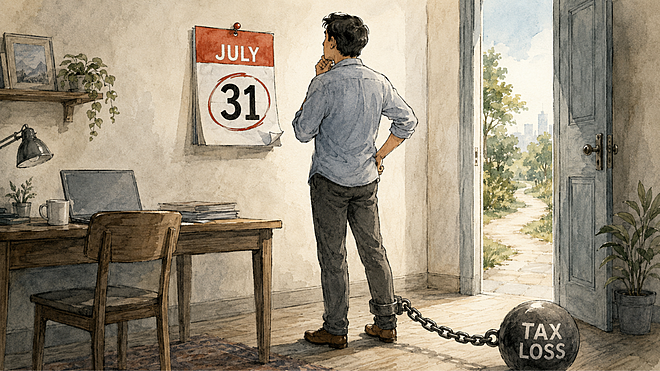
 Ujjal Das/AI-Generated Image

Summary: Most people think missing the tax filing deadline means paying a small penalty. It can, but that's rarely the biggest cost. One overlooked rule can affect your taxes for years after. This story explains what many taxpayers realise only when it's too late.
When people think about missing the July 31 tax deadline, they picture a fine. The fine is small. The real damage is something most people never notice. If you sold shares or mutual funds at a loss this year, filing even a day late means you can no longer use that loss to cut your tax in future years. The fine might be Rs 1,000. What you lose by filing late can be worth far more.
This is for people whose deadline is July 31 2026: salaried employees, pensioners, and anyone who earns by selling shares, mutual funds or property but does not run a business. In tax terms, you file ITR-1 or ITR-2. If you run a business or a profession (you would file ITR-3 or ITR-4), your deadline is later, so this piece is not about you.
One quick point before we start. You may have heard that a new Income Tax Act, 2025 has come in. It changes nothing for the return you file now. This year’s return still follows the old law, the Income Tax Act, 1961, and that is where all the sections below come from.
The fine is the small part
The late fee comes first (Section 234F). File late and you pay Rs 5,000, or just Rs 1,000 if you earn up to Rs 5 lakh a year. Earn too little to need a return at all, and you pay nothing. That is the whole fee.
Then there is interest, 1 per cent a month, but only on tax you have not yet paid (Section 234A). If your employer already deducted your tax, or the government owes you a refund, there is no interest at all. That is most salaried people.
After that, the only thing you lose is time. A late return simply means your refund reaches you later.
Zero tax still means a fine
This is where people trip up. Under the new tax regime, most people earning up to Rs 12 lakh pay no tax at all, and up to Rs 12.75 lakh if they are salaried. This is thanks to a discount called the Section 87A rebate. So many think, “I owe nothing, so a missed deadline cannot hurt me.”
It can. Owing no tax is not the same as being allowed to skip filing. You have to file the moment your income crosses Rs 4 lakh, even if your final tax works out to zero. So someone earning Rs 9 lakh pays no tax, yet must still file, and if they file late, they still pay the fine.
The cost you cannot undo
Say you sold some shares or mutual funds this year and made a loss. The law lets you keep that loss on record and use it to pay less tax when you make a profit in a later year, for up to eight years. But there is a condition. You keep this right only if you file on time. File late, and the loss is wiped out. No return you file afterwards can bring it back (Section 80, read with Section 139(3)).
Say your loss this year is Rs 2 lakh, and next year you make a profit of the same size. File on time, and that loss cancels the tax on next year’s profit. File a day late, and it does not. If that profit would have been taxed at 20 per cent, filing late just cost you Rs 40,000. One loss does survive a late return, a loss on a house you rent out, under Section 71B. You can also still use this year’s loss against this year’s own income. It is only the saving for future years that goes.
There is a smaller second cost, and it hits only some people. A few taxpayers still pay less under the old tax regime, usually those with a home loan, rent to claim, and large tax-saving investments. You can pick the old regime only if you file on time. Miss the deadline, and you are placed on the new regime for the year, whether it suits you or not (Section 115BAC). For most people the new regime is the better deal now, so this changes nothing. For the few with big deductions, it stings.
If you miss it
If you do miss the deadline, you can still file. Two of the ways get confused, so here is what each one is for.
| Option | Last date | Cost | The catch |
|---|---|---|---|
| Belated return, filed after the deadline (Section 139(4)) | December 31, 2026 | The fine, plus interest if you owe tax | You still lose the loss you saved for later, and the old regime |
| Revised return, to correct a return you already sent (Section 139(5)) | December 31, 2026 free; March 31, 2027 with a fee | Free till December 31, 2026. After that, Rs 5,000, or Rs 1,000 if you earn up to Rs 5 lakh (Section 234I). Interest only on extra tax the correction adds. | No help if you never filed in the first place |
If you slip past July 31, file a belated return as soon as you can, and no later than December 31. It stops the interest from building and keeps your record clean. Miss December 31 as well, and one last option is left, an updated return, but it only lets you pay more tax, never less. It cannot get you a refund or bring back a lost loss.
What to do now
If your deadline is July 31, do not wait for the last evening. File now. And if you made a loss this year, be strict with yourself about the date, because that loss is the one thing you cannot claim back later.
Also read: File your tax return in the right order
This article was originally published on July 24, 2026.
Ask Value Research 

 New episodes every Friday










 New Process Alert
  Seems like you've uploaded a wrong QR code. Please upload the QR code downloaded from MF Central platform.


