




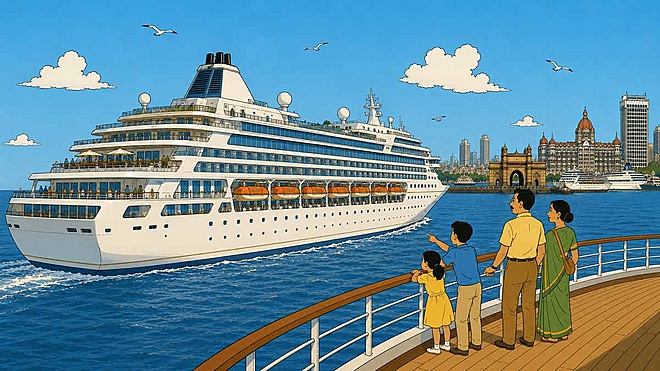
 Anand Kumar/AI-Generated Image

Summary: Two years ago, Waterways Leisure Tourism's auditors weren't sure the company could survive. Today, it's asking the public for Rs 585 crore at 112 times earnings to fund lease commitments for two ships it has already signed for, before raising a single rupee.
Two years ago, Waterways Leisure Tourism's auditors were not sure the company could survive. They flagged a material uncertainty related to going concern. Net worth had been fully eroded. Current liabilities exceeded current assets. The auditors could not physically verify the company's assets and had to rely on third-party confirmations for food and fuel inventories.
Today, the same company is asking the public for Rs 585 crore at 112 times earnings.
That gap, from going concern risk to a four-digit price-earnings multiple in 24 months, is not the story of a turnaround. It is the story of a bet. The company has signed leases for two new ships, nearly tripling its capacity, before the IPO has raised a rupee. Rs 480 crore of the money being raised goes directly to fund those lease commitments. The investor is not backing growth. They are paying for obligations already made.
That is the question the expansion story does not answer.
One ship, one monopoly, one bet on what comes next
Waterways Leisure Tourism operates under the Cordelia Cruises brand and runs scheduled ocean and coastal cruises in India. It currently operates a single vessel, the MV Empress, which can carry over 2,000 passengers. The ship primarily sails domestic routes of two to ten nights, calling on Mumbai, Goa, Kochi, Chennai and Lakshadweep. International sailings to Sri Lanka, Thailand, Malaysia and Singapore exist but contributed only around 3 per cent of revenue in FY26.
Revenue comes from two sources. Cruise ticket sales account for 91 per cent of the total and cover cabin accommodation, meals at standard restaurants and access to public areas. The remaining 9 per cent comes from discretionary passenger spending during the voyage—specialty dining, paid shows, shore excursions, Wi-Fi packages, spa visits and casino activity. The company generated Rs 580 crore in revenue from operations in FY26.
The company does not own any of its vessels. It operates on a lease model, with day-to-day vessel management handled through its subsidiary Bay Cruise. This keeps the asset base light but ties the business to fixed lease obligations regardless of how many passengers actually sail.
A 79% market share and a 20-25% growth runway
Waterways holds a 79 per cent market share in India's overnight ocean and coastal cruise industry, per Crisil. The industry is projected to grow at 20 to 25 per cent compounded annually from FY26 to FY31, driven by rising incomes and growing demand for premium experiential travel.
To expand, the company has signed leases for two new vessels. The Norwegian Sky is expected by September 30, 2026 and will add capacity for up to 2,004 guests. The Norwegian Sun is scheduled for November 2027 and will accommodate up to 1,936 guests. Together, this will nearly triple passenger capacity. New domestic routes to Port Blair, Diu, Porbandar and Kolkata are planned alongside fresh international itineraries to the Maldives, Indonesia, Australia and the UAE.
Direct bookings are another advantage. In FY26, 62 per cent of cabins were sold directly through the company's proprietary call centres, bypassing travel agents and the commissions they charge. A higher share of direct sales lowers distribution costs and improves realisation per booking.
The company is also building out destination weddings and corporate events as a secondary revenue stream, two segments that tend to command better margins than standard cruise ticket sales.
The going concern history and what came after
In FY23 and FY24, statutory auditors flagged a material uncertainty related to going concern, meaning they were unsure whether the company could continue to operate. Net worth had been fully eroded. Accumulated losses were significant. Current liabilities exceeded current assets. Auditors could not physically verify the company's property, plant and equipment, and had to rely on third-party confirmations for food and fuel inventories. Net worth in FY24 stood at negative Rs 118 crore.
The company has since recovered. Net worth turned positive in FY25 at Rs 33 crore and reached Rs 80 crore in FY26. But the recovery is recent, thin and about to be tested by the most ambitious expansion the business has ever attempted.
Profit after tax fell from Rs 93 crore to Rs 52 crore in FY26, primarily because shipboard operating costs jumped from Rs 88 crore to Rs 136 crore after vessel management was brought in-house through subsidiary Bay Cruise. The restructuring did bring savings, depreciation halved from Rs 63 crore to Rs 30 crore and finance costs fell from Rs 38 crore to Rs 9 crore, but those savings were not enough. Revenue dipped, and other costs rose.
Operating cash flows turned negative in FY26, to Rs 96 crore, largely due to an advance lease rental of $10 million for Norwegian Sky. Occupancy on the existing vessel fell from 91.6 per cent in FY25 to 85 per cent in FY26, even as the company prepared to nearly triple capacity.
Rs 308 crore in annual lease costs. Rs 52 crore in profit
The scale of the new lease obligations is worth spelling out clearly.
Each new vessel costs roughly Rs 154 crore a year in charter hire for the first two years, dropping to around Rs 135 crore from year three onward. With both ships running, the combined annual lease bill in the initial years will be around Rs 308 crore. That is nearly six times the company's entire profit in FY26. These payments run whether the ships are full or half-empty.
To justify the current valuation at even a generous 40 times earnings, the company would need profits of roughly Rs 145 crore, nearly three times FY26 levels. Getting there requires the new ships to not only cover their own lease costs but to generate meaningful surplus above them. There is no evidence yet that demand is deep enough to fill three ships simultaneously.
Waterways Leisure Tourism IPO details
| Key financials | 2Y CAGR (%) | FY26 | FY25 | FY24 |
|---|---|---|---|---|
| Revenue (Rs cr) | 14.3 | 580 | 591 | 444 |
| EBIT (Rs cr) | - | 80 | 145 | -81 |
| PAT (Rs cr) | - | 52 | 93 | -108 |
| Net worth (Rs cr) | - | 80 | 33 | -118 |
| Total debt (Rs cr) | -36.6 | 118 | 56 | 293 |
Post-IPO
| IPO details | |
|---|---|
| Total IPO size (Rs cr) | 585 |
| Offer for sale (Rs cr) | - |
| Fresh issue (Rs cr) | 585 |
| Price band (Rs) | 769-807 |
| Subscription dates | June 23 - June 25, 2026 |
| Purpose of issue | Payment of deposit, advance lease rental, monthly lease payments for new vessels, and general corporate purposes. |
Financial history
| Key financials | 2Y CAGR (%) | FY26 | FY25 | FY24 |
|---|---|---|---|---|
| Revenue (Rs cr) | 14.3 | 580 | 591 | 444 |
| EBIT (Rs cr) | - | 80 | 145 | -81 |
| PAT (Rs cr) | - | 52 | 93 | -108 |
| Net worth (Rs cr) | - | 80 | 33 | -118 |
| Total debt (Rs cr) | -36.6 | 118 | 56 | 293 |
| EBIT stands for earnings before interest and tax PAT stands for profit after tax |
||||
Operational history
| Key financials | FY26 | FY25 | FY24 |
|---|---|---|---|
| Occupancy rate (%) | 85 | 91.6 | 78.5 |
| Revenue per passenger (Rs) | 12,036 | 11,977 | 10,524 |
Key ratios
| Key ratios | FY26 | FY25 | FY24 |
|---|---|---|---|
| ROE (%) | 92.3 | 282.5 | - |
| ROCE (%) | 55.6 | 110.2 | -46.4 |
| EBIT margin (%) | 13.8 | 24.6 | -18.3 |
| Debt-to-equity (times) | 1.5 | 1.7 | - |
| ROE is return on equity, ROCE is return on capital employed FY24 ROE and debt-to-equity are not meaningful due to negative net worth. |
|||
Risk report
Company and business
- Did Waterways Leisure Tourism report earnings before tax of Rs 50 crore or more in the last 12 months? Yes. The company reported a profit before tax of Rs 78 crore for FY26.
- Will the company be able to scale up its business?
Yes. India's overnight ocean and coastal cruise industry is projected to grow at 20 to 25 per cent compounded annually from FY26 to FY31. The company is scaling with two additional leased vessels that will nearly triple passenger capacity. - Does the company have recognisable brands with client stickiness?
No. - Does the company have a credible moat?
No. The company has an early-mover advantage in domestic ocean cruising, but the industry is seeing intensifying competition from new domestic entrants and established international cruise lines.
Management
- Do any of the company's founders still hold at least a 5 per cent stake? Or do promoters hold over 25 per cent?
Yes. Promoters Global Shipping and Leisure Limited and Rajesh Chandumal Hotwani collectively hold 99.3 per cent of the company ahead of the issue. - Do the top three managers have over 15 years of combined leadership at the company?
No. The company was incorporated in 2020. No manager can have more than five years at the helm. - Is the management trustworthy and transparent in its disclosures, which are consistent with SEBI guidelines?
Yes. There is no information in the prospectus to suggest otherwise. - Is the company's accounting policy stable?
Yes, broadly. However, auditors raised qualifications and emphasis-of-matter remarks in FY23 and FY24, highlighting going concern uncertainty, limitations in verifying certain assets, and reliance on third-party inventory confirmations. - Is the company free of promoter pledging?
Yes.
Financials
- Did the company generate a current and three-year average ROE of more than 15 per cent and ROCE of more than 18 per cent?
Partially. ROE was 92 per cent in FY26 and ROCE was 56 per cent. Both metrics were deeply negative or not meaningful in FY24 when net worth had been fully eroded. The improvement is real but rests on a very thin equity base following years of losses. - Was operating cash flow positive in the last three years?
No. Operating cash flows turned negative in FY26 at Rs 96 crore, compared to positive flows of Rs 130 crore in FY25. The shift was primarily due to an advance lease rental paid for Norwegian Sky. - Is the net debt-to-equity ratio less than one?
No. Debt-to-equity stands at 1.5 times as of FY26. - Is the company free from reliance on large working capital?
No. The company requires significant working capital to fund operations, marketing and advance lease payments, as evidenced by the Rs 96 crore negative operating cash flow in FY26. - Can the company run its business without external funding over the next three years?
No. It is raising Rs 585 crore in this IPO primarily to service lease commitments already entered into. Rs 480 crore of net proceeds are earmarked for deposit, advance lease rentals and monthly lease payments for Norwegian Sky and Norwegian Sun. - Is the company free from meaningful contingent liabilities?
No. Contingent liabilities totalling Rs 38 crore — including a disputed port authority claim of Rs 12 crore, income tax demands of Rs 25 crore and GST demands — represent 47 per cent of the company's pre-IPO net worth of Rs 80 crore.
Valuations
- Does the stock offer an operating earnings yield of more than 8 per cent on enterprise value?
No. It stands at 1.3 per cent. - Is the stock's P/E less than its peers' median?
Not applicable. There are no listed domestic peers in the cruise industry. The P/E stands at 112 times based on FY26 earnings. - Is the stock's price-to-book value less than its peers' average?
Not applicable. The price-to-book stands at 73 times, with no listed peer to compare against.
The valuation asks you to believe a lot
At 112 times FY26 earnings, this stock is priced for a specific future: two new vessels arriving on time, achieving near-full occupancy quickly and generating profits nearly three times current levels. Net worth stands at Rs 80 crore against Rs 480 crore in lease obligations being funded from this very IPO. The equity cushion is thin.
The fleet expansion is genuinely ambitious and the cruise market tailwind is real. But the public is being asked to fund commitments already made, and to believe, on the strength of the story alone, that tripling capacity will restore and then multiply the earnings that justify the current asking price.
That is a lot to pay for a business that was fighting for its survival two years ago.
Also read: IPOs: Why should you not invest in them
Ask Value Research 

 New episodes every Friday












 New Process Alert
  Seems like you've uploaded a wrong QR code. Please upload the QR code downloaded from MF Central platform.


