 Widely read:




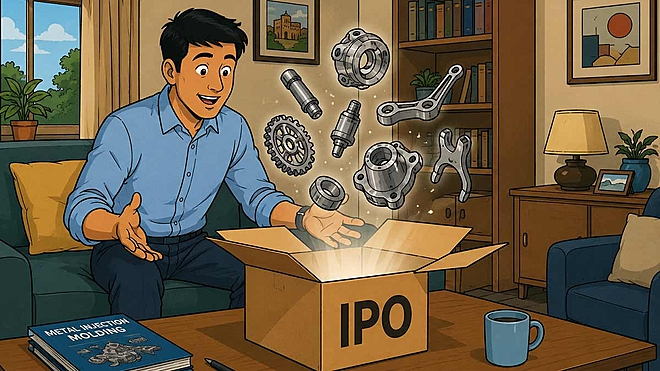 Anand Kumar/AI-Generated Image

Summary: Some companies are easy to admire but much harder to buy. Indo-MIM appears to tick many of the boxes investors look for, yet one question keeps getting in the way. This story explores whether an outstanding business can still become an ordinary investment.
Indo-MIM does what few manufacturers manage. It grows profit faster than sales, earns more than 20 per cent on its capital, and does it without leaning on debt. The catch is the price. It wants 45 times earnings, and most of the Rs 3,812 crore on offer goes to owners selling their stock, not into the business.
Hard to make, hard to replace
Indo-MIM makes metal parts, but not the kind most engineering firms do. Machining, forging and casting suit larger or simpler components; Indo-MIM specialises in tiny, complex parts with tight tolerances that are hard or uneconomical to make the traditional way. It uses metal injection moulding (MIM), where fine metal powder is mixed with a binder, injected into a mould, then heated until the binder burns away and the metal fuses into a dense, finished part. MIM brings in about 58 per cent of revenue, the rest from casting, machining, powder and traded goods. The parts go to the automotive, defence, medical, consumer and aerospace industries.
It reaches further down the chain than most rivals. Rather than buy ready-mixed feedstock, it mills its own metal powder and blends the paste itself, which lets it control exactly how each part shrinks and hardens in the furnace.
The harder part is staying in. An equipment maker usually buys a given part from one supplier, using tooling built for that part alone, after trials and audits that run two to three years. Once a supplier clears that process, switching means starting over, so customers rarely move. In FY26, 92 paise of every revenue rupee came from customers who had bought before. Indo-MIM has no order book to point to, because it works on purchase orders rather than long contracts, but that repeat rate does the same job.
Where the business is strong
| End-use industry (in Rs cr) | FY26 | FY25 | FY24 |
|---|---|---|---|
| Automotive | 1,032 | 959 | 873 |
| Defence | 784 | 892 | 785 |
| Medical | 758 | 577 | 562 |
| Aerospace | 501 | 376 | 282 |
| Consumer products | 453 | 325 | 275 |
| Sale of metal powder, tools, & traded products | 665 | 199 | 94 |
| Total revenue from operations | 4,193 | 3,330 | 2,870 |
#1 The export business traded up
Export volumes fell about 30 per cent in FY26, yet export revenue rose 8 per cent, because Indo-MIM shifted towards lower-volume, higher-value parts. Medical and aerospace each grew about a third over the year, and consumer products by nearly 40 per cent. Consumer grew quickest, but medical and aerospace matter more: their parts, from surgical and orthopaedic instruments to engine nozzles and housings, earn far more per piece, so leaning into them lifted revenue even as fewer parts shipped. That is pricing power, and the clearest sign the core is strengthening.
#2 The returns are high, and the growth paid for itself
Revenue has grown at 21 per cent a year over two years and profit at 37 per cent, to Rs 534 crore. The company earns close to 22 per cent on capital employed. Unlike most equipment-heavy manufacturers, it did this without loading up on debt: borrowings are roughly flat at Rs 1,368 crore and debt-to-equity has eased to 0.5 times. The growth has not depended on the balance sheet stretching.
#3 It is expanding well beyond moulding
Indo-MIM is no longer only a metal-injection business, and the new lines are where it is spending to grow. It has added investment casting and precision machining, which make the larger, lower-volume parts moulding cannot and already run busier than the core, at 55 to 58 per cent of capacity. It has also bought firms in the US and the UK, adding aerospace vacuum casting and 3D printing. Together these let it make parts of almost any size and volume and reach faster-growing markets such as medical devices and additive manufacturing. This, not more moulding capacity, is the next leg of growth.
Where it is exposed
#1 The core factories are running cold
The flagship business shrank in throughput last year. Indo-MIM's core moulding lines ran at 30.6 per cent of capacity in FY26, down from 35.8 per cent, as volumes fell about 30 per cent. There is an upside to that slack, the room to roughly triple output without building a new plant, but moulding carries heavy fixed costs, and running two-thirds empty means those costs weigh on margins every quarter the lines stay idle. Much of the bull case rests on filling them.
#2 The growth that filled the gap is lower quality
Look at the bottom line of the revenue table. The metal powder, tools and traded-products business grew from Rs 94 crore in FY24 to Rs 665 crore in FY26, lifting its share of revenue from 3 to 16 per cent. Almost all of it came from India, where strong manufacturing demand created ready buyers. This is largely selling metal powder and traded goods rather than making high-value MIM components, a sensible use of spare capacity but a lower-margin one. So FY26's growth flattered the headline: profit kept pace mainly because interest and tax costs fell, not because the core parts business became more profitable.
Indo-MIM IPO details
| Total IPO size (Rs cr) | 3,812 |
| Offer for sale (Rs cr) | 3,312 |
| Fresh issue (Rs cr) | 500 |
| Price band (Rs) | 461-485 |
| Subscription dates | 23-27 July 2026 |
| Purpose of issue | Offer for sale & Repayment of debt |
Post-IPO
| M-cap (Rs cr) | 23,981 |
| Net worth (Rs cr) | 3,320 |
| Promoter holding (%) | 77.7 |
| Price/earnings ratio (P/E) | 44.9 |
| Price/book ratio (P/B) | 7.2 |
Financial history
| Key financials | 2Y CAGR (%) | FY26 | FY25 | FY24 |
|---|---|---|---|---|
| Revenue (Rs cr) | 20.9 | 4193 | 3330 | 2870 |
| EBIT (Rs cr) | 22.3 | 851 | 734 | 569 |
| PAT (Rs cr) | 37.1 | 534 | 424 | 284 |
| Net worth (Rs cr) | 2820 | 2199 | 2051 | |
| Total debt (Rs cr) | 1368 | 1433 | 1272 | |
| EBIT stands for earnings before interest and tax. PAT stands for profit after tax. | ||||
Key ratios
| Ratios | 3Y average (%) | FY26 | FY25 | FY24 |
|---|---|---|---|---|
| ROE (%) | 18.3 | 21.3 | 19.9 | 13.8 |
| ROCE (%) | 20 | 21.8 | 21.1 | 17.1 |
| EBIT margin (%) | 20.7 | 20.3 | 22 | 19.8 |
| Debt-to-equity (times) | 0.6 | 0.5 | 0.7 | 0.6 |
| ROE is return on equity. ROCE is return on capital employed. | ||||
Our verdict
Indo-MIM trades at 45 times its FY26 earnings. Part of that is a scarcity premium, since there are few listed ways to own a pure metal-injection business. But scarcity is not value. The closest comparable, Shenzhen-listed Jiangsu Gian, trades north of 300 times earnings, far too erratic to anchor anything, so the valuation has to stand on the business alone.
The record it stands on is soft. The flagship lines are running cold, and much of last year's growth came from lower-margin powder and trading work, which flattered the headline while the core shipped fewer parts. That makes the premium hard to justify.
The price already banks the growth still to come. Idle lines must fill, the export mix must keep climbing, and the newer casting, machining and powder businesses must turn a profit. The business is easy to back: it earns high returns without debt and keeps customers for years. The price is not. It asks investors to pay for all of that now, before any of it arrives. On the evidence, that is a lot to pay for a promise, with little room for error.
Also read: How to think about IPO
Ask Value Research 
 New episodes every Friday












 New Process Alert
  Seems like you've uploaded a wrong QR code. Please upload the QR code downloaded from MF Central platform.


