




 Yogesh Sharma/AI-generated image

Summary: India's consumption story is compelling, but identifying the companies that will benefit most is far harder than it appears. This story explains why a consumption ETF can be a cleaner, lower-risk way to participate in India's long-term rise in household spending.
Every investor in India has an intuitive understanding of the consumption story. They see it in the queues outside new restaurants, in the airport terminals bursting at their seams, in the Maruti Swift that has replaced the bicycle in the villages their parents grew up in.
India is getting richer; Indians are spending more, and the categories they spend on are shifting from necessities toward aspirational goods, experiences and services that, a generation ago, were luxuries.
The story nobody gets right
The consumption sector in India is deceptively simple on the surface and genuinely complex underneath. It spans FMCG companies selling biscuits in rural areas, airlines flying newly minted middle-class passengers to Goa, telecom operators providing data to millions of smartphones, automobile manufacturers selling everything from tractors to luxury SUVs, paint companies riding the home improvement wave and jewellers capturing the aspirational shift from gold bars to branded jewellery.
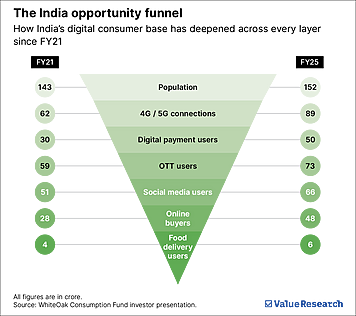
That breadth is precisely what makes stock-picking in this sector so punishing. Brand cycles shift without warning; the FMCG leader of one decade gets disrupted by a D2C startup in the next. A telecom company that looked invincible gets destroyed by a price war. A paint company that seemed to have an unbreachable moat faces a new entrant with deep pockets and a willingness to lose money for years.
The Nifty India Consumption Index sidesteps this problem by changing the question. Instead of “Which consumption company will win?” it asks “Will Indian consumers spend more over the next decade?”
Tailwinds are converging
India’s per capita income has crossed $2,500, a threshold that, in China’s case, preceded a sharp and sustained acceleration in discretionary spending. The non-food share of private consumption expenditure has already risen from 56.1 per cent in FY14 to 64.2 per cent in FY24, as households direct more of each incremental rupee toward wants rather than needs.
What makes the current moment particularly interesting is that a simultaneous policy push is amplifying the usual structural tailwinds. Income tax relief, GST rationalisation, RBI rate cuts, state welfare schemes, and the anticipated 8th Pay Commission together represent an estimated consumption stimulus of Rs 11.7 lakh crore.
What the index holds
The Nifty India Consumption Index draws 30 stocks from the Nifty 500, selecting only companies that derive more than 50 per cent of their revenues from domestic consumption. Individual stocks are capped at 10 per cent. The result is a portfolio that spans FMCG, automobiles, consumer services, consumer durables, telecom, power, realty, and healthcare, all sectors whose revenues ultimately trace back to what Indian households choose to spend on.
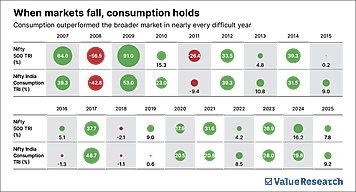
One dimension of the consumption index that is underappreciated is its behaviour in market downturns. In the 2008 Financial Crisis, the Nifty India Consumption Index fell
43 per cent: painful, but substantially less than the Nifty 500’s 57 per cent decline. In the 2020 Covid crash, the index fell 26 per cent against the Nifty 500’s 37 per cent. Consumer demand, particularly for essentials, is less sensitive to financial market stress, interest rate cycles, and global economic shocks than most other sectors.
The case for the index
The Consumption sector has one quality that distinguishes it from most others: its strongest companies tend to be extraordinarily durable, but picking which company endures is extraordinarily difficult.
Hindustan Unilever has spent decades as the undisputed leader in FMCG and has also spent extended periods significantly underperforming the broader market. Being right about FMCG, paints or automobiles as categories has not automatically meant being right about the leading company in each.
The consumption index holds all of them: leaders and challengers, staples and discretionary, urban and rural plays. When a new entrant disrupts an incumbent, the index absorbs both. When the category rotates from staples to discretionary, as happens when incomes rise, the index rebalances to reflect it.
The story that writes itself
Consumption investing is not without its own vulnerabilities. Rural demand is sensitive to monsoon performance and food inflation. Urban consumption, while more resilient, remains exposed to interest-rate cycles and employment conditions.
However, India’s consumption growth does not require a precise forecast of which company captures it. It requires only the conviction that more Indians will earn more, spend more, and spend differently over the next two decades than they do today.
The consumption index is the instrument that translates that conviction into a portfolio without requiring anyone to bet on a single brand, management team or sub-category.
This article was originally published on August 01, 2026.
Ask Value Research 











 New Process Alert
  Seems like you've uploaded a wrong QR code. Please upload the QR code downloaded from MF Central platform.


