


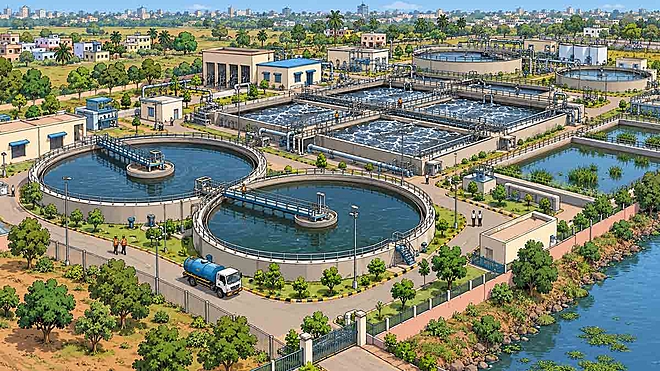
 Anand Kumar/AI-Generated Image

Summary: On paper, this sewage treatment specialist looks like an easy call: a niche leader whose profit has risen every year. Yet the cash has not kept pace. Before this IPO opens, it is worth knowing where the money is going and what you are really betting on at this price.
A city’s sewage is probably being cleaned in a tank designed by SFC Environmental Technologies. Its technology sits in 728 treatment plants handling about 17,500 million litres a day. In this niche, the sequencing batch reactor (SBR), SFC claims over 80 per cent of the market.
The offer
The IPO runs from October 27 to 29, 2026. Of the Rs 668 crore it raises, Rs 150 crore is fresh money, mainly to repay debt (Rs 42 crore) and fund working capital (Rs 75 crore). The remaining Rs 518 crore is an offer for sale by two promoters and other shareholders.
How SFC makes money
Think of a sewage plant as a car. The contractor builds the body; SFC supplies the engine. SFC works with every contractor bidding for a project, so whoever wins usually buys from SFC. That is why 92 per cent of its FY26 revenue came from returning customers.
Wastewater treatment (68 per cent of FY26 revenue) is the core. Where conventional plants use a chain of tanks, SFC’s C-Tech treats sewage in one, saving land and power. SFC earns mostly one-time fees for design, equipment and supervision.
Solid waste treatment (17 per cent) uses SFC’s OREX technology to turn city garbage into biogas, compost and fuel. Here SFC invests its own capital and earns income for years from running the plants.
Recycling and reuse (2 per cent), started in 2025, cleans treated sewage for industry using DuPont membranes that SFC alone distributes in India’s municipal market.
Automation (13 per cent) is Chavare Engineering, a subsidiary making control panels and automation systems, mostly for other industries.
Financial summary (Rs crore)
| Particulars | FY24 | FY25 | FY26 |
|---|---|---|---|
| Revenue | 657 | 698 | 804 |
| Operating EBITDA | 193 | 207 | 236 |
| Net profit | 144 | 152 | 160 |
| Cash from operations | -12 | 66 | -26 |
Key ratios
| Particulars | FY24 | FY25 | FY26 |
|---|---|---|---|
| Revenue growth (%) | - | 6.1 | 15.2 |
| Operating EBITDA margin (%) | 29.4 | 29.7 | 29.3 |
| ROCE (%) | 28.6 | 29.3 | 22.2 |
| Net Debt-to-equity (times) | -0.09 | -0.08 | 0.05 |
Operational KPIs
| Particulars | FY24 | FY25 | FY26 |
|---|---|---|---|
| Order book (Rs crore) | 785 | 560 | 1,575 |
| Treatment installations (cumulative) | 577 | 639 | 705 |
| Treatment capacity (MLD, cumulative) | 13,907 | 15,209 | 17,144 |
| Cash conversion cycle (days) | 156 | 232 | 242 |
| MLD is a million litres a day. | |||
Growth is coming from outside the core
SFC’s revenue grew 11 per cent a year between FY24 and FY26, but little of that came from sewage, the business it leads. Sewage revenue grew less than 2 per cent a year. Garbage did the heavy lifting: solid-waste revenue almost tripled. Sewage still earns operating margins of about 32 per cent, while solid-waste margins slipped from 34 per cent to 29 per cent. The order book nearly tripled in FY26, mostly from garbage-to-gas and recycling projects.
The cash test
A business with 30 per cent margins and little machinery would usually be expected to generate healthy cash. SFC has not. Over three years, it turned just 6 per cent of its profit into operating cash. The money is stuck with customers: dues rose 67 per cent in two years, against 22 per cent revenue growth.
SFC traces this to its customers’ calendar. Government bodies release funds late in the financial year, and the monsoon stalls construction from June to September. So 86 per cent of the parent’s FY26 sewage revenue came in the second half, leaving bills unpaid on March 31. That explains why dues peak every March, not why they rise every year.
The strengths
Recycling grows out of sewage. The new wastewater recycling business cleans the water SFC’s plants treat and sells to the same contractors and city bodies. A year after its first order, its order book stood at Rs 561 crore.
The need keeps growing. NITI Aayog projects that India’s solid waste will triple, from 159 million tonnes in 2030 to 476 million tonnes in 2070, and that domestic wastewater will reach 2.7 lakh MLD. Under a recent rule, oil and gas marketing companies must also blend compressed biogas into their supply, rising from 1 per cent in FY26 to 5 per cent from FY29.
Garbage-to-gas brings steady income. A government-owned oil company has hired SFC’s subsidiary to build two garbage-to-gas plants and run them for 10 years. One, at Tinsukia in Assam, will handle 125 tonnes of unsorted waste a day; the other, at Bhubaneswar in Odisha, 300 tonnes of sorted waste a day.
The risks
The government pays, eventually. About 92 per cent of sewage revenue and all solid-waste revenue come from government projects.
The Goa plants may not stay. The North Goa concession ends on August 20, 2027, with no automatic renewal. In any fresh tender, SFC must match the best bid to stay.
Customers are concentrating. The top 10 customers brought in 64 per cent of FY26 revenue, up from 59 per cent in FY24. Most have no long-term contract with SFC.
Much of the technology is borrowed. Membranes, turbo blowers and disc filters come from foreign suppliers, and SFC has no formal R&D programme.
Our verdict
At Rs 330, the top of the band, SFC is priced at about 20 times its FY26 earnings. That is below Ion Exchange, at about 34 times, and Praj Industries, at about 192 times, though both peers’ multiples are inflated by recent falls in their profits. SFC also earns a higher return on equity: about 21 per cent, against 11 per cent for Ion Exchange and 1.5 per cent for Praj.
On earnings alone, it looks relatively inexpensive. The catch is that those earnings have not been turning into cash. An investor buying at this price is, in effect, betting on two things: that SFC will collect what it is owed, and that its garbage and recycling businesses will deliver the growth that sewage has struggled to provide.
Also read: When profits turn into cash: what this ratio can reveal
Ask Value Research 

 New episodes every Friday













 New Process Alert
 Seems like you've uploaded a wrong QR code. Please upload the QR code downloaded from MF Central platform.


