


 Harish Kumar Singh/AI-generated image
Summary: Small-cap funds have been the best-returning diversified equity category over 10 years, but the last two years have been a rough ride. This cover story argues that investing in small caps is less about catching the rise than surviving the fall. It sets out four questions to settle before investing: whether you are suited to them, how much to hold, which fund to pick and how long to stay.
If you started investing in a small-cap fund in the last two years, you have had quite the ride. The Nifty Smallcap 250 index peaked in September 2024. Over the next five months, it lost 27 per cent. By July 2025, it had climbed back almost all the way. Then it slid again. By March 2026, it was 20 per cent below that July high. It recovered once more to touch a new peak in September, only to give up 9 per cent since. Two deep falls and two recoveries later, the index stands about where it was a year ago.
You were not alone on this ride. Small-cap funds were managing Rs 2.5 lakh crore in February 2024; by October 2026, this number grew to Rs 4.4 lakh crore. Just a little over a quarter of that growth came from rising prices. The rest, Rs 1.4 lakh crore, is fresh money. More remarkably, through both falls, there was not a single month in which investors took out more than they put in. Some of the biggest inflows came right after the market had dropped.

That is either admirable discipline or a hard lesson waiting to be learnt. Which one it turns out to be depends on something the market doesn’t decide.
Consider the record. Over the last 10 years, the typical small-cap fund has earned 15.2 per cent a year, more than any other diversified equity category.
Mid-cap funds earned 14.3 per cent, flexi-cap funds 11.9 per cent and large-cap funds 10.7 per cent. And those 10 years were no smooth climb: they include the crash of 2020 and the two falls you have just lived through.
Now consider what that record was built on. Of the 750 companies that were small caps in December 2017, those ranked 251 to 1,000 by market value, only 34 have since grown into mid or large caps. More than half are now micro caps or no longer listed.
So the winners are few, the falls are deep and the rewards go to those who are still around when the winners show up. Small-cap investing is less about catching the rise than surviving the fall. The investors who do that well usually settle four things before they put in a rupee: Am I suited to small caps at all? How much of my money should go there? Which fund should I choose? And, how long am I prepared to stay?
The rest of this story takes them one at a time.
The funds won, the companies did not
Why should small companies pay more? Because when you buy one, you buy early. Few analysts follow it, and few investors have heard of it. If the business works, its profits grow from a small base, and the market discovers it late. Almost every company that has grown tenfold in value started small.
The catch is the word ‘almost’. For every small company that grows into a large one, many more never do. Of the 750 companies that were small caps in December 2017, 314 are still small caps. Around 329 have slipped into micro-cap territory, and 73 are no longer listed. Only 34 grew into mid or large caps.
If you had bought all 750 in equal amounts in 2017, more than half your money would have gone into companies that later shrank in standing or disappeared. Those are poor odds for anyone picking stocks on their own.
This is where a fund earns its keep, in three ways.
First, it spreads your money widely. The typical small-cap fund today holds 84 stocks, and the largest hold more than 250. A handful of big winners can pay for many small disappointments, which is exactly how small caps work.
Second, it chooses. Fund managers did not pick only winners; nobody does. But in December 2017, small-cap funds owned half of the 34 companies that went on to become mid or large caps, and less than a third of those that later sank. Of the money they had in these 750 companies, 30 per cent sat in the ones that later slipped or vanished. Buying all 750 equally would have put 54 per cent there.
Third, the funds avoid the riskiest corner. India currently has more than 4,400 listed companies below the 1,000 largest, and small-cap funds put just 2.8 per cent of their money there. Of every Rs 100 they invest outside the 250 largest companies, Rs 97 goes to the next 750.

The result shows up in the record. Of the 13 small-cap funds with 10-year records, 11 beat the Nifty Smallcap 250 index, and they did so after their costs; the index pays none. Even the worst 10-year SIP among these funds returned 13.7 per cent a year. That is well ahead of the 10.5 per cent the typical large-cap fund delivered.
So the case for small caps is really a case for small-cap funds. Owning small companies is a gamble with poor odds; owning a well-run basket of them has been one of the better bets in Indian equity.
But a basket is only as good as the person filling it, and small-cap funds are not all filled equally well. Before we get to that, every small-cap investor pays a price, no matter which fund they choose.
What small caps charge, and when they collect
Small caps don’t charge you extra for their higher returns. They charge you in falls, and they collect when you least expect it.
By historical standards, the last two years were gentle. The Nifty Smallcap 250 fell 27 per cent from its September 2024 peak and took 23 months to climb back above it. Between January 2018 and March 2020, the same index lost 60 per cent and did not regain its old high until May 2021. In 2008, it lost 76 per cent and took six and a half years to recover. Most of the money that has arrived since 2024 has never been through anything like that.
Small-cap funds softened these falls, but only partly. Take the year to March 2020. The Rs 10 lakh put into the typical small-cap fund in March 2019 was worth Rs 7.1 lakh a year later; in the worst fund, Rs 5.7 lakh. Among the 19 small-cap funds with records going back before 2020, the typical fund’s worst three months cost 32.7 per cent.
What happened next matters more. By August 2020, the typical fund was back where it had been in March 2019. By March 2021, that Rs 7.1 lakh had become Rs 14.6 lakh. The fall cost nothing to those who stayed. It cost nearly 30 per cent to those who left at the bottom.
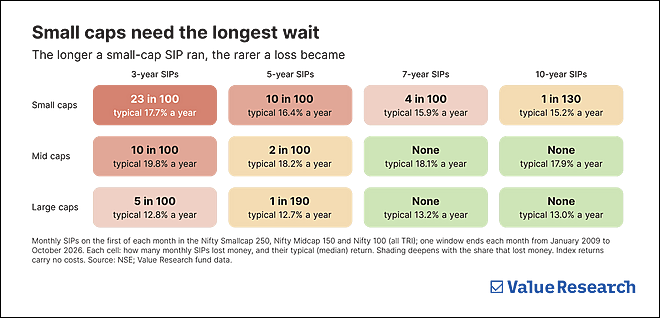
That is the first part of the price: watching a large part of your money disappear, and doing nothing. The second part is time. To measure it, we looked at monthly SIPs in the Nifty Smallcap 250 starting in every month since 2006. Over three years, nearly one in four lost money. Over five years, one in 10 did. Over seven years, one in 25. Over 10 years, almost none. Large caps are gentler. Three-year SIPs in the Nifty 100 lost money one time in 20, and none of its seven- or 10-year SIPs did.

What hardly changes with time is the reward. The typical small-cap SIP earned between 15 and 18 per cent a year, whether it ran for three or 10 years. What changes is your chance of actually earning it, and that rises the longer you stay.
Even 10 years is not a guarantee. One 10-year SIP in the index did lose money: the one that ended in March 2020, at the bottom of the crash. A decade of discipline was worth slightly less than what had gone in. One year later, the same SIP showed 13.1 per cent a year. The lesson is not that 10 years is too short. It is that the worst time to judge a small-cap investment is in the middle of a fall, and the worst thing to do then is leave.
So budget for both: a fall of a third or more, and 7-10 years of patience. If either sounds unbearable, the question that matters most isn’t which fund to buy, but how much to put in. We will come to that. First, the fund.
Same label, very different funds
Two small-cap funds can share a label, a benchmark and the same rulebook, and still own very little in common. That is the first thing to understand about choosing one.
Pick any two small-cap funds and compare their portfolios. Typically, only about 12 per cent of their money sits in the same stocks. For two large-cap funds, the figure is about 50 per cent; for two mid-cap funds, 25. Between them, the 36 active small-cap funds own nearly 900 different companies, and just nine of those are held by half the funds or more.
This is not by chance. Large-cap managers fish in a small pond where everyone must own the same big names. Small-cap managers fish in a sea, and each one decides what to catch. But it means that buying ‘a small-cap fund’ tells you far less about what you own than buying a large-cap fund does.

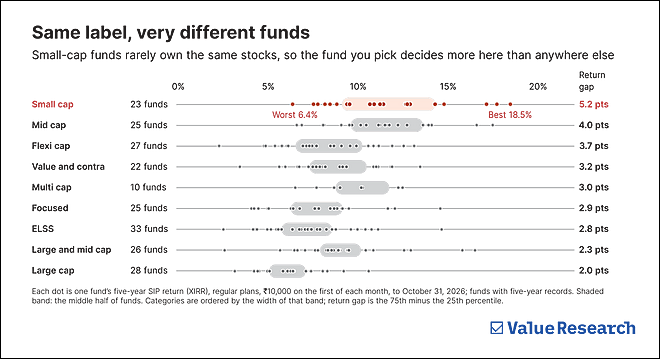
Different portfolios lead to different results. Over the last five years, the gap between a small-cap fund in the top quarter of the category and one in the bottom quarter was 5.2 percentage points a year for SIP investors. No other category matches it. In mid-cap funds, the gap was 4.0 points, and in large-cap funds, 2.0.
In rupees, it looks like this: Rs 10,000 a month for five years, which adds up to Rs 6 lakh. In the best small-cap fund, it becomes Rs 9.5 lakh; in the worst, Rs 7.1 lakh. That Rs 2.4 lakh difference is two-fifths of everything you put in. Between the best and worst large-cap funds, the difference was Rs 1.3 lakh.
You can’t avoid the choice by buying an index fund either. Motilal Oswal Nifty Smallcap 250 Index Fund, the best-performing passive fund in the past five years, turned the same SIP into Rs 7.8 lakh. Fifteen of the 23 active small-cap funds did better; eight did worse. Pick well, and you beat the index. Pick badly, and you would have been better off with it.
Time does narrow the gap. Over 10 years, small-cap funds bunch closer together than mid-cap funds do, and even the weakest 10-year SIP among them, at 13.7 per cent a year, beat the typical large-cap fund. This is the point from the last section, seen through funds: stay long enough and almost any well-run small-cap fund has paid.
But five years is a long time to spend in the wrong fund. One more thing separates small-cap funds from one another. Stock picking matters most, but it isn’t the only thing that sets small-cap funds apart. How big a fund has grown also shapes how freely its manager can act on those picks.
Big funds, narrow doors
Small companies are small in the stock market too. On a typical day, only a modest value of their shares changes hands. That matters little when a fund is small. It matters a great deal when the fund is large, and its investors all want out at once.

Since early 2024, every small-cap fund has had to disclose how many days it would take to sell half its portfolio without selling more than a fraction of each stock’s usual daily trade. The answers vary enormously.
Half of the 36 funds could do it within five days. Three would need more than six weeks: HDFC Small Cap (52 days), SBI Small Cap (51) and Quant Small Cap (46). Together, these three manage Rs 1.2 lakh crore, a quarter of all the money in small-cap funds.
Weighted by size, small-cap funds would need 26 days to sell half their holdings. Mid-cap funds would need 19 days. At its worst, in January 2026, the small-cap figure touched 42 days.
Why should you care? Because exit time matters only when everyone heads for the door together. A slow fund facing heavy withdrawals in a sharp fall has to sell whatever it can, which usually means its most easily traded stocks, at whatever price is on offer. The investors who stay behind are left holding what was hardest to sell. The last two years never tested this. As we saw, investors kept buying through both falls. But a fall like that of 2018-20, deeper and longer, could test it.
Some of the slowest funds keep a cushion. HDFC Small Cap and SBI Small Cap each hold about a tenth of their money in cash, which lets them meet withdrawals without selling stocks straight away. That softens the problem; it doesn’t remove it.
Has being big and slow at least paid? Not lately. The six funds that would need 30 days or more returned a median 9.4 per cent a year over the last three years. The other 18 small-cap funds with a three-year record returned 12.8 per cent. That doesn’t prove size hurts returns. But it does show that investors in the slowest funds have not been paid extra for the risk.
So when you choose a small-cap fund, how big it has grown and how quickly it could sell matter as much as its performance. That is the bridge from understanding small caps to investing in them, which is where we turn next.
The playbook: Four questions, answered
We began with four questions. Here are the answers.
#1 Am I suited to small caps at all?
Only if you pass two tests: one of time and the other of temperament.
The time test is simple. Money you may need within seven years does not belong here. As we saw, a small-cap SIP lost money in one of every four three-year stretches, and seldom over 10.
The temperament test is harder, because you can only take it honestly by looking back. Think of March 2025, or March 2026. Your small-cap fund was down a fifth or more, and every headline said it would fall further. What did you do? If you stopped your SIP or sold, small caps will probably cost you more than they pay. And those falls were the mild ones. In 2018-20, the index lost 60 per cent and took more than three years to recover. You may not be able to sit through such periods, and your resolve may falter.
#2 How much should go into them?
Less than you think. Our long-held view is that mid- and small-cap funds together should make up no more than 25 to 30 per cent of your portfolio, and that is for investors who pass both tests. Small caps are a part of that share, not all of it.
Before you work out your share, count the small caps you already own. Flexi-cap, multi-cap and mid-cap funds all hold them, and multi-cap funds must keep at least a quarter of their money in small caps. Many investors who believe they have none have more than they realise. We show how much later in this story.
#3 Which fund should I choose?
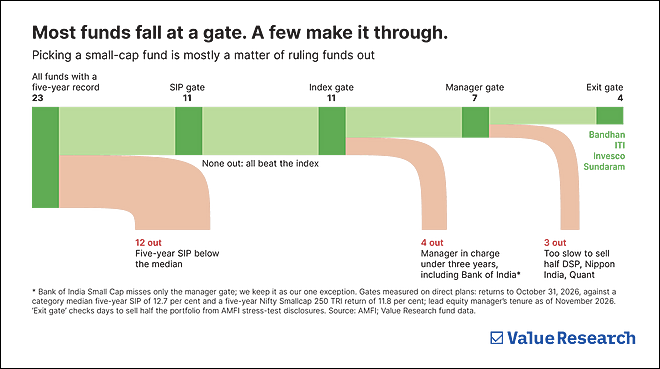
Not the one with the best last year, and not simply the biggest. Since funds differ so much, choose with the four tests mentioned below. First, the manager who built the record is still running it. We want at least three years in charge. A five-year record means little if the person behind it has gone.
Second, it has done well for patient investors. The fund’s five-year SIP return should be above the category median.
Third, it has earned its fee. Over five years, it should have beaten the Nifty Smallcap 250 index after costs. A cheaper index fund beats a fund that can’t.
And fourth, it can get out quickly. It should be able to sell half its portfolio faster than the category average of 26 days.
Of the 23 small-cap funds with a five-year record, just four clear all four gates, along with one fund that misses a single gate for a reason we explain. We name them shortly. If you invest directly, buy the direct plan of whichever fund you choose. For the funds in this story, it costs about a percentage point a year less than the regular plan, and over 10 years that adds up.
#4 How long should I stay?
At least seven years, and 10 if you can. And however you invest, through an SIP or otherwise, the rule in a fall is the same: don’t stop and don’t sell. The 2020 investor who stayed doubled their money from the bottom within a year. The one who left kept the loss.
Review your fund once a year, against the four tests, not against last month’s return. Reconsider if the fund fails them: the manager goes, it lags the category for two or three years running, or it grows so big that it can no longer sell quickly. Don’t leave because the market fell. That is the price you agreed to pay at the start.
The small caps you already own
Most small-cap money does not sit in small-cap funds.
As of September 2026, active equity and hybrid funds held Rs 9 lakh crore worth of small-cap stocks. Small-cap funds held just over a third of that. The other Rs 5.6 lakh crore, or 62 per cent, sat in funds without ‘small cap’ in their names. Of the 731 active schemes, 695 own at least one small company.

Sectoral and thematic funds are the biggest holders, with Rs 1.3 lakh crore between them. Mid-, multi- and flexi-cap funds follow, with about Rs 70,000-75,000 crore each, and hybrid funds hold another Rs 63,000 crore.
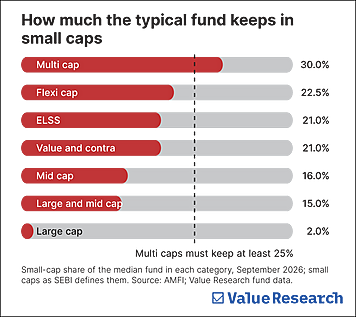
For a single fund, the share can be large. Multi-cap funds must keep at least a quarter of their money in small caps; the typical one keeps 30 per cent. The typical flexi-cap fund keeps 22.5 per cent, ELSS and value funds about a fifth, and mid-cap funds about a sixth. In all, 200 funds outside the small-cap category keep a quarter or more of their money in small caps.
This matters in two ways.
First, count before you add. Take an investor with equal amounts in a typical flexi-cap fund and a typical multi-cap fund. About a quarter of their money is already in small caps. Our view is that mid and small caps together should make up no more than 25 to 30 per cent of a portfolio. Adding a small-cap fund on top could take such an investor well past that.
Second, if you own equity funds like these, you may need no small-cap fund at all. A fund that keeps a healthy share of its assets in small caps, alongside larger companies, gives you a stake in small companies within a broader portfolio, managed by someone who can move between the two.
That is what the next five funds on the previous page offer. Each keeps a quarter or more of its money in small caps, and each has a record that stands on its own. If one of them is already in your portfolio, you may already have the small-cap exposure you need.
Plant, then wait
Small caps will fall again. Nobody knows when, or how far, and anyone who claims to is guessing. What the record does show is who gets paid when they recover.
It is rarely the investor who arrived after the best year, or who chose the fund with the biggest recent return, or the biggest fund, or who left in the first deep fall. It is the investor who settled the four questions before putting in a rupee.
They knew they could sit through a fall of a third or more. They kept small caps to a modest slice of the portfolio, counting what their other funds already held. They chose a fund that passed the tests. And they gave it seven to 10 years.
That is a smaller group than the crowd that has put Rs 1.4 lakh crore into small-cap funds since early 2024. The crowd held its nerve through two falls, and that deserves credit. But neither fall was as deep or as long as 2018-20. The next deep fall will show whether that discipline was real or simply untested.
Most small companies stay small. The few that grow take years to do it, and they reward only the investors still there to see it.


Ask Value Research 



 New episodes every Friday








 New Process Alert
 Seems like you've uploaded a wrong QR code. Please upload the QR code downloaded from MF Central platform.


