




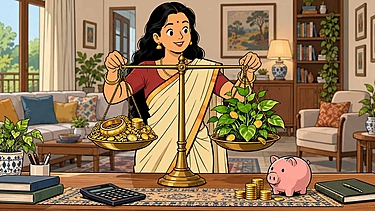
 Anand Kumar/AI-Generated Image
Summary: Insurance is bought when it is cheap and boring, not when it is expensive and exciting. In January, Indian investors paid the exciting price for gold. Since then both metals have fallen hard, silver hardest. Gold is meant to be the part of your portfolio you can afford to ignore. Can you, right now?
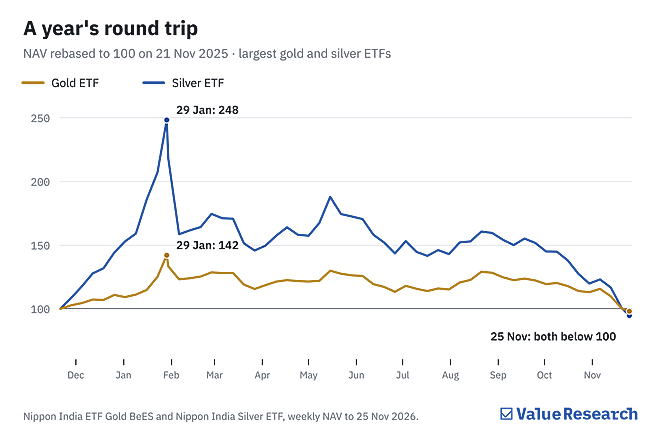
Gold funds have lost 31% since their 29 January high and silver funds 62%. Long-term holders are still well ahead: the largest gold ETF has returned 24.1% a year over three years. The loss sits mostly with the money that arrived last, and late-bought silver hurts the most.
Higher US rates took away gold's easy year
Gold pays no interest, so it does best when rates fall and worst when they rise. The US Federal Reserve raised rates in September, its first increase in three years. Minutes of its October meeting, released on 18 November, showed almost all policymakers judged that further increases would likely be appropriate. The dollar climbed to its strongest since March 2025, and spot gold traded near $3,530 an ounce on 25 November, its lowest since early September 2025 and more than a third below January's record.
In India, the fall has been smaller, 31% for the largest gold ETF. A weaker rupee and the import duty raised to 15% in May have held domestic prices up. On 25 November alone, the largest gold ETF fell 2.8% and the largest silver ETF 5.8%.
This leaves the case for holding gold where it was. We hold it as insurance against stress in the monetary system itself, such as frozen reserves and doubts over the dollar. A central bank raising rates to fight inflation is a different event.
The late money paid for the excitement
In January, Indian investors put a record Rs 24,040 crore into gold ETFs, as much as equity funds drew that month (Rs 24,029 crore). About three-quarters of three years' gold ETF inflows arrived in the eight months to April 2026. The buying went on as prices slid: another Rs 25,359 crore from February to October, taking the ten-month total to Rs 49,399 crore, more than in all of 2025. Silver ETFs drew Rs 3,092 crore in October alone, 57% more than in September.
This is the behaviour gap, the distance between what a fund earns and what its investors earn, in its plainest form. In May we wrote that insurance is bought when it is cheap and boring, not when it is expensive and exciting. The January buyers paid the exciting price. A Rs 1,000 monthly SIP in the largest silver ETF over the past year has turned Rs 12,000 into about Rs 7,510.
Silver fell twice as far because it rose almost three times as far
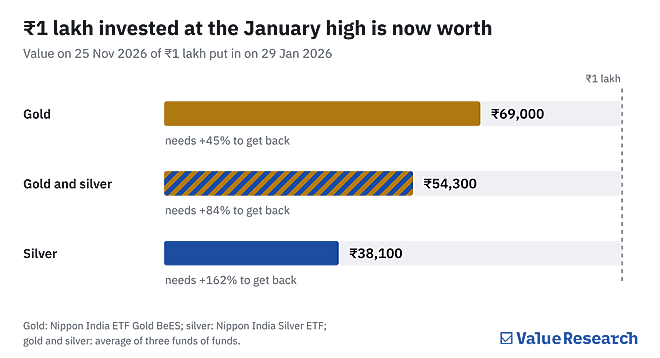
In the year to 29 January the largest gold ETF gained 113% and the largest silver ETF 308%. Silver has since slid to about $40 an ounce, two-thirds below its January record.
Silver lacks what holds gold up. Central banks keep gold in their reserves. No central bank holds silver, so its price rests on private sentiment and industrial demand, and that demand is weakening: the Silver Institute expects it to fall 5% this year, with solar use down 19%.
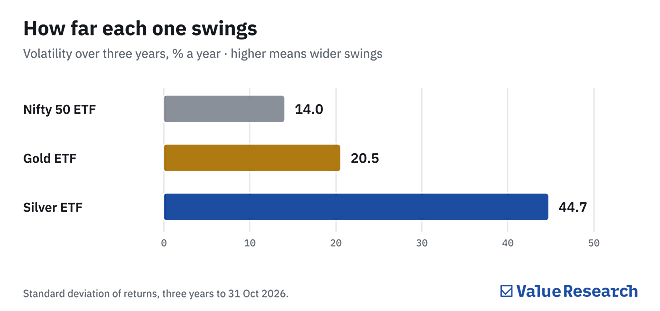
Silver's price also swings more than twice as much as gold's: three-year volatility of 44.7% a year against 20.5%, and 14.0% for the Nifty 50. In October 2025, with the rally in full cry, we called silver a leveraged version of gold. Rs 1 lakh put into the largest silver ETF at the January high is now Rs 38,100. To get back, it needs to gain 162%.
What gold and silver fund investors can do now
- Count all your gold first. Most Indian households hold 20% to 30% of their wealth in gold once jewellery is counted. Judge your gold fund against that whole, not on its own.
- Check the slice against your target. If gold is within five percentage points of the share you chose, this fall calls for no action. In June we wrote that a hedge which grows unchecked becomes a bet. For many investors who never trimmed, the fall has turned the bet back into a hedge.
- If you are below target, close the gap in instalments, then stop. Point new money at gold before selling anything else. Most fund houses have stopped taking fresh money and new SIPs in their gold funds of funds since mid-October, so for now that means buying an ETF through a demat account. A top-up to a set share is a different thing from an open-ended gold SIP, which we would still not start because of a price move.
- Read no bargain into the fall. After its August 2013 high, gold fell 29% and took six years to return. It has now fallen a little more.
- Keep silver small, if you hold it at all. If it is big enough to cost you sleep, it is too big. In two-metal funds the silver share decides the damage: in three months Motilal Oswal's fund lost 29.2% and Kotak's 33.5%. To sell a silver ETF in a fast market, use a limit order and check the fund's indicative NAV, because exchange price bands can hold the traded price away from fair value.
- Choose on cost, and mind the duty. Gold ETFs charge 0.34% to 0.81% a year, and a fund of funds adds 0.06% to 0.64%. Gold funds track the Indian price, which carries the 15% import duty. The government has reportedly weighed a cut; a return to 6% would by itself lower domestic prices by about 8%. ETF gains are taxed at 12.5% after one year, a fund of funds after two.
The takeaway
Gold has earned its place: over ten years it has returned 14.1% a year, against 13.5% for the Nifty 50 ETF. Its job is insurance, held at a small fixed share and checked once a year. Gold is meant to be the part of your portfolio you can afford to ignore. Silver belongs at the edge, if anywhere.
Also read: How long it took Nifty investors to break even after a crash
Ask Value Research 

 New episodes every Friday










 New Process Alert
 Seems like you've uploaded a wrong QR code. Please upload the QR code downloaded from MF Central platform.


