


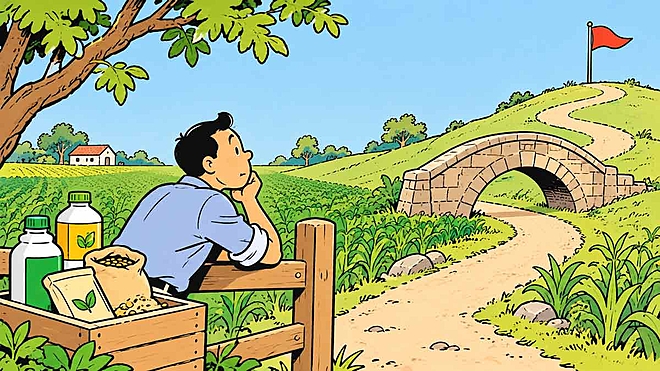
 Anand Kumar/AI-Generated Image
Summary: Thirteen acquisitions, a dealer network that keeps growing and fatter margins every year. On paper, Crystal Crop Protection is getting better at its business. But one number has refused to follow, the auditor keeps raising the same flag and the IPO price is quietly counting on things changing.
Crystal Crop Protection is getting better at turning sales into profits. Its operating margin has expanded for three consecutive years, and revenue has grown rapidly. But that improvement hasn't translated into stronger returns on capital. Acquisitions have helped build its portfolio, yet the returns on that investment remain difficult to judge. Add an auditor's qualification over an insurance claim and an ongoing criminal case, and the IPO demands closer scrutiny.
A clean-up, not a growth raise
The issue is worth Rs 455 crore: a fresh issue of Rs 355 crore to the company and an offer for sale of Rs 101 crore by the promoter, Ankur Aggarwal. Bidding runs from November 18-20, 2026. Roughly three-quarters goes to cutting debt, against a borrowing book of around Rs 963 crore.
What the company does
Crystal makes two broad categories of products that sit at different stages of the farming cycle: crop protection products for standing crops and seeds for the next sowing. About 80 per cent of its sales protect a standing crop - herbicides, fungicides and insecticides, plus a newer line of natural crop solutions that help a plant cope with stress such as heat or poor soil. The other 19 per cent, growing close to 29 per cent a year for the past two years, is seeds: hybrid cotton, pearl millet, mustard and vegetables.
The ground beneath it is competitive. Crystal imports 40-49 per cent of its raw material from China, its dealers sell rivals’ products from the same counter, and no contract binds a farmer to its brand. Demand builds before each Kharif and Rabi sowing, so it stocks up and lends to dealers just as selling begins, tying up cash.
The research is reformulation, not invention
Think of Crystal as a cook rather than a chemist. The active molecules are the same ones anyone can buy once the original patent lapses; its craft is the recipe. Sometimes it blends two off-patent chemicals into one bottle, so a single spray does the work of two, or it changes the form a chemical comes in, or tunes an existing chemistry to the exact pest a farmer faces. Each can earn a patent of its own, but on the blend, never on the molecule beneath. Since the molecule is free, a rival can use the same ingredients; what protects Crystal is the stack around it - the brand a farmer trusts, the government registration and the dealer network.
The numbers: profit growing faster than sales
| Rs crore | FY24 | FY25 | FY26 |
|---|---|---|---|
| Revenue | 2,230 | 2,691 | 3,152 |
| Operating profit | 209 | 315 | 456 |
| Profit after tax | 87 | 118 | 145 |
| Cash flow from operations | 338 | 383 | 256 |
The reason is the mix. Each year Crystal sold a little more under its own brands and a little less in bulk, and own-brand sales carry the fatter margin. A branded sale to a farmer earns more than a bulk sale to another company, which has its own bargaining power. That shift lifted the operating margin and raised profit after tax as the dealer network grew from about 9,000 to nearly 14,000 distributors. Cash told a quieter story: operating cash flow fell in FY26 even as profit rose, as a faster-growing year ties up more money in stock and dealer credit before it returns.
But the returns have not followed
| Ratio | FY24 | FY25 | FY26 |
|---|---|---|---|
| Operating profit margin (%) | 9.4 | 11.7 | 14.5 |
| Return on capital employed (%) | 8.2 | 9.7 | 10.8 |
| Return on equity (%) | 6.6 | 8.3 | 7.9 |
| Debt-to-equity | 0.4 | 0.7 | 0.4 |
The margin improvement is encouraging, but it has not yet become meaningfully better returns for shareholders. Return on equity has stayed at 7-8 per cent for three years, while return on capital employed works out to around 11 per cent once the money invested in acquired brands is counted in. For a company that has spent heavily on acquisitions, that gap matters: growing the business and widening margins is one achievement; earning an attractive return on all the money put in to build it is another, and it still lies ahead.
Where the moat is genuine
The first is registrations: to sell a crop chemical in India you need a government licence proving it is safe and effective, and first-time ones take five to seven years and heavy spending. Crystal holds 139 technical, 601 formulation and 45 first-time registrations, and the first-time products earn its fattest margins. The second, sturdier barrier is seeds. A seed company lives on its germplasm - the bank of genetic material new varieties are bred from, which takes decades to build. Crystal leads in pearl millet and marigold seeds and is the only Indian company breeding mustard with BASF.
Three things to weigh
A repeated qualified audit opinion. Crystal’s auditor has qualified its accounts in every period in the prospectus, over a Rs 16 crore insurance claim it still carries as an asset even though the insurer rejected it and the case is in court.
A criminal case touching the promoters. Agencies allege about Rs 76 crore of wrongly claimed export-incentive refunds, in a case naming the company and promoters Nand Kishore Aggarwal and Ankur Aggarwal. The sum is modest, but it is a governance matter to be aware of.
Acquisitions that are still maturing. The 13 acquisitions brought scale, brands and a richer mix, and so far have added more to sales than to returns. But several acquired assets have yet to reach their full potential, so the FY26 return on capital understates the longer-term gains the company expects.
Our verdict
At the top of the band, the offer is valued at about 24.6 times FY26 profit. To justify that, several things must go right together: the margin must keep rising towards its stronger peers’ high-teens, the branded mix must keep rising, the pending Rs 1,846 crore purchase of FMC’s India business must be absorbed well, and acquisition returns must improve as those assets mature. The growth is real and the margin trend is in the company’s favour.
Also read: Why Chambal Fertilisers trades at 8 times earnings
Ask Value Research 
 New episodes every Friday









 New Process Alert
 Seems like you've uploaded a wrong QR code. Please upload the QR code downloaded from MF Central platform.


