




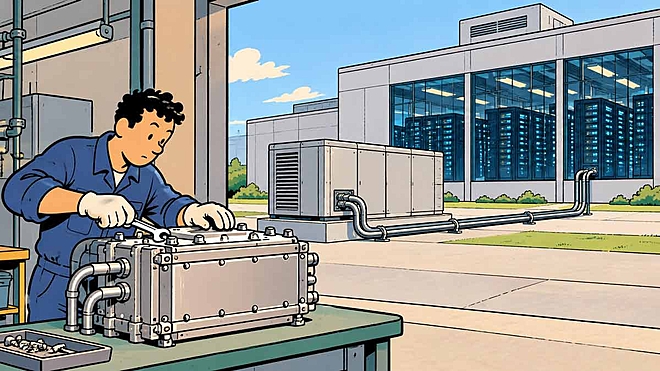
 Aprajita Anushree/AI-Generated Image
Summary: An Indian workshop born out of a nuclear embargo now makes a crucial part for America's AI power rush. Its share price has run hard, and unusually, profits have run harder. But one detail about who buys its parts changes how that rally should be read.
A year ago, MTAR traded at around Rs 2,700. On 20 November 2026, it closed at about Rs 5,615, up roughly 110 per cent. At its mid-2026 peak, it touched Rs 8,715.
Rallies this steep in small engineering companies usually run ahead of the business. MTAR's is unusual. Over the same year, its profit for the last four quarters rose from about Rs 45 crore to about Rs 190 crore, more than four times. Profit grew twice as fast as the share price. Here is why, and why that is not the whole story.
A workshop for parts that cannot fail
MTAR was born out of an embargo. In 1970, as foreign suppliers squeezed India's nuclear programme, three engineer friends in Hyderabad set up a four-machine workshop to make reactor parts. It went on to make rocket engines for ISRO and parts for Agni missiles.
Most of its work is 'build to print'. The customer owns the design; MTAR owns machines, assemblies and tests the part to within a few microns. Its edge is trust, not a brand or patent. Approving a new part can take 18 to 24 months of tests, so customers rarely switch suppliers. The flip side is that its fortunes follow its customers', and one customer matters more than all others combined.
One customer, one box
That customer is Bloom Energy of the US. Bloom makes power plants in a box: fuel cells that turn natural gas into electricity on site. A new grid connection in the US can take years; Bloom's boxes run in months. That makes them a quick fix for power-hungry AI data centres.
The heart of each Bloom system is the 'hot box', where the fuel cells run at very high temperatures. MTAR has made them for over 14 years and meets 50-60 per cent of Bloom's needs, by its own estimate. Rating agency ICRA estimates Bloom brought in over 70 per cent of MTAR's revenue in FY25.
Sales rose, profit wobbled
|
|
FY23 | FY24 | FY25 | FY26 | H1 FY27 |
|---|---|---|---|---|---|
| Revenue (Rs crore) | 574 | 581 | 676 | 876 | 768 |
| EBITDA margin (%) | 26.8 | 19.3 | 17.9 | 19.5 | 24 |
| Net profit (Rs crore) | 104 | 56 | 53 | 94 | 110 |
| Order book (Rs crore) | – | – | 979 | 2,582 | 5,977 |
| Data as of Sep ’26. Order book is at the end of each period and is not shown for FY23 and FY24. | |||||
Profit swings far more than revenue. A factory's salaries and machines cost the same whether it is busy or idle. So when sales rise, most extra revenue becomes profit, and when sales stall, profit shrinks fast. This is operating leverage. In FY24, Bloom changed its hot box model and ran down its stock of parts. MTAR's revenue barely moved, but profit nearly halved. Now the reverse is under way: first-half FY27 revenue almost matched all of FY26, and the EBITDA margin rose to 24 per cent.
The order book grew six-fold in 18 months to about four times annual revenue. About two-thirds is clean energy, mostly Bloom. Advance payments from customers also lifted cash flow, though that cushion will shrink as the orders are delivered.
What powered the rally
- Bloom's AI deals. Bloom signed some of its biggest contracts ever, for up to 2.8 gigawatts with Oracle and about 1.5 gigawatts with Brookfield, and joined the S&P 500. Investors seeking an Indian route into the AI power story found Bloom's hot box maker.
- A guidance upgrade. In May 2026, MTAR raised its FY27 revenue growth guidance from 50 per cent to over 80 per cent, at an EBITDA margin of about 24 per cent. Management now expects to beat both.
- Record orders. The same month, MTAR won two international orders worth about Rs 2,746 crore, more than three times its FY26 revenue. First-half order inflows reached Rs 4,102 crore. Two years after it ran short of orders, MTAR is now short of capacity.
Beyond Bloom
The newer businesses are what make a bigger MTAR possible.
- Civil nuclear. A Rs 504 crore order for the Kaiga 5 and 6 reactors anchors an Rs 820 crore order book. Most of it turns into revenue from FY28 to FY30. Next in line are four reactors at Mahi Banswara in Rajasthan, worth Rs 700-1,000 crore to MTAR.
- Aerospace and defence. Global names such as Thales, GKN and IAI are moving from sample orders to volume production. MTAR expects over Rs 150 crore from them this year.
- Its own products. Ball screws and roller screws, which turn rotation into precise straight-line motion, are MTAR's own designs. Products should bring in close to Rs 500 crore this year, and management aims for over Rs 1,000 crore by FY30.
- New lines. Data centre parts for SLB, with Rs 350-450 crore of potential over two years, and oilfield parts for Weatherford ramp up from FY28.
What MTAR has to prove
At about 90 times past profit, the price assumes years of fast growth. Management's roadmap, Rs 5,000 crore by FY30, is nearly six times FY26.
MTAR must build fast enough. Bloom must keep ordering; a Bloom-linked data centre project pause report cut the price 15 per cent of MTAR in two days in June. Nuclear, aerospace and new lines must become a second engine from FY28.
Our take
MTAR is a better business today than at any time since its 2021 listing, with a record order book and a credible plan beyond Bloom. If management delivers close to its roadmap, today's price, about a third below the peak, can be justified.
But for the next two years, MTAR is a supplier to one American company riding one boom. When that boom wobbles, MTAR wobbles harder. Anyone holding it must track Bloom as closely as MTAR and be ready for falls of 30-40 per cent. The next few quarters will show whether the roadmap is turning into revenue.
Also read: Beyond the watch dial
Ask Value Research 

 New episodes every Friday










 New Process Alert
 Seems like you've uploaded a wrong QR code. Please upload the QR code downloaded from MF Central platform.


