


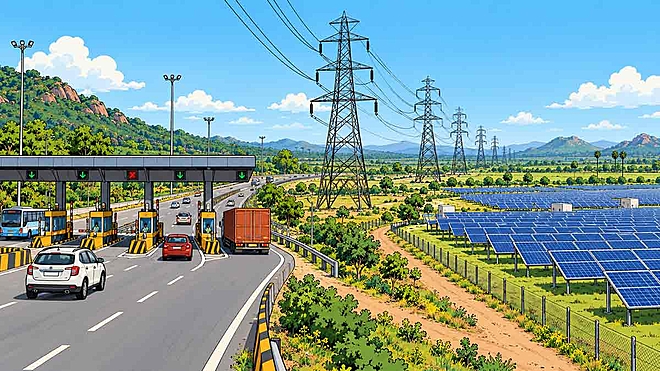
 Anand Kumar/AI-Generated Image

Summary: Highway tolls, power lines and loans banks will not make all feed a fund manager most investors have never heard of. Its parent is now selling a slice to the public. But what it reports managing and what it earns fees on are two very different numbers, and that gap shapes what you would pay for.
The toll you pay on a highway, the electricity carried by a power line and the energy produced by a solar farm can all generate income for investors. EAAA India Alternatives manages funds that invest in these kinds of assets, along with funds that lend to businesses. Unlike a mutual fund, its investors usually lock in their money for years. Now, EAAA is going public through a Rs 1,200 crore offer for sale.
The offer opens on October 26 and closes on October 28. Its parent, the Edelweiss group, is selling shares at a valuation of Rs 10,765 crore at the upper price band of Rs 1,665. EAAA will receive none of the money raised.
What EAAA actually does
Its work falls into two halves.
Real Assets. These funds buy working roads, power lines, solar plants and offices, run them better, then sell them, often to an InvIT or a REIT.
Private Credit. These funds lend where banks will not, such as to companies getting back on their feet or housing projects that need money to finish.
EAAA earns in three ways:
- A management fee of about 1.5 per cent a year, which brings in about three-fifths of its income.
- A share of the profit, called Variable Additional Return (VAR): up to 20 per cent of a fund’s profit once investors earn an agreed minimum return. This brings in about three-tenths.
- A return on its own small stake in each fund, called GP income.
Headline AUM does not show what EAAA earns fees on. It records how much investors committed to each fund when it was raised, and that figure stays until the fund formally closes. But as a fund sells assets and returns money, EAAA charges fees only on what is still invested. So older funds still count in AUM while paying almost nothing, and only about half of AUM earns a fee.
How it is different from a mutual fund company
At first glance, EAAA looks like a mutual fund company such as HDFC AMC. The similarity ends there.
A mutual fund company buys listed shares and bonds that can be sold any day. EAAA buys roads and makes loans that are hard to sell and take years to pay off. So its investors lock in their money for years, which makes its fees more predictable.
A mutual fund company mainly earns a fee. EAAA’s profit share adds income but makes it less predictable: a good year for exits lifts profit sharply, a slow one leaves income waiting.
Its clients are few and large: 11,009, against 28.6 crore mutual fund folios. And while listed shares have a price every day, roads and loans are valued using estimates.
A market that is growing quickly
Most Indian investors now know the SIP. Fewer know where wealthy families put their money once mutual funds are not enough. More and more, it goes into alternative investment funds (AIFs).
A CareEdge report commissioned for the IPO says alternatives grew about 30 per cent a year between FY19 and FY26, against about 18 per cent for mutual funds. In FY14, they were barely 1 per cent of the money managed in India. Today, they are about a sixth. Yet they still equal only about 5 per cent of GDP, a quarter of the share held by mutual funds.
There is a catch. Industry figures count commitments, which are promises to invest, and only about two-fifths have been drawn.
Financial summary
| Rs crore | FY24 | FY25 | FY26 | Q1 FY26 | Q1 FY27 |
|---|---|---|---|---|---|
| AUM | 54,679 | 59,629 | 72,706 | 62,970 | 95,345 |
| Fee-paying AUM | 30,398 | 33,833 | 44,710 | 38,157 | 48,623 |
| Money raised | 9,687 | 6,605 | 10,855 | 3,000 | 20,380 |
| Total income | 584 | 787 | 964 | 212 | 336 |
| Profit after tax | 175 | 230 | 265 | 56 | 81 |
Key ratios
| Ratio | FY24 | FY25 | FY26 | Q1 FY26 | Q1 FY27 |
|---|---|---|---|---|---|
| PAT margin (%) | 30 | 29.2 | 27.5 | 26.3 | 24 |
| Cost-to-income (%) | 63.6 | 63.9 | 63.8 | 63.3 | 68.5 |
| Return on equity (%) | 27.3 | 27.1 | 26 | 22.2 | 29 |
| Debt-to-equity (times) | 0.6 | 0.5 | 0.4 | 0.5 | 0.3 |
| VAR as share of income (%) | 16.2 | 24.3 | 30.1 | 27.6 | 32.4 |
Strengths
- Money that stays for years. Investors cannot easily withdraw, so future fees are more visible.
- More fees without fresh fundraising. Three large funds have about Rs 11,850 crore yet to be collected from investors. As it is invested, fees can grow.
- Plenty of room to grow. Private credit in India equals just 0.6 per cent of GDP, against 4.4 per cent in the US and 8.4 per cent in the UK. Even a small step towards those levels would mean a much larger market for lenders such as EAAA.
Weaknesses
- A few large clients carry a big share. About a quarter of fee-paying AUM comes from just 10 clients. Losing even one of them for a future fund would leave a noticeable gap.
- Volatile Performance Fees: Close to 30% of EAAA’s top-line revenue comes from variable performance fees. If the real estate or private credit markets experience a cyclical downturn, the fund's net performance and variable payouts drop sharply.
- Costlier to run than its closest listed peer. EAAA spends about 64 paise of every rupee it earns, mostly on staff. Gaja Alternative Asset Management, the only other listed alternatives manager, spends about 45 paise
Our verdict
EAAA is in a growing part of India’s financial industry. Its long-term funds, repeat clients and rising fee-paying assets give it a strong base. Its hands-on management of real assets also sets it apart.
At the upper band, EAAA trades at about 41 times FY26 earnings. That is double Gaja Alternative Asset Management, India’s only other listed alternatives manager, which trades at about 20 times. Brookfield Asset Management, its closest global peer, trades at about 27.5 times trailing earnings, and Blackstone at about 25 times, even though each manages more than $1 trillion.
Also read: Elevate Campuses: Interesting business, complicated IPO
Ask Value Research 

 New episodes every Friday














 New Process Alert
 Seems like you've uploaded a wrong QR code. Please upload the QR code downloaded from MF Central platform.


