




 Anand Kumar/AI-Generated Image

Summary: Dhoot Transmission, which opened its IPO today, has a dominant position in two- and three-wheeler wiring harnesses, with electrification offering another leg of growth. But shrinking margins, weak free cash flow and a valuation of nearly 45 times earnings leave little room for disappointment.
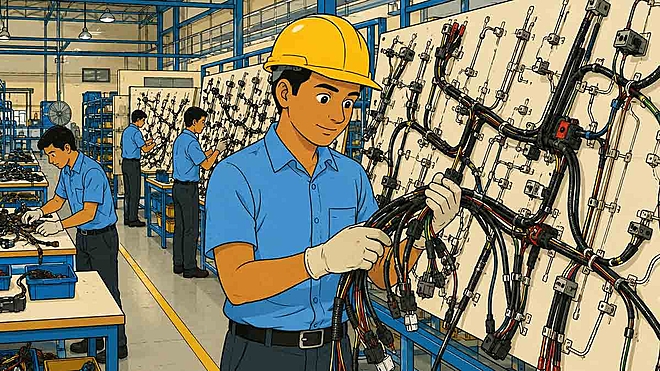
For those of you who own or often take two- or three-wheelers (autorickshaws, e-rickshaws) to get around the city, there’s largely a single company that makes their harnesses: Dhoot Transmission.
Today, two out of every five two- and three-wheelers in India have a Dhoot Transmission harness. Extend this to the EV space and the figure gets bigger: closer to seven in 10. This near-monopoly sits in front of a market expected to double by FY31.
At the upper end of the IPO price band (Rs 871), investors are asked to pay 45 times last year's profit. The question is not whether Dhoot Transmission is a good business, but whether a market leader's price is right for one growing fast and earning less on every rupee of it.
About the company
Dhoot Transmission makes wiring harnesses, the bundles of cable and connectors carrying power and signals around a vehicle, and is among India's top two suppliers for two- and three-wheelers, with 41 per cent of that market by value and close to 70 per cent of the electric version.
Its stickiness is physical, not contractual: each harness is built to the automaker's own design, on tooling the customer owns and keeps inside Dhoot's plants, with every part approved through a process that is slow and costly to recreate elsewhere.
The company boasts strong client retention, with its top five customers having stayed 13 years on average.
Wiring harnesses were 77 per cent of FY26 revenue, the rest battery packs, sensors, controllers and switches. Two-wheelers gave 65 per cent of revenue and three-wheelers 13 per cent, with clients including Bajaj Auto, TVS Motor and Honda Motorcycle and Scooter India; over 90 per cent of sales are domestic.
What Dhoot gets right
The wiring itself is getting more valuable: a digital display, anti-lock brakes and electronic fuel injection each add their own circuit. Dhoot already draws 57 per cent of two-wheeler revenue from premium and electric platforms, a segment forecast to grow 6-9 per cent a year against 4-6 per cent for petrol motorcycles overall.
The debt is going away too. Debt-to-equity has already halved to 0.4, and Rs 767 crore of the fresh issue, roughly half of consolidated debt as of July 2026, will repay borrowings at the company and three subsidiaries. Most of last year's Rs 91 crore finance cost should now drop to the bottom line.
Electrification raises the price of the same sale: an electric two-wheeler needs 1.5 to 2.5 times the harness content of a petrol one, from high-voltage cables, battery interconnects and charger links. CRISIL expects electric penetration in two-wheelers to climb from 6.6 per cent in FY26 to 25-30 per cent by FY31, doubling the domestic harness market to about Rs 12,000 crore in five years, of which Dhoot already holds close to 70 per cent, a tailwind needing no extra vehicle sold.
Where Dhoot is lagging
There is no contract under the revenue: Dhoot operates on rolling purchase orders with no minimum volume guarantees, a volume-linked business that goes unnoticed while the market is strong. If two-wheeler sales stall, revenue drops with the broader auto cycle, while the fixed costs of running 22 plants stay exactly where they are.
Margins are compressing too. Dhoot is growing volumes aggressively while earning less on every unit, with operating margins down from 15.6 per cent in FY24 to 12.6 per cent in FY26. It buys copper and polymers with no long-term price protection, while automakers demand annual price cuts.
Growth is consuming its own cash. Over the last three years, Dhoot generated Rs 909 crore from operations but spent Rs 985 crore on capex, leaving free cash flow negative at Rs 76 crore; FY26 finally turned positive, but only barely, at Rs 20 crore. More spending is planned, including new plants and a pending Rs 435 crore acquisition, and until it tapers, the profit in the table is not yet cash in the business.
Dhoot Transmission IPO details
| Particulars | Details |
| Total IPO size (Rs cr) | 3,067 |
| Offer for sale (Rs cr) | 1,667 |
| Fresh issue (Rs cr) | 1,400 |
| Price band (Rs) | 829-871 |
| Subscription dates | August 10-12, 2026 |
| Purpose of issue | Rs 465 crore debt repayment, Rs 302 crore subsidiary investment, Rs 150 crore new plant, rest general corporate purposes |
Post-IPO
| Market cap (Rs cr) | 17,816 |
| Net worth (Rs cr) | 3,834 |
| Promoter holding (%) | 68.8 |
| P/E (times) | 44.9 |
| P/B (times) | 4.6 |
Financial history
| Key financials | 2Y CAGR (%) | FY26 | FY25 | FY24 |
|---|---|---|---|---|
| Revenue (Rs cr) | 27.2 | 4,525 | 3,445 | 2,798 |
| EBIT (Rs cr) | 14.1 | 568 | 498 | 436 |
| PAT (Rs cr) | 15.2 | 397 | 354 | 299 |
| Net worth (Rs cr) | - | 2,434 | 994 | 748 |
| Total debt (Rs cr) | - | 918 | 815 | 576 |
| EBIT is earnings before interest and tax. PAT is profit after tax. | ||||
Key ratios
| Key ratios | 3Y average (%) | FY26 | FY25 | FY24 |
|---|---|---|---|---|
| ROE (%) | 34.6 | 23.1 | 40.6 | 39.9 |
| ROCE (%) | 28.9 | 22 | 31.8 | 32.9 |
| EBIT margin (%) | - | 12.6 | 14.4 | 15.6 |
| Debt-to-equity (times) | - | 0.4 | 0.8 | 0.8 |
| ROE is return on equity. ROCE is the return on capital employed. | ||||
Our verdict
Dhoot Transmission is a good business: a dominant position, a wider margin than peers and the sector's tailwinds behind it, deserving of a premium.
The premium's size is where the doubt lies. At the upper band, it is asking for 45 times earnings, not cheap by any reading, from a company yet to fund a single year of its own expansion.
The comparison that matters is Motherson Sumi Wiring, at 43 times. On quality, it is the better business: 39 per cent return on capital employed against Dhoot's 22 per cent, almost no net debt and ample free cash. Dhoot wins on FY26 revenue growth, 31 per cent against 23 per cent and on margin, 12.6 per cent against 7.4 per cent.
So you pay a shade more for the better-run balance sheet, growth and margin both under pressure, betting that electrification lifts content faster than customers claw back price, and that spending stops before returns fall again. Dhoot has the position to make that happen, but at 45 times, the price leaves nothing for the year it does not. Three things will show which way it goes: the operating margin holding rather than stepping down again, free cash flow staying positive once new plants are paid for, and Indian two-wheeler production holding its pace, since every gain in content per vehicle rests on that base.
Also read: How to win the IPO game: IPO handbook
Ask Value Research 

 New episodes every Friday













 New Process Alert
  Seems like you've uploaded a wrong QR code. Please upload the QR code downloaded from MF Central platform.


