




 Anand Kumar/AI-Generated Image

Summary: A year after listing, Atlanta Electricals has more than doubled while promoters held firm and profit grew against just a fifth rise in valuation multiple. This story traces what drove that, from a near-doubled order book to the 19-year approval climb that's its real moat, while flagging what's still unproven and priced in.
One year ago, Atlanta Electricals was a 37-year old transformer maker most investors didn’t even know of. It went public at a modest Rs 754 per share, was subscribed 70 times and then listed at just 9 per cent premium.
However, the stock gradually began picking pace. And today, a Rs 1 lakh allotment held since has grown to about Rs 2.25 lakh. Had you invested the same Rs 1 lakh in a Nifty 50 index fund, your money would just be worth Rs 96,000.
Three investors, three outcomes
The same Rs 1 lakh, three entry points, against a Nifty 50 index fund over the identical days
| Path | Worth today (Rs.) | Return (%) |
|---|---|---|
| Sold on listing day | 1.1 lakh | 9 |
| Held from allotment | 2.2 lakh | 125 |
| Bought at listing close | 2.1 lakh | 106 |
| Data as of September 21, 2026. No dividend, bonus or split since listing, so price return equals total return. | ||
Big funds bid nearly 200 times their quota, ordinary investors about ten times. Flipping on day one cost allottees more than Rs 1 lakh. So what did the company do to earn that patience?
Who was selling
Of the Rs 687 crore raised, Rs 400 crore was fresh money; the rest came from family owners selling about 5 per cent. The fresh money went into working capital and debt repayment, not new factories. The plants had already been built and financed with debt.
What Atlanta makes
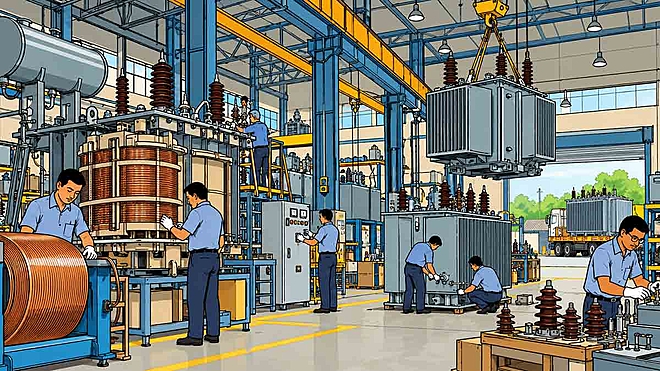
Transformers change the voltage of electricity so it can travel long distances and then be used safely. Atlanta makes small and large transformers for power utilities and renewable-energy plants. Power transformers were about four-fifths of last quarter's sales, and its customer count has more than tripled since 2022.
The year the capacity arrived
FY26 was the first full year with Atlanta's newest plant running, and both revenue and profit hit records, each having compounded at more than 30 per cent a year over five years.
Capacity fuels growth
Atlanta's expanding capacity has supported strong growth in revenue and profit over the past two years
| Metric | FY22 | FY23 | FY24 | FY25 | FY26 | 5Y CAGR (%) |
|---|---|---|---|---|---|---|
| Revenue (Rs cr) | 625.7 | 873.9 | 867.6 | 1,244.20 | 1,851.50 | 31.2 |
| EBITDA (Rs cr) | 89.4 | 143.1 | 118.7 | 193.6 | 344.4 | 40.1 |
| EBITDA margin (%) | 14.3 | 16.4 | 13.7 | 15.6 | 18.6 | — |
| Profit after tax (Rs cr) | 55.3 | 87.5 | 63.5 | 118.7 | 201.8 | 38.2 |
| PAT margin (%) | 8.8 | 10 | 7.3 | 9.5 | 10.9 | — |
| Return on capital employed (%) | 55 | 58 | 42.3 | 39.4 | 34.1 | — |
| Return on equity (%) | 71.2 | 53.1 | 27.8 | 33.9 | 21.7 | — |
| Debt-equity (x) | 0.97 | 0.44 | 0.21 | 0.4 | 0.05 | — |
FY24 was flat, with profit actually falling. And the company's returns on capital have drifted down even as profits rose, because it added capital faster than profit, first by borrowing and then through the IPO. Some of that reverses as the new plants fill. Some of it is simply the price of expanding. The clearer signal is the order book, which nearly doubled in a year to about Rs 3,100 crore.
Why it is hard to arrive here
A transformer maker does not move up to a higher voltage class by deciding to. It moves up by being allowed to. Utilities pre-qualify suppliers on what they have already built and run without failure, one rung at a time, with years of watching in between.
Atlanta shows the cost of that rule. It began supplying 132 kV machines in 2007, reached 220 kV in 2014, and only won approval for 400 kV in 2026. Nineteen years to climb two rungs. That same barrier is the moat: rivals adding factories cannot instantly bid for the same work.
Nobody left the building
The usual first-anniversary story is insiders selling when their lock-in ends. There was none here. Promoters held about 87 per cent before and after the lock-in expired, even as the stock broke out.
That left a thin free float of under 13 per cent. The thin float likely amplified the stock’s swings, but this will not last indefinitely. Promoters must bring their holding down to 75 per cent or below within three years of listing, potentially increasing the free float over the next two years.
Not cheap, and priced for all of it
At today’s price, Atlanta is worth about Rs 13,000 crore, more than twice its listing value. Most of the gain came from earnings, not just a higher market multiple. Still, the stock is costlier than when it listed. It trades at roughly 60 times earnings, up from 49 times at the IPO.
Among the 103 companies that listed in 2025, more than half now trade below their issue price, while only about a dozen have doubled. Atlanta’s performance stands out, but so does the risk of assuming every new listing will follow the same path.
Our verdict
This is a case where the business delivered and the stock followed. The plants were built, debt cleared, the order book nearly doubled, and margins improved with scale.
What Atlanta has not yet done is sell very high-voltage transformers, sign a top-tier partner or export, while its guidance depends on all three and on running plants twice as hard. The last year was earned. The next few quarters are priced in.
Before the next IPO tempts you, ask three things: where the money is actually going, whether growth comes from higher volumes or prices, and what valuation you are paying versus the IPO. A company can deliver on its promises and still be a poor investment at the wrong price.
Also read: Two stocks fell 70%. Funds bought one and dumped the other
Ask Value Research 

 New episodes every Friday












 New Process Alert
  Seems like you've uploaded a wrong QR code. Please upload the QR code downloaded from MF Central platform.


