




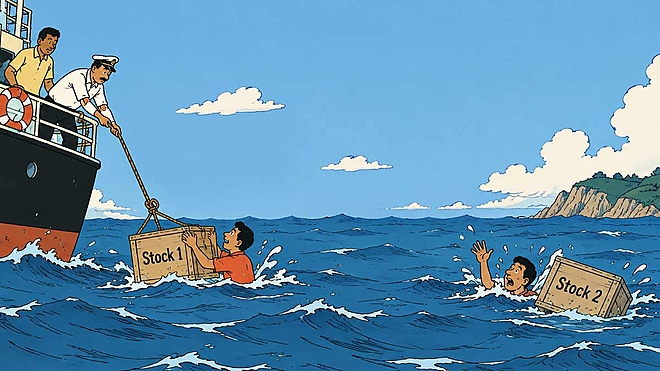
 Anand Kumar/AI-Generated Image

Summary: Whirlpool of India and KEC International fell by almost the same amount. One got fresh money from mutual funds and the other got shown the door. If fund managers aren't reading the size of the crash, they're reading something else. The question is whether you're looking at it too.
Whirlpool of India and KEC International both lost close to 70 per cent from their three-year highs. Same damage, near enough. Yet as the price slid, mutual funds quietly added to Whirlpool and backed out of KEC. Same fall, opposite call.
That gap is the whole point. From the chart, a crash looks like one thing: a stock on sale. But the size of the fall turns out to tell you almost nothing about whether there is a business worth owning at the lower price. To see what does, we tracked what funds did with the market's worst wrecks, quarter by quarter, as the price came down.
How we picked them
- We started with every listed company worth more than Rs 5,000 crore.
- From these, we kept the ones that had fallen 66 per cent or more from their highest price in the last three years, meaning they had lost two-thirds of their value or worse.
- For each, we found the quarter just before the price peaked and compared total mutual fund ownership then with ownership as of June 2026, the latest quarter available.
- We ranked them by that change. The five with the biggest rise in fund ownership make the first list. The five with the biggest fall make the second.
- Separately, we counted how many active equity funds held each stock at its peak and how many still held it in August 2026, using monthly scheme-level data.
Stocks funds bought into
Top 5 stocks that saw fund ownership rise
| Company | Fall from 3Y high (%) | Quality score | Mutual fund ownership before (%) | Mutual fund ownership now (%) | Change in ownership (%) | Active funds then | Active funds now |
|---|---|---|---|---|---|---|---|
| Sonata Software | -68.3 | 5 | 16.6 | 24 | 7.5 | 27 | 14 |
| Cohance Lifesciences | -68.3 | 6 | 14.1 | 18.2 | 4.1 | 44 | 33 |
| Whirlpool Of India | -69.9 | 6 | 29 | 31.8 | 2.8 | 59 | 34 |
| Birlasoft | -67.4 | 9 | 18.1 | 20.8 | 2.7 | 44 | 18 |
| KPIT Technologies | -71.2 | 9 | 9.9 | 11.9 | 2 | 43 | 22 |
| Fund ownership change is based on the quarter before the stock’s three-year high versus June 2026. Universe restricted to companies with market cap above Rs 5,000 crore and a fall of at least 66 per cent from the high. Fund count includes only active equity funds and is based on August 2026 data. | |||||||
Mutual funds now own more of these five than they did before the fall. Sonata is the clearest case. Funds owned about a sixth of the company before its slide (16.6 per cent) and now own nearly a quarter (24.0 per cent).
Stocks funds walked away from
Top 5 stocks where funds reduced their stakes
| Company | Fall from 3Y high (%) | Quality score | Mutual fund ownership before (%) | Mutual fund ownership now (%) | Change in ownership (%) | Active funds then | Active funds now |
|---|---|---|---|---|---|---|---|
| Zee Entertainment Enterprises | -73.2 | 1 | 32.5 | 3.2 | -29.3 | 68 | 3 |
| KEC International | -69.5 | 1 | 24.3 | 20.7 | -3.5 | 54 | 26 |
| Shakti Pumps (India) | -67 | 5 | 5.1 | 2.3 | -2.8 | 9 | 11 |
| Jyothy Labs | -67.3 | 10 | 13.8 | 12 | -1.7 | 40 | 17 |
| Ircon International | -69 | 1 | 1.7 | 0.3 | -1.4 | 11 | 0 |
| Fund ownership change is based on the quarter before the stock’s three-year high versus June 2026. Universe restricted to companies with market cap above Rs 5,000 crore and a fall of at least 66 per cent from the high. Fund count includes only active equity funds and is based on August 2026 data. | |||||||
Zee Entertainment is in a class of its own. Funds owned a third of the company (32.5 per cent). They now own about one-thirtieth (3.2 per cent), and only three schemes hold any at all. Ircon International is starker in its own way: almost nothing left, and not one active equity fund still holding it.
Read the two columns together
Look at the fund counts and something odd shows up. They fell almost everywhere, including in the list where funds were net buyers. Sonata went from 27 holders to 14. Birlasoft from 44 to 18. Whirlpool from 59 to 34.
So most funds left these stocks too. The difference is what the ones who stayed, or the new arrivals, did with their money.
Both things are true at once, and together they say something useful. The buying was concentrated in fewer hands, and bigger ones. Whatever the departing funds sold, those who stayed or arrived more than absorbed it. A shrinking number of owners taking a larger share of a company is a different signal from a crowd drifting in.
The second list is simpler. Both numbers move the same way. Fewer funds hold these stocks, and the ones that remain own less. Shakti Pumps is the lone exception: the number of funds holding it rose, from 9 to 11, yet ownership still fell. More funds, each holding less.
The lesson is that counting funds and measuring ownership answer different questions. A stock can gain holders and lose conviction at the same time.
What separated the two groups
The falls tell you nothing. Both lists run between 67 and 73 per cent. The businesses tell you a great deal.
The Value Research quality score grades a company on the strength and consistency of its financials, from 1 at the weakest to 10 at the strongest. The typical stock funds bought into scores 6. The typical stock they abandoned scores 1, and three of those five sit at the bottom grade.
The one apparent exception makes the point. Jyothy Labs is the only strong business in the sell list, at a score of 10, and it is the one funds mostly stuck with: they still hold about 12 per cent of it, barely below the 13.8 per cent they owned before. The wholesale exits, Zee down to 3.2 per cent and Ircon to almost nothing, were reserved for the bottom-grade names.
Being beaten down is not the same as being cheap. The price only tells you a stock costs less than it did. What funds seem to be weighing is whether there is a business worth owning at the new price, and on that question the two lists part company.
The takeaway
A 70 per cent fall is not information. It tells you what has already happened, not what you own now.
Two stocks down the same amount can be completely different propositions, and the difference sits in the accounts, not the chart. Before deciding a battered stock is cheap, ask what the price cannot tell you. Does the business earn a decent return on the money it uses? Can it survive two bad years with the debt it carries? Was the original climb built on profits, or on an order book and a good story?
If it was the story, the fall may not be an opportunity. It may just be reality arriving.
Next time a stock on your watchlist is down two-thirds, run the test before you decide it is a bargain. Pull up its quality score and its last two years of accounts first. Let the price tell you it is cheaper. Let the business tell you whether cheaper is worth owning.
Also read: Elevate Campuses: Interesting business, complicated IPO
Ask Value Research 

 New episodes every Friday










 New Process Alert
  Seems like you've uploaded a wrong QR code. Please upload the QR code downloaded from MF Central platform.


