




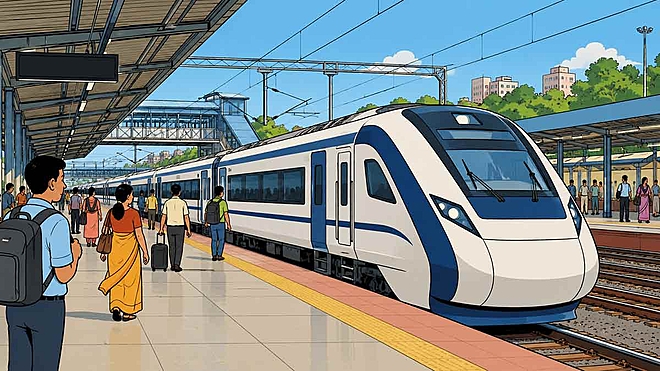
 Anand Kumar/AI-Generated Image

Summary: Titagarh and Jupiter Wagons share freight wagon roots and a tough FY26. Yet their plans for what comes next could hardly be more different, and so is the risk that will decide whether each bet pays off for shareholders.
Titagarh Rail Systems and Jupiter Wagons still earn most of their revenue from freight wagons. But their next phase of growth is taking them in different directions.
Titagarh is moving towards complete passenger rolling stock such as metro coaches and Vande Bharat trains. Jupiter is moving deeper into the parts that go inside railway vehicles, including wheels, axles, wheelsets and braking systems.
That difference changes what investors need to watch. Titagarh’s main challenge is execution. Jupiter is earning enough on the large amount of capital it is investing.
|
|
Titagarh Rail Systems | Jupiter Wagons |
|---|---|---|
| FY26 revenue* | Rs 3,144 cr | Rs 2,916 cr |
| June 2026 order book | Rs 12,865 cr | Rs 4,550 cr |
| Main existing business | Freight wagons | Freight wagons |
| Main growth engine | Passenger rolling stock | Wheels and railway components |
| Strategy | Sell more of the complete train | Make more components in-house |
| Main risk | Execution | Return on new capital |
| *Titagarh standalone rail revenue; Jupiter consolidated revenue. | ||
Same starting point, different answers
FY26 showed why both companies want to reduce their dependence on wagons.
Titagarh’s freight revenue fell 25 per cent to Rs 2,604 crore. Passenger rail more than doubled to Rs 539 crore, but still formed only 17 per cent of rail revenue.
Jupiter was hit harder. Consolidated revenue fell about 26 per cent to Rs 2,916 crore as a shortage of wheelsets hurt wagon production. Yet its wheelset business crossed Rs 500 crore of revenue.
Their responses are different. Titagarh is reducing freight dependence by entering passenger transport. Jupiter is trying to control more of the railway supply chain.
Titagarh: Moving towards the complete train
Titagarh’s current revenue mix still looks freight-heavy, but its order book shows where the business is heading.
Passenger rail formed only 17 per cent of FY26 rail revenue. Yet by June 2026, it accounted for Rs 10,395 crore, or 81 per cent, of Titagarh’s Rs 12,865 crore rail order book. In Q1 FY27, passenger rail had already risen to 31 per cent of revenue.
The margins have held up too. Passenger rail earned a segment operating profit margin of 14.3 per cent in FY26, against 12.2 per cent for freight. In Q1 FY27, passenger margin was 14.7 per cent.
Passenger trains are more complex than freight wagons. Titagarh must integrate the coach body, propulsion, electrical systems, interiors and other parts into a finished train. That raises execution difficulty, but also increases the value of the product it sells.
It also opens a long-term maintenance revenue stream. Titagarh and BHEL have a 50:50 joint venture to maintain Vande Bharat sleeper trains for 35 years. That gives passenger rail a different revenue profile from one-off wagon manufacturing.
Titagarh has already invested and won the orders. It now has to deliver them on time and turn the larger passenger business into cash.
Jupiter: Owning more of each wagon
Jupiter is taking a different route. Instead of moving mainly towards complete passenger trains, it is making more critical railway components itself.
Its wheelset business crossed Rs 500 crore of revenue in FY26, with management reporting an earnings before interest, tax, depreciation and amortisation (EBITDA) margin of around 17 per cent.
Its next step is much larger. Jupiter is investing roughly Rs 2,600 crore in a wheel-and-axle facility in Odisha.
This helps in two ways. Jupiter becomes less dependent on outside suppliers for wheelsets, the same component shortage that hurt production in FY26. It can also sell wheels, axles and wheelsets to other wagon and passenger-train makers.
Stone India’s braking systems add another piece. Jupiter is increasing the share of each railway vehicle that it can manufacture within the group.
But the investment bill is large. The new plants need to earn strong returns, not merely add revenue. Investors should therefore watch cash flow and return on capital as closely as sales growth.
Different order books, different risks
Titagarh’s order book gives it longer revenue visibility. Passenger rail alone makes up 81 per cent of its rail backlog, although these contracts can take years to execute.
Jupiter’s Rs 4,550 crore order book is smaller and turns faster. Around 80 per cent of its wagon backlog is from private customers, reducing its dependence on Indian Railways. But it also needs fresh orders more often.
The choice is no longer simply between two wagon makers.
Titagarh is trying to sell more of the finished train. Jupiter is trying to manufacture more of the parts inside it. For Titagarh, watch passenger deliveries and margins. For Jupiter, watch whether its new component capacity produces strong cash flow and returns on capital.
Also read: IRCTC's moat is intact. So why did its stock halve?
Ask Value Research 

 New episodes every Friday













 New Process Alert
  Seems like you've uploaded a wrong QR code. Please upload the QR code downloaded from MF Central platform.


