
Powered by
Investors' Hangout | 25-Sep-2026 | Ruchira Sharma

What Small Caps Actually Pay You For
The ten-year chart is real. So is the 50 per cent fall inside it. Ruchira Sharma on what this week's conversation with Dhirendra Kumar taught her about staying put.
Every small-cap pitch shows the same chart. Fourteen to sixteen per cent a year over ten years, the best long-run numbers in Indian equity. What the chart leaves out is most of the experience.
A payment, not a prize
Why do small caps earn more at all? Not magic, Dhirendra Kumar said. They are thinly researched, few people know them, and when you buy one, you buy early, ahead of the crowd. Every large company in India today was once small, and somebody held through its awkward years.
But the extra return is a payment, not a prize. You are being paid for backing a company that is illiquid, little known, and could simply die. When bad weather hits a company nobody follows, it falls freely. A small cap losing three-fourths of its value in a year is normal.
He had the 2008 numbers ready. From its January 2008 peak to its March 2009 low, the Sensex fell 61 per cent. The micro-cap fund of the time fell 75 per cent. And that was a portfolio of 50 to 80 companies, not one unlucky bet.
What ten years feel like
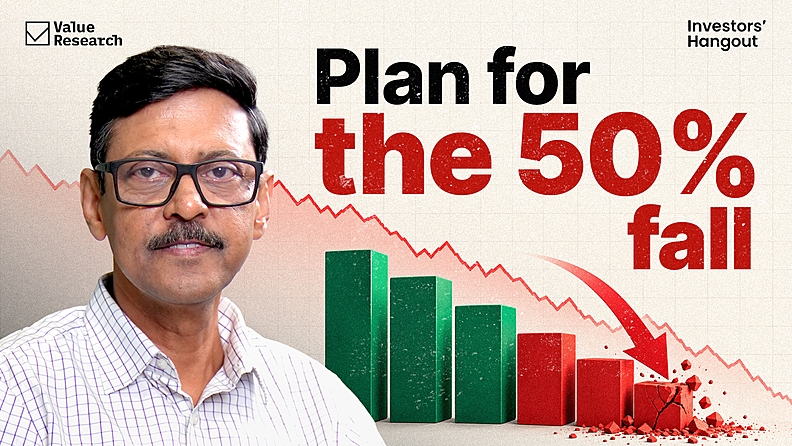
A typical ten-year small-cap stretch will include a fall of about 50 per cent. Repeat 2008, and it is 75.
The SIP makes it feel worse. Start at Rs 5,000 a month. After three years, you have put in Rs 1.8 lakh, and even a 20 per cent return does not look handsome, because most of that money went in recently. You are doing everything right, and nothing appears to be happening.
The compounding shows up after five or seven years. That is also when your pot is finally worth something, and that is when the fall arrives. Six lakh can look like one and a half lakh inside a month. "It looks like somebody has robbed you," he said. That is where most people quit.
That is why, for most investors, the small-cap reward isn't payment for picking a brilliant fund. It is payment for endurance. For not stopping the SIP, not cutting it, not pulling out.
Who should be here at all
Three conditions, all compulsory.
The core comes first. A small-cap fund should never be your only fund, or your first. For anyone starting equity at 35 or 40, Dhirendra would start with an aggressive hybrid: steadier growth that doesn't crumble in the worst of times.
Then a genuine ten-year horizon. Not ten years until it falls.
Then the stomach test. If a falling market has you awake at 2 am checking your portfolio, you are not built for this. And the app that lets you invest with one click lets you redeem with one click. You can watch your value hourly, and many people do. That watching provokes action. Technology did not make small caps riskier. It made quitting easier.
When the crash comes
What to do at minus 50 is mostly decided before. Keep the core, the fixed income and the emergency fund in place, so the fall never touches money you need soon. Money you need in four years does not belong here. Automate the SIP so it continues without monthly courage. And price the alternative in advance: the cheap units you never buy, the recovery you miss.
Nothing else, he said, will keep you invested.
And if the ten years go beautifully? Celebrate, he said, and thank Investors’ Hangout.
What I am keeping
The best small-cap fund is not the one with the highest return. It is the one you can stay with through a crash. Keep it as a supplement to a diversified core and some fixed income. Then stop watching it.
Other Videos


You chose 60:40. The market made it 75:25
16-Oct-2026 · 19,609 Views

The next scam will not look like a scam
09-Oct-2026 · 19,730 Views

Multi-asset funds share a name, not a portfolio
02-Oct-2026 · 30,949 Views

The first SIP at 40: what 20 years can still build
18-Sep-2026 · 2.6 Lakh Views

Aggressive Hybrid VS Balanced Advantage Funds
11-Sep-2026 · 64,653 Views

How Much Is Too Much in One Fund?
04-Sep-2026 · 29,522 Views

Thirty Funds to Six. A Two-Year Exit Plan.
28-Aug-2026 · 43,178 Views

Your SGB Is Maturing. The Money Needs a Plan.
21-Aug-2026 · 44,134 Views

Building Financial Freedom, Decade by Decade
14-Aug-2026 · 17,024 Views

Why Your Best Fund Suddenly Looks Average
07-Aug-2026 · 24,921 Views

REITs Pay Regularly. Is It All Income?
31-Jul-2026 · 42,949 Views

What 20 years of investor trust looks like
· 72,057 Views

New Fund Offer - Not a cheaper fund.
24-Jul-2026 · 21,709 Views

How Much Equity in Retirement?
17-Jul-2026 · 17,882 Views

STP, SWP, or Sell in One Go?
10-Jul-2026 · 30,943 Views

Perfect Timing vs a Plain SIP
03-Jul-2026 · 14,473 Views
 New Process Alert
  Seems like you've uploaded a wrong QR code. Please upload the QR code downloaded from MF Central platform.


