




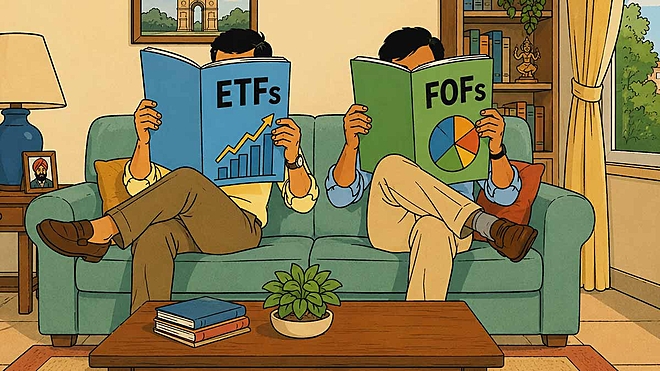
 Anand Kumar/AI-Generated Image

Summary: ETFs and FoFs may both offer passive investing, but they work differently in practice. This article explains the key distinctions to help investors understand which option may better suit their needs.
What is the difference between ETFs and FoFs? Please clarify – Dinesh Mohan
If you've dipped a toe into passive investing, chances are you've got your head around index funds fairly quickly. But the moment ETFs (exchange-traded funds) and FoFs (fund of funds) enter the conversation, things get a little tricky. Both are passive options, both promise low-cost exposure to an index or asset, yet they work quite differently under the bonnet.
Here's a simple breakdown to help you tell them apart.
What exactly are ETFs and FoFs?
An ETF is a basket of securities (shares, bonds, gold or a mix) that tracks an index and trades on a stock exchange, just like an individual share. Its price moves through the day as buyers and sellers trade it.
A FoF, on the other hand, is a mutual fund scheme that doesn't hold securities directly. Instead, it invests in units of another fund, often an ETF, sometimes an international fund or a mix of debt and equity funds. You buy and sell it like any ordinary mutual fund, based on its end-of-day NAV (net asset value).
How do you actually invest?
This is where the practical difference really shows up. To buy an ETF, you need a demat and trading account, and you can only buy at the prevailing market price; there's no proper SIP route, since ETF purchases depend on live liquidity on the exchange (though some platforms offer a workaround).
A FoF needs no demat account at all. You can invest through the AMC, an app or a distributor and set up a SIP or lumpsum just as you would with any mutual fund. For investors who want disciplined, automated investing without the hassle of a trading account, FoFs are usually the simpler route.
Taxation
When it comes to taxation, ETFs and FoFs are quite similar.
Equity ETFs and FoFs are taxed like equity mutual funds – long-term capital gains are taxed at 12.5 per cent, while short-term capital gains are taxed at 20 per cent. Debt ETFs (and FoFs), too, have the same tax treatment as debt funds, i.e., capital gains are taxed as per the investor’s tax slab.
On the other hand, gold, silver and international ETFs (or FoFs) have a long-term capital gains tax of 12.5 per cent, while short-term gains are taxed according to the applicable tax slab.
Cost and liquidity
ETFs generally have a lower expense ratio because there's no separate layer of fund management to buy the underlying fund. However, real-world liquidity can be a problem, as some ETFs have thin trading volumes, which can lead to wider bid-ask spreads.
FoFs charge a slightly higher expense ratio (they add their own layer of costs atop the underlying fund's), but they offer guaranteed liquidity since the AMC itself processes redemptions at NAV.
So, which one wins?
Neither is universally better; it depends on your convenience, cost sensitivity and whether you already have a demat account. If you'd like a clearer, more personalised answer, Value Research Fund Advisor can help you evaluate your options and decide which one best fits your portfolio.
Subscribe to Fund Advisor today
This article was originally published on July 08, 2026.
Ask Value Research 

 New episodes every Friday









 New Process Alert
  Seems like you've uploaded a wrong QR code. Please upload the QR code downloaded from MF Central platform.


