




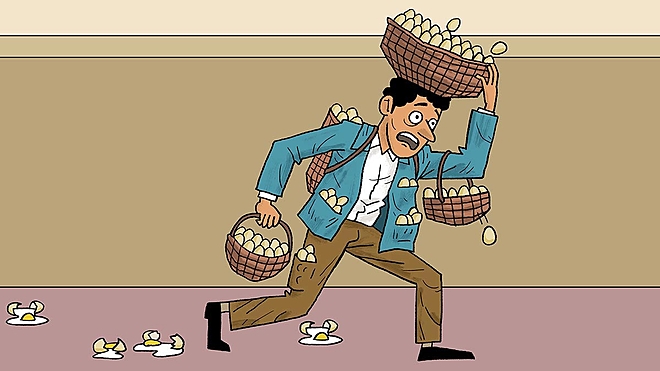
 Illustration: Anand Kumar
Summary: He invested steadily for 25 years, never sold a single fund, only redirected his SIP to whichever was doing better. After two and a half decades of attentiveness, he owns 50 funds and a tax bill he hadn't bargained for if he tries to clean it up.
A reader wrote to me recently with a confession that many investors would recognise as their own. He has been investing steadily for close to 25 years, with SIPs running without a break, which is exactly the discipline that all good financial advice tries to instil. There was only one habit he now regrets. Every year or so, when he noticed a fund doing better than the ones he was buying, he pointed his SIP money at the new winner, without ever touching what he had accumulated in the old one. He never sold. He only redirected. After two and a half decades of this, he owns more than 50 funds. The obvious tidy-up, selling the clutter and folding it into a handful of good schemes, would land him with a tax bill he had not bargained for. What, he asked me, should he do?
The first thing I want to say to him, and to everyone who recognises their own portfolio in his, is that the number 50 is a distraction. The question worth asking is not how many funds you hold. It is how many genuinely different things you own, and these are rarely the same number. An investor who keeps moving towards whichever fund has lately done well is drawn, almost by the nature of the exercise, to the same fashionable corners of the market again and again. So 50 line items on a statement frequently turn out to be six or seven real bets, each held several times over under different branding. The portfolio looks sprawling. It is actually far more concentrated than it appears. Which means the work in front of him is smaller than the figure 50 suggests, and perhaps less urgent than the alarm it has provoked.
It is worth pausing on how a careful person ends up here, because there is nothing foolish in it. Moving your money towards what is working feels like attentiveness, not error. At every moment, it looks like the responsible thing to do. The trouble becomes visible only years later, in the aggregate: last year’s best fund is seldom next year’s, and the chase leaves a trail behind it, a string of half-finished holdings, none of them large enough to matter on its own. He was not careless. If anything, he was too engaged.
So what should he actually do? The most useful move requires no selling at all, costs nothing and triggers no tax: stop feeding the laggards from today. Every rupee of fresh SIP money can be pointed at the small number of funds that genuinely deserve to be owned. The remaining 40-odd holdings need not be exited. They need only to stop being fed. When done consistently, this one change consolidates the portfolio through attrition, as the good funds grow with new money and steady returns, and the abandoned ones shrink in relative weight, all without a single taxable transaction.
The backlog, the holdings he would actively like to be rid of, is where patience will pay.
Long-term gains on equity funds are taxed at 12.5 per cent only on the portion above Rs 1.25 lakh in a financial year, and that exemption resets every April. A portfolio built one instalment at a time is not a single block. It is a long stack of tranches, each with its own purchase date and cost, and that granularity is an advantage rather than a complication: the poorer holdings can be unwound a slice at a time, kept within the annual exemption, so that the consolidation he dreads gets done over a few years at little or no tax. The funds that are both low-quality and modest in gains can go first, almost freely. The large, deeply appreciated ones deserve more thought, and that thought belongs to him rather than to me.
There is one more relief that an old portfolio enjoys and a newer one does not. When equity gains became taxable again in 2018, everything that had accrued up to January 31 that year was left untouched. For any unit bought before that date, and across 25 years, that is the great majority of them, the cost the law recognises is not what he actually paid but the value as it stood at the end of January 2018. The growth of all the long years before then escapes tax entirely, however late he comes to sell. So the holdings he has owned the longest, the very ones he assumes would be the dearest to unwind, often carry a far smaller taxable gain than the figure on his statement would lead him to fear.
This kind of seeing is exactly what I built Value Research Fund Advisor to do. Our Portfolio Analysis is, before it is anything else, an instrument for revealing that 50 funds are really six. It lays bare the overlap and duplication that a statement is designed to conceal, so that you can tell genuine diversification from the same bet wearing different labels. Our Buy, Sell and Hold verdicts, and the shorter Analyst’s Choice list drawn from within them, tell you which of your holdings are worth keeping and where your fresh money ought to flow, so the redirection I have described becomes a matter of judgement rather than guesswork. And the tax view sits alongside all of it, showing the gain embedded in each fund, so the cost of every exit is visible to you before you make it, rather than being discovered painfully afterwards.
One thing is worth stating plainly. We earn nothing from your buying or selling: no commission, no cut of the transaction, nothing that improves for us when you trade more. The impulse to keep switching to the latest winner, the very impulse that quietly built this reader’s 50 funds, is exactly the impulse a commission-funded advisor has every reason to encourage. We have none.
I would leave him and you with one caution. A portfolio that looks untidy is not failing, and the urge to make it neat is an aesthetic goal, not a financial one. There is no prize for owning a few funds, and no sense in paying real, irrecoverable tax to buy yourself the feeling of tidiness. What you should want is a portfolio that is doing its work: concentrated where it ought to be, free of the genuine duplicates and the genuine laggards and growing without demanding your anxiety, so that you sleep better at night. The 50 funds are not a confession to be ashamed of. They are a to-do list. And the first item on it costs nothing: redirect next month’s instalment.
Also read: Why we built it this way
Ask Value Research 
 New episodes every Friday












 New Process Alert
  Seems like you've uploaded a wrong QR code. Please upload the QR code downloaded from MF Central platform.


