




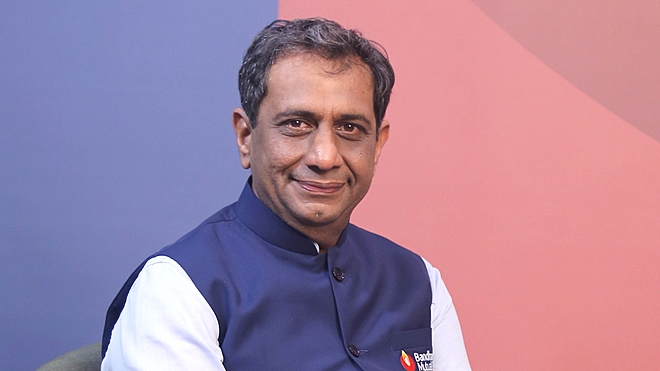
Summary:Manish Gunwani runs one of the highest alpha-generating small-cap strategies in the country. His framework is simple and demanding: only buy what has a genuine chance of doubling in three to four years. The more interesting question is what he won't buy and why.
Summary:Manish Gunwani runs one of the highest alpha-generating small-cap strategies in the country. His framework is simple and demanding: only buy what has a genuine chance of doubling in three to four years. The more interesting question is what he won't buy and why. Thirty years in markets teaches you something that no framework can fully capture: when to act and when to wait. Manish Gunwani, CIO - Equity at Bandhan AMC, has built his reputation on exactly that kind of patience and conviction. Managing over Rs 57,000 crore across seven funds, he runs one of the country’s highest alpha-generating small-cap strategies while staying grounded in a simple but demanding idea—only buy what has a genuine chance of doubling in three to four years. In this conversation, he shares his thinking on IT services, the flexi-cap dilemma, the value versus growth debate and where the next big rerating opportunity lies. Your small-cap fund has generated the highest alpha in the country, not just within the category but across active diversified equity funds. What’s driving that? First, a disclaimer. The current team has been together for only about three years, which may not be long enough to draw definitive conclusions. That said, it’s always good to get off to a strong start. I still see this as the beginning. A few things have probably helped. The first is risk management. Small-cap investing comes with liquidity risk, which we’ve tried to address through a highly granular portfolio. We hold more than 200 stocks. Second, every portfolio carries macro risk. We’ve tried to minimise that by maintaining exposure across industries and segments rather than concentrating heavily in financials, capital goods or any single theme. If you look at our portfolios over the last three years, we don’t go heavily cyclical or very defensive. We are present in most sectors in a reasonable proportion. The third risk is business fragility. Small-cap companies tend to be more vulnerable than large caps. They may have client concentration, key-person dependence or other operational risks. Diversification helps us manage those risks as well. Beyond risk management, the heart of the fund is research. We have a relatively large team and a broad coverage universe. We track more than 700 companies. Very few AMCs cover that many stocks. It’s about the DNA of focusing on small caps. One aspect that’s particularly important is how we evaluate our research team. Most AMCs use model portfolios to measure analyst performance. That works reasonably well for large caps and mid caps, but it has limitations in small caps. In a model portfolio, the smaller companies often carry very low weights. As a result, analysts naturally focus more on the larger positions. We’ve tried to solve that by creating a separate process that specifically measures small-cap research performance. It may sound like a small change, but many such changes add up. Over time, they help build a culture where analysts are genuinely hunting for the next multibagger. That’s really what small-cap investing is about. You can’t reduce that entirely to a process document. It’s a combination of systems, incentives, performance measurement and day-to-day interactions. Our effort has been to build an ecosystem where there is genuine enthusia
 New episodes every Friday













 New Process Alert
  Seems like you've uploaded a wrong QR code. Please upload the QR code downloaded from MF Central platform.


