




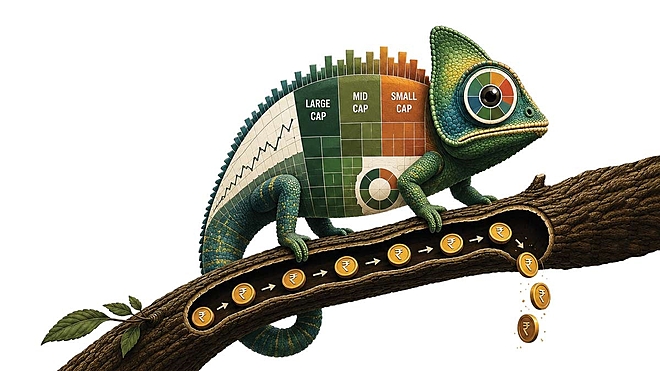
 Yogesh Sharma/AI-generated image
Summary: Flexi-cap funds were built on one promise: the freedom to go anywhere. Most of them haven't moved in years. The alpha that once justified the category has faded. And the investors still paying for flexibility may not be getting any.
Summary: Flexi-cap funds were built on one promise: the freedom to go anywhere. Most of them haven't moved in years. The alpha that once justified the category has faded. And the investors still paying for flexibility may not be getting any. “What’s in a name?” For flexi-cap fund investors, a great deal. The category name promises flexibility, the freedom to move across the market and chase returns anywhere, with nothing in the rulebook to stop them. This free hand, partly, explains why investors have been fond of the category, flooding it with more money than any other diversified equity category in the last three years. Yet most of these funds are barely using their free rein. The portfolios have drifted into large caps and stayed there, barely moving through crashes, recoveries and bull runs. That drift has come at a cost: investors have quietly paid a tax for staying invested, the price of holding a flexi-cap fund that behaves like something else. The pages that follow examine why this tax exists, and what state the freedom promise is really in. Promise of freedom The category’s flexibility was designed, not stumbled into. When SEBI reorganised fund categories in 2020, it had a problem with multi-cap funds: sold as go-anywhere products, they had quietly drifted into large caps. So it ruled that every multi-cap fund must hold at least 25 per cent each in large, mid and small caps. The flexi-cap category arrived two months later with no such rule. It had a single mandate: to keep 65 per cent of its money in equity, and could invest the rest wherever it chose. Alone among the diversified categories, it kept the right to roam the whole market. That right exists for one reason: to earn you more. A manager free to roam can do two things an index cannot. They can lean into smaller companies where bargains are easier to find and crowd into whichever sector is leading. Used well, that should beat a simple index and decisively so. But flexi caps over the last two decades have gradually lost that upper hand, more and more. The freedom has stopped paying The simplest measure of whether the freedom is working is a fund’s alpha: the margin by which it beats its benchmark, after adjusting for the risk it took. If the flexibility is doing its job, that number should be comfortably positive. In the category’s early years, it was. Not any more. The chart ‘The edge that faded’ tracks the average flexi-cap fund’s alpha back to 2004. In the early years, its three-year alpha ran high, between 6 and 12 per cent. Over time it normalised to 1 to 3 per cent. Since about 2018, as retail money poured in through discount brokers and the market grew more efficient, it has hovered between zero and 1 per cent, at times slipping below zero. So the edge has not crashed but it has reduced, from something worth paying for to next to nothing. An investor in the average flexi-cap fund today is barely ahead of the BSE 500, the very benchmark it is measured against. That can be traced to how the category has grown stagnant instead of using its flexibility. Stuck on large caps Look first at what the average flexi-cap actually holds. Today it keeps around 62 per cent of its equity in large caps, 19 per cent in mid caps and 19 per cent in small caps. That 38 per cent in mid and small is not nothing. A pure large-cap fund, required to hold at least 80 per cent in large caps, cannot offer it. So a flexi cap is not secretly a large-cap fund.
This article was originally published on June 20, 2026.

 New episodes every Friday












 New Process Alert
  Seems like you've uploaded a wrong QR code. Please upload the QR code downloaded from MF Central platform.


