




 Illustration: Anand Kumar

Summary: A prolonged oil shock does not affect all businesses equally. This story explores how crises that cause real economic damage, not just panic, expose which companies have resilience through pricing power, strong cash flows and export earnings and which are far more vulnerable than the market realises.
Last month, I wrote something I had not written in 30 years. I said that the standard advice, stay the course, this too shall pass, may not apply in its usual form to the US-Iran war.
Hundreds of readers wrote back. The question in almost every email was the same: you told us it is different. Now tell us what to do.
This column is not about mutual funds. It is about stocks. And for the stock investor, the answer begins with a distinction that most market commentary has missed.
Sentiment damage vs physical damage
Most market crises damage the mood. Valuations get ahead of earnings. Panic sets in. Prices fall. But the factories are still there. The workers are still there. Mood recovers. It always does.
The conflict in West Asia is damaging things. If even a fraction of the world’s crude refining capacity is destroyed, that capacity will not return even if confidence improves. It returns when steel is welded, and pipelines are rebuilt. That takes years.
For the stock investor, this distinction matters enormously. Because it tells you which businesses will absorb the shock and which will transmit it.
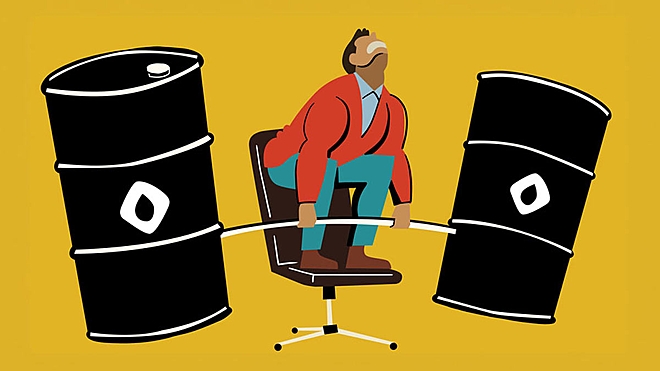
The $100 barrel as a sorting machine
A crude price above $100 does not hurt every business equally. It sorts them.
On one side, there are businesses whose costs are dominated by oil, either directly or through derivatives such as plastics, fertiliser, freight and packaging. Cement companies. Auto ancillaries. Paints. FMCG firms with thin margins. Airlines. For these businesses, a sustained oil shock compresses earnings for as long as the price of the barrel stays high. The market has not yet fully priced this in because it still expects a quick resolution. If the resolution is slow, next year’s earnings estimates will be cut.
On the other side, there are businesses that earn in dollars and spend in rupees. IT services. Pharma exporters. Speciality chemicals with global customers. For these, a weaker rupee inflates reported earnings without them lifting a finger. They are accidental beneficiaries of the same disruption that hurts importers.
And in between, a category most investors overlook is businesses with pricing power. A company that can pass higher input costs to customers without losing volume is a company whose margins survive the barrel. This is not a sector label. It is a company-level characteristic. Two paint companies in the same sector will respond differently depending on brand strength, distribution reach and whether their customers have alternatives. Pricing power is invisible in a benign economy. It becomes the most important line in the annual report during a crisis.
What we are doing at Stock Advisor
At Value Research Stock Advisor, our response to this crisis has not been to buy gold, raise cash or hedge with commodities. It has been to re-examine every holding against one question: If crude stays above $100 for two years, does this business still earn enough to justify its place?
For some holdings, the answer is clearly yes. Businesses with low dependence on crude inputs, strong pricing power and export earnings are better positioned now than they were six months ago. We have not sold these. We will not.
For others, the answer has become less clear. Businesses with already compressed margins and oil as a direct input cost face a longer recovery than the market expects. We are watching these closely. Two of our recent exits, discussed in last month’s column, were made on exactly this logic: the business had changed, not the price.
This is the discipline we built Stock Advisor around. Every recommendation carries a written thesis with explicit headwinds and tailwinds. The final decision is not made in the heat of the moment. It is made against conditions we agreed to watch from day one. When a headwind materialises, we act. When it does not, we hold. The crisis does not change the framework. It activates it.
The honest forecast
I will be direct about what I expect.
The recovery in Indian equities will be slow and uneven. Earnings growth for FY27 will likely be lower than the 12 to 15 per cent the market was expecting six months ago.
Oil-sensitive sectors will report margin compression. Rate cuts may not arrive on the schedule the bond market is pricing in.
None of this changes the case for owning good businesses. It changes the timeline.
A portfolio of businesses with strong cash flows, low debt, pricing power and essential products will compound through this. Not smoothly. Not quickly. But through it. A portfolio of leveraged, commodity-dependent, low-moat businesses may not.
The $100 barrel does not end equity investing. It ends the pretence that every stock is an equity investment worth holding. The sorting has begun. The question for every stock investor is whether your portfolio is on the right side of the market.
At Stock Advisor, that is the question we answer every month. In months like this, it is the only question that matters.
Subscribe to Stock Advisor today
Ask Value Research 
 New episodes every Friday













 New Process Alert
  Seems like you've uploaded a wrong QR code. Please upload the QR code downloaded from MF Central platform.


