




 Illustration: Anand Kumar

Summary: Even the best investors don’t just focus on picking great stocks, they manage risk actively. This piece explores a counterintuitive decision that highlights the importance of discipline over conviction. It reveals why managing positions can matter more than choosing them.
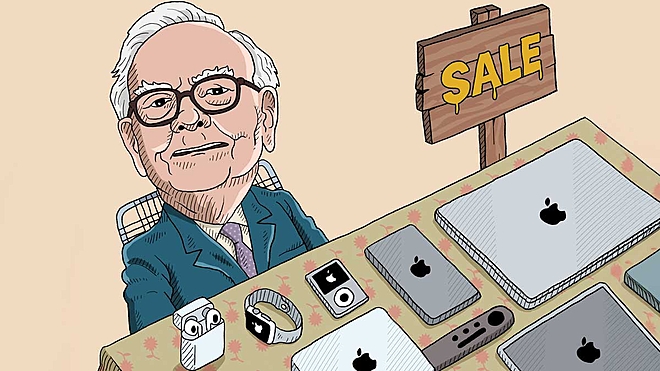
Here is a paradox. Warren Buffett called Apple ‘a better business than any we own.’ He praised Tim Cook as the manager who had made Berkshire more money than he himself ever had. Earlier this year, he reportedly said, “I sold it too soon.”
And yet, starting in 2024, Buffett sold. Aggressively. By late 2025, Berkshire had sold nearly three-quarters of the position. Even after that, Apple remained their largest holding, worth about Rs 5 lakh crore. The scale of that sell-down surprised many observers who had come to see Apple as a permanent fixture in the Berkshire portfolio.
So, why did the greatest investor of our time sell his best stock while openly acknowledging it was his ‘best stock’?
The answer is a skill that matters far more than stock picking: portfolio discipline. Buffett wasn’t selling because he had lost faith in the company or its products. He was selling because a single stock had grown to dominate his portfolio to an unhealthy degree. When one position accounts for over half your portfolio, you’re making a concentrated bet on a single company’s future, regardless of how confident you feel about that company. Even the most thoroughly researched conviction has limits. Even if that company is Apple.
This is a lesson most investors never learn, and it’s the one that costs them the most. We fall in love with our winners. A stock doubles, then triples, and we feel vindicated: “I bought Infosys in 2003” or “I’ve held Titan since the IPO.” Selling feels like betrayal. It feels like admitting a mistake, even when it isn’t one. The emotional pull of a stock that has rewarded you is surprisingly strong, and it works actively against rational decision-making at precisely the moment when clear thinking matters most. Buffett, to his credit, overcame that pull.
But here’s the thing. If a single stock makes up half your portfolio and it falls 40 per cent, your entire portfolio drops 20 per cent. That is a devastating loss from a single decision, or more often, a single act of inaction. Think about Yes Bank in 2020. Anyone who had let it grow to half their equity portfolio watched a single stock wipe out years of carefully accumulated gains. This is the asymmetry of risk that Buffett understood, and that most of us ignore until it’s too late.
Tim Cook’s departure from Apple this week brought this into sharp focus. A social media post argued that Cook took Apple from $350 billion to $4 trillion, yes, but in the same period, Microsoft grew 12 times, Google 20 times and Amazon 28 times. The post claimed Apple had every advantage in AI: Siri, user data, its own chips, and squandered them all.
Parts of that are unfair. Cook built Apple Services into a $100 billion business, an achievement that often goes underappreciated in the broader conversation about his legacy. But parts ring uncomfortably true. Apple had every advantage in AI and failed to capitalise on it in any meaningful way. The market barely flinched at Cook’s departure, which itself speaks volumes.
The lesson? Even a company led by one of the most competent operators in business history can miss a technological revolution. No business, regardless of its brand strength, loyal customer base or accumulated financial advantages, is immune to disruption. If that can happen to Apple, it can happen to any company in your portfolio.
This is exactly the discipline we’ve built into Value Research Stock Advisor. Our three portfolios, Long-term Growth, Aggressive Growth and Dividend Growth, aren’t just lists of good stocks. They’re carefully constructed frameworks, where position sizing, diversification and ongoing monitoring are integral to the design. No single stock is ever allowed to grow so large that its fortunes alone determine yours.
Every month, our research team thoroughly reviews each portfolio. We evaluate whether companies remain fundamentally sound and whether the portfolio’s overall risk profile has shifted in ways that require timely action. When changes are needed, we notify you immediately with clear, reasoned explanations so you always understand the thinking behind each decision.
You don’t have to fight the emotional battle of trimming a winner. You don’t have to worry about concentrated bets. We handle that, applying the same disciplined portfolio management that Buffett practised with Apple, except you don’t need to be Buffett to benefit from it.
Buffett loved Apple. He also sold most of it. That is not a contradiction; that’s discipline.
At Stock Advisor, we bring that discipline to your investments. At Rs 9,990 a year, it’s a small price for the peace of mind that comes from knowing your portfolio is being managed with the rigour that even the best investors struggle to maintain on their own.
The hardest part of investing isn’t finding great companies. It’s having the discipline to manage them properly once you’ve found them.
Subscribe to Stock Advisor today
Ask Value Research 

 New episodes every Friday











 New Process Alert
  Seems like you've uploaded a wrong QR code. Please upload the QR code downloaded from MF Central platform.


