




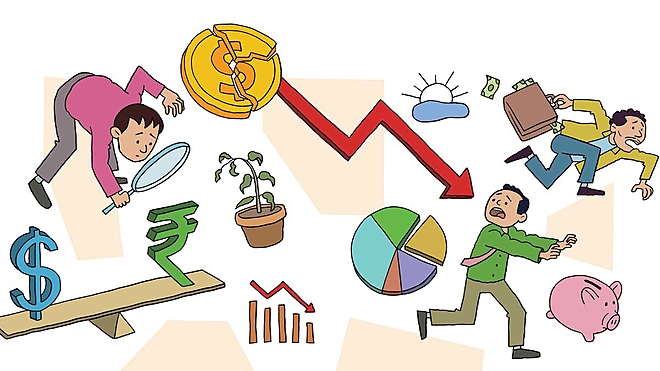
 Illustration: Anand Kumar
Summary: The dominance of the US dollar is being questioned, but not easily replaced. This piece explores what a shifting currency landscape means for Indian investors and how portfolios need to adapt.
Summary: The dominance of the US dollar is being questioned, but not easily replaced. This piece explores what a shifting currency landscape means for Indian investors and how portfolios need to adapt. The Indian rupee has depreciated significantly against the US dollar in recent weeks, even as the dollar itself has been under pressure against other currencies. In this era, as global politics shifts from a unipolar world to a more fragmented one, understanding the dollar’s future path can be of significant importance to portfolios. In this scenario, few books could be more timely for serious Indian investors than Kenneth Rogoff’s ‘Our Dollar, Your Problem: An Insider’s View of Seven Turbulent Decades of Global Finance, and the Road Ahead’. As the former Chief Economist of the International Monetary Fund and a professor at Harvard, Rogoff has spent his career documenting the ‘eight centuries of financial folly’ that led to market collapses. The book offers a sweeping analysis of the US dollar’s post-war ascent, and the gathering clouds that could reshape the global monetary order. The long walk to hegemony The dollar’s ascent begins in the aftermath of World War II, at the Bretton Woods Conference, where the United States emerged as the world’s pre-eminent economic power. With Europe and Japan devastated, the US accounted for roughly half of the global GDP and held the bulk of the world’s gold reserves. The Bretton Woods system institutionalised this dominance by pegging other currencies to the dollar, which, in turn, was convertible into gold. Even after Richard Nixon ended gold co
This article was originally published on May 01, 2026.

 New episodes every Friday










 New Process Alert
  Seems like you've uploaded a wrong QR code. Please upload the QR code downloaded from MF Central platform.


