




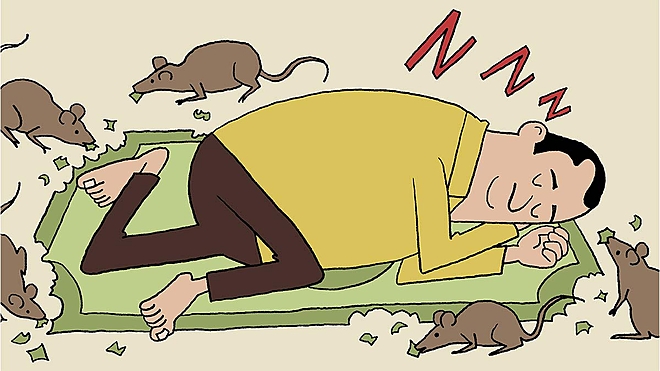
 Illustration: Anand Kumar


Summary: Markets can shift sentiment overnight, but opportunities don’t wait for reassurance. This piece explores how investor hesitation during uncertainty often leads to missed advantages. It highlights the subtle cost of waiting for clarity in investing decisions.
The Nifty 50 opened 3.5 per cent higher this morning (April 8, 2026). In the first 15 minutes of trade, the index added over 700 points. The trigger? A two-week ceasefire between the US and Iran, contingent on Iran reopening the Strait of Hormuz. Subsequently, Brent crude crashed 13 per cent overnight.
Television anchors smiled. Portfolio screens went green. The mood pivoted from dread to relief at a speed only financial markets can manage. But here is what no one on television is saying: the businesses rallying were the same ones that were available at steep discounts earlier. Their factories are producing the same goods. Their customers are placing the same orders. Their return on capital is exactly what it was seven days ago. Nothing has changed except the mood. And the mood, it turns out, was the only thing standing between investors and some exceptional prices.
The underlying reality of these businesses was never in question. The factories did not slow down. The order books did not shrink. The competitive positions of the stronger companies remained fully intact. What changed was simply how investors chose to feel about information they already had right in front of them.
‘Buy when there is fear’ has become so common that it is almost meaningless. Everyone quotes it. Almost no one does it. And the few who try often do it badly, buying whatever has fallen the most, as if the size of the decline were itself the investment thesis. It is not. Some stocks fall because the market is anxious. Others fall because the business is genuinely impaired. The discipline lies in separating the two. That is the real work, and it has nothing to do with courage. It requires research. It requires sitting with a balance sheet when the headlines are alarming and asking honestly whether the underlying numbers still make sense. Most investors find that task deeply uncomfortable, so they wait for someone else to confirm what the data is already quite clearly telling them.
Consider what the data was telling us before the ceasefire changed everyone’s feelings. The Nifty 50 P/E had dropped to around 20, below its five-year median of 22. The index had corrected roughly 15 per cent from its September 2024 peak of 26,277. Mid and small caps had fallen harder: 20 per cent to 35 per cent in many cases. Every one of these is a number that, historically, has preceded strong returns for patient investors. The businesses had not changed. Only the prices had.
This morning’s rally is the proof. The Nifty has already reclaimed a chunk of that discount in a single session. The investors who were waiting for clarity, for the geopolitical picture to settle, for comfort before committing capital, are now looking at higher prices for the same businesses they could have bought last week. This is how it always works. The comfort of consensus arrives only after the best prices have passed. Waiting for the world to feel safe is, and has always been, a reliable method of ensuring that you never buy anything cheaply.
Our cover story this month provides a framework for identifying quality businesses that were punished by a broad, indiscriminate correction. I would urge you to read it carefully. Use it as a starting point for your own analysis. Do not treat it as a final answer. Comfort is expensive. It always has been. The price of feeling good about a purchase is paying more. The investors who acted last week, when every headline screamed risk, bought the same businesses that everyone wants today. They just paid less.
Ask Value Research 


 New episodes every Friday









 New Process Alert
  Seems like you've uploaded a wrong QR code. Please upload the QR code downloaded from MF Central platform.


