




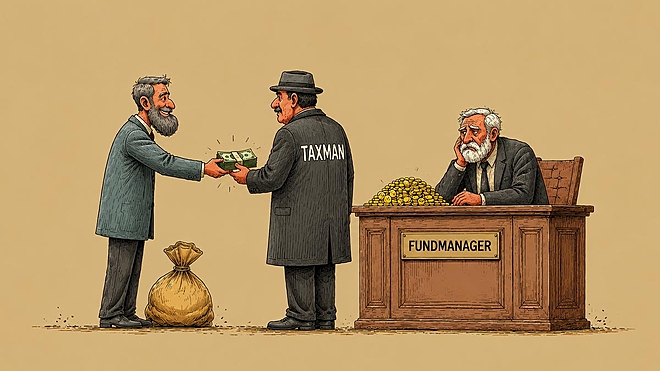
 Vinayak Pathak/AI-Generated Image

Summary: A financial decision many mutual fund investors quietly avoid is examined through real numbers, and the results may surprise those who have been sitting on the fence.
Many investors enter mutual funds the way most people enter swimming pools: with someone holding their hand. That someone is usually a distributor or advisor, and the vehicle is a regular mutual fund plan.
Years pass and financial literacy grows, until one fine day, the investor stumbles upon an uncomfortable truth: direct mutual fund plans, with their lower expense ratios, can deliver a meaningfully larger corpus over time than the regular plan they had invested in.
How? Regular plans pay a commission from the fund's assets each year. Direct plans don't. The annual gap seems modest, usually 0.5 to 1.25 per cent, but compound that over a couple of decades and it grows into a number worth noticing.
So why doesn't everyone switch? One word: tax.
The tax hurdle
Switching from a mutual fund’s regular plan to the direct one is not a quiet, behind-the-scenes way to flip from one to the other. You sell, you pay tax, you reinvest. Simply put, redeeming the units of your regular plan is a taxable event that you cannot avoid.
For equity funds, long-term gains above Rs 1.25 lakh are taxed at 12.5 per cent. For debt funds, gains get added to your income and taxed at your slab rate.
The internal monologue is predictable: Why hand the taxman a chunk of my gains today for a benefit I won't see for years?
Fair question. Let's put numbers to it.
Take an investor who started a monthly SIP of Rs 10,000 in an average flexi-cap fund in January 2016, through a regular plan. Here is where the investor stands today.
The cost of switching
What a 10-year SIP investor would face if they moved from regular to direct plans today
| Particulars | Amount (Rs) |
|---|---|
| Monthly SIP since January 2016 | 10,000 |
| Current corpus (May 12, 2026) | 23.2 lakh |
| Capital gains tax on switching | 1.2 lakh |
| Post-tax corpus reinvested in a direct plan | 22.0 lakh |
| Assumes a monthly SIP of Rs 10,000 starting January 2016 in an average flexi-cap fund through a regular plan. Capital gains tax includes both long-term and short-term gains. | |
The moment you switch, the portfolio drops by about Rs 1.2 lakh. That is the speed bump. The question is how long it takes the lower expense ratio of the direct plan to clear it.
When direct catches up, and by how much
Continuing with the same example, let’s now see how the portfolio could evolve over different time periods under two scenarios: staying in the regular plan versus switching to the direct plan, accounting for tax outgo.
From catch-up to lead
How direct plans gradually overcome the initial setback and pull ahead
| Time period | Staying with regular (Rs) | Switching to direct (Rs) |
|---|---|---|
| Starting corpus (May 12, 2026) | 23.2 lakh | 22.0 lakh |
| After 3 years | 37.8 lakh | 37.1 lakh |
| After 5 years | 50.9 lakh | 51.1 lakh |
| After 7 years | 67.7 lakh | 69.3 lakh |
| After 10 years | 1.0 crore | 1.1 crore |
| After 15 years | 2.0 crore | 2.2 crore |
| After 20 years | 3.7 crore | 4.3 crore |
| Corpus values at different time periods are based on the average five-year rolling returns of flexi-cap funds since the introduction of direct plans, assuming a monthly SIP of Rs 10,000. | ||
As seen from the above table, for the first three years, regular stays ahead. The tax has dug a hole that the lower expense ratio hasn't had time to fill.
By year five, direct catches up, ahead by a whisker.
Stretch the clock further and the gap becomes harder to ignore. Ten years: Rs 10 lakh ahead. Fifteen years: Rs 20 lakh. Twenty years: Rs 60 lakh, on a portfolio that started at Rs 23 lakh.
The tax is a one-off. The expense ratio gap shows up every year. Compounding eventually picks its winner.
Why staying in a regular plan makes sense for some
Switching isn't the answer for everyone.
If you are getting real advice for what you pay someone who built your asset allocation, who called you during a market crash and talked you out of something expensive, that relationship is worth the fee. Good advice tends to save more than it costs.
But if the relationship has shrunk to an annual statement and a festive greeting, you are paying for a service that quietly stopped showing up.
There is also a practical constraint. Some funds, particularly those investing abroad, have paused fresh inflows because of RBI limits. Since switching requires buying new units in the direct plan, the door may simply be shut. Here, staying put is less a choice and more a circumstance.
The bottom line
If your horizon is five years or longer and you are not getting much in return for the cost of a regular plan, the numbers point in one direction. The tax is a speed bump, not a wall.
What deserves more worry is the cost that keeps quietly leaving your portfolio every year you wait.
Also read: Going direct: The move that can save lakhs
Ask Value Research 

 New episodes every Friday









 New Process Alert
  Seems like you've uploaded a wrong QR code. Please upload the QR code downloaded from MF Central platform.


