 Widely read:




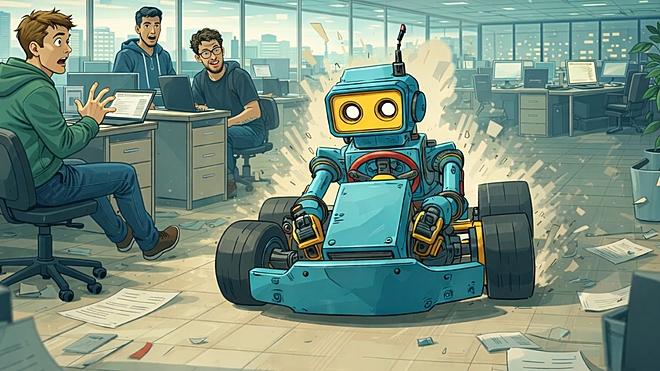 Aditya Roy/AI-Generated Image

Summary: AI is disrupting Indian IT. Or is it forcing its reinvention? With the BSE IT index down 21 per cent and earnings slowing, the market seems convinced the outsourcing model is broken. But is this structural decline or a painful transition phase? This piece unpacks what AI really means for Indian IT and what investors should watch next.
For years, Indian IT was seen as the market’s steady compounder. Today, it is the market’s question mark.
The BSE IT index has fallen 21 per cent over the past year, wiping out much of its earlier gains. Over three- and five-year periods, it has been the weakest-performing sectoral index. Even on a 10-year basis, returns now sit near the bottom, alongside FMCG and telecom, and well behind broader benchmarks.
Earnings reflect the same strain. In the latest quarter, listed IT companies reported a 5.6 per cent decline in profit before tax. On a trailing 12-month basis, profit growth has slowed to 3.9 per cent year-on-year, the weakest in two years. Growth guidance has been trimmed. Infosys is down 26 per cent over one year; TCS has fallen 31 per cent.
The market’s verdict is blunt: artificial intelligence may be structurally disrupting India’s IT services model.
Why the fear is understandable
For three decades, Indian IT thrived on a services-led outsourcing model built on scale, execution and labour arbitrage. Global clients outsourced development, testing, maintenance and integration. Revenue was tied closely to effort-based billing.
AI complicates that equation.
Generative AI tools can automate parts of coding, documentation and testing. Internal client teams are becoming more productive. Smaller projects that once required vendors can increasingly be handled in-house. Deal cycles have lengthened and discretionary tech spending has slowed.
If AI reduces the need for human-intensive coding, it strikes at the core of the traditional billing model. The concern, therefore, is not just cyclical weakness but structural compression.
It was against this backdrop that Infosys hosted a recent AI-focused summit to outline its strategy.
This is not just a productivity upgrade
Nandan Nilekani, co-founder and chairman of Infosys, framed AI as a “root and branch” transformation of enterprise operations, not merely an efficiency tool.
Unlike earlier waves of technology, such as the internet and cloud computing, AI builds on existing infrastructure—digitised enterprises, cloud computing and vast data pools. Adoption could therefore be faster and more disruptive.
Faster adoption means compressed cycles. Competitive advantages may shift more quickly than in past technology transitions.
But Nilekani’s more consequential point concerns enterprise readiness.
There is a widening gap between what AI systems can do and what companies can deploy at scale. Large enterprises operate on layered legacy systems, fragmented data and complex governance structures. AI cannot simply be plugged in.
In fact, AI forces modernisation. Data must be standardised. Technology stacks simplified. Workflows redesigned. Legacy systems re-architected.
If that holds true, the opportunity does not disappear. It shifts from pure coding to integration, orchestration and enterprise transformation.
Transition, not terminal decline
If AI were only about automating code, demand would shrink. But most global corporations must retrofit AI into decades-old systems. That process is complex and risk-sensitive.
Integration capability, domain knowledge and risk management—traditional strengths of large IT firms—remain relevant. Foundational systems will increasingly act as systems of record, with AI layers built on top. Designing and governing that architecture is not trivial.
The nature of work will evolve. Coding remains important, but AI governance, deployment engineering, cybersecurity and data management gain prominence. The key question is whether Indian IT firms can retrain talent and reposition offerings fast enough.
Security adds another layer. AI amplifies productivity but also risk. Enterprises will need stronger monitoring and governance frameworks as adoption deepens.
The balance between efficiency-led compression and transformation-led expansion will determine revenue trajectories.
What investors should watch
The earnings slowdown is real. So is the structural shift.
AI will alter Indian IT. The traditional labour-arbitrage model faces pressure. But adjacent opportunities—AI integration, enterprise modernisation, cybersecurity and data management—could expand.
Three variables matter.
- First, how quickly companies pivot towards AI-led transformation.
- Second, how effectively they retrain talent and protect margins.
- Third, how client spending evolves as enterprises move from experimentation to scaled deployment.
The sector today sits in the gap between technological capability and institutional readiness. If adaptation lags, disruption dominates. If deployment complexity sustains demand for integration expertise, reinvention is possible.
The next decade for Indian IT will depend not on whether AI grows more powerful, but on how effectively companies evolve alongside it.
Want to know which IT stocks can adapt, not just survive, in the AI era?
Value Research Stock Advisor helps you cut through the noise, identify fundamentally strong businesses and avoid structural losers before the damage shows up in the numbers.
Invest with clarity, not headlines.
Also read: The million bug reports that AI can't match
Ask Value Research 

 New episodes every Friday












 New Process Alert
  Seems like you've uploaded a wrong QR code. Please upload the QR code downloaded from MF Central platform.


