




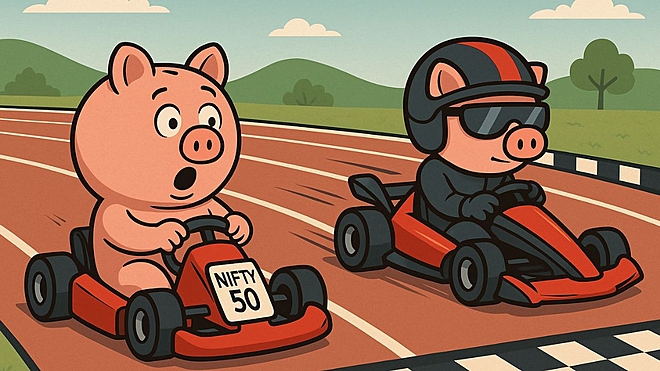
 Aditya Roy/AI-Generated Image

Summary: This analysis dives into what’s driving the Nifty 50 Equal Weight Index’s recent outperformance, how it has held up across market cycles, and what that means for investors considering this index.
Over the last few months, multiple reports from top brokerages and global research houses have started singing from the same hymn sheet: large caps are back in favour.
Naturally, retail investors are paying attention. too. But if you’re looking at large caps, there’s one index that’s quietly been doing even better than the Nifty 50, the Nifty 50 Equal Weight (EW) Index.
And not just by a small margin.
In the past five years, here’s how they stack up:
- Nifty 50 TRI: 18.4 per cent
- Nifty 50 Equal Weight TRI: 24.3 per cent
That’s a handsome 5.9 per cent annualised edge in favour of the equal-weight index. But before you rush to move your money, let’s unpack what this index really is and whether it deserves a place in your portfolio.
What exactly is the Nifty 50 Equal Weight Index?
Think of the Nifty 50 TRI is home to the 50 largest listed companies in the country. It’s a market-cap weighted index, meaning the larger the company, the higher the representation the company has in the index. Simply put, companies like Reliance Industries, HDFC Bank and Infosys have a much bigger say in performance than smaller constituents like Divi’s Labs or Wipro.
The Nifty 50 Equal Weight Index, on the other hand, treats everyone the same. Each of the 50 companies gets an equal 2 per cent weight.
To maintain this balance, the index automatically buys more of the underperformers and sells some of the outperformers during each rebalancing. In other words, it follows a built-in ‘buy low, sell high’ approach, the kind of disciplined rebalancing most investors wish they had the patience for.
This structure is what has allowed the Nifty 50 EW TRI to shine in certain periods, especially when smaller or mid-sized large caps have outperformed the giants.
How consistent has the performance been?
To measure consistency, we use rolling returns. Instead of just checking performance over one fixed five-year period, rolling returns look at every possible five-year window, showing whether an index performs well regularly or only shines occasionally.
The average five-year returns of 1,231 dates between October 26, 2020, and October 24, 2025, are:
- Nifty 50 TRI: 15.6 per cent
- Nifty 50 EW TRI: 16.6 per cent
That’s another point in favour of the equal-weight index. But dig deeper, and the picture changes a bit.
The Nifty 50 EW TRI’s dominance really began after May 2023. From then until October 2025, its five-year rolling returns beat the benchmark in nearly every instance, underperforming only twice.
However, looking at the full five-year dataset, the EW index beat the Nifty 50 TRI just 49 per cent of the time, almost a coin toss.
So while recent returns look impressive, most of the outperformance is a recent phenomenon, not a long-standing trend.
Why has the Equal Weight Index outperformed recently?
The answer lies in market leadership and rotation.
During 2018–2022, a handful of heavyweight stocks — Reliance, HDFC Bank, Infosys, TCS — drove most of the Nifty 50’s returns. Smaller large-cap names lagged behind.
But the script turned around after that. Broader participation returned, and mid-sized large caps — think Larsen & Toubro, Coal India and Power Grid — also took part in the growth of the large-cap index.
Since the equal-weight index gives each company the same importance, it benefited more from this broad-based rally.
The longer-term picture
Since the five-year performance was a tale of two halves, we decided to stretch the time horizon so that we got a clearer picture.
On a 10-year rolling return basis, here’s what we see:
- Nifty 50 TRI: 11.9 per cent
- Nifty 50 EW TRI: 11.4 per cent
And over this period, the Nifty 50 TRI outperformed its equal-weight index 54 per cent of the time.
So while the equal-weight index has enjoyed a purple patch recently, the long-term consistency still tilts slightly in favour of the regular Nifty 50.
We also looked at how each of the indices handled volatility in the last 10 years, since this is another crucial piece of the puzzle.
During big market falls, the Nifty 50 TRI has proven to be steadier:
- 2008 Global Financial Crisis: -44.8 per cent vs -47.1 per cent fall by the EW index
- 2020 Covid crash: -28.6 per cent vs -28.9 per cent (EW)
- September 2024–February 2025 correction: -15.3 per cent vs -17.7 per cent (EW)
Even statistically, this shows up in their volatility numbers.
Between 2005 and 2025, the Nifty 50 TRI’s standard deviation (a measure of how much returns fluctuate) was 2.3 per cent, compared to the Equal Weight Index’s 2.7 per cent.
In simple terms, the EW index’s returns have bounced around more, with higher highs, but also deeper lows.
So, is Nifty Equal Weight a smart buy?
It depends on what kind of investor you are.
If you like the idea of disciplined rebalancing and are comfortable with slightly higher volatility, the Nifty 50 Equal Weight can be a smart tactical play, especially when broader markets, not just a few big names, are driving growth.
But if you prefer a steadier, lower-risk option for the long haul, the Nifty 50 TRI still remains the more reliable choice.
Over the long run, the plain Nifty 50 has shown greater consistency, smoother performance, and smaller drawdowns, all of which make it a better core holding in most portfolios.
This article was originally published on October 28, 2025.
Ask Value Research 











 New Process Alert
  Seems like you've uploaded a wrong QR code. Please upload the QR code downloaded from MF Central platform.


