




 Yogesh Sharma/AI-generated image
Summary: PSU funds have returned to the spotlight, and investors suddenly have several index options to choose from. But are these products really as different as they appear? This story looks beyond the names to uncover what you may actually be buying.
PSU stocks have made a dramatic comeback. After spending much of the last decade disappointing investors, they have become some of the market’s biggest winners since 2021. Unsurprisingly, investors wanting to ride the theme are returning to PSU funds and ETFs.
They have four broad passive indices: Nifty CPSE, Bharat 22, Nifty PSE and BSE PSU. At first glance, they might look different. One holds just 11 companies while another owns 60. Some track central public sector enterprises, others cast a wider net. Look closer, though, and the differences begin to shrink.
Different labels, many of the same themes
The four indices do differ sharply in breadth and concentration. Nifty CPSE is the narrowest and most concentrated: its top five holdings account for 86.6 per cent of the index, and almost two-thirds of the portfolio sits in energy and utilities alone. BSE PSU is much broader, with 60 stocks and a more balanced sector mix, while Bharat 22 and Nifty PSE sit somewhere in between.

Yet all four lean heavily on the same sectors: energy, utilities and industrials. Only BSE Bharat 22 and BSE PSU carry meaningful exposure to financials.
Bharat 22 is the one real exception, because it is not a pure PSU index at all. Alongside public-sector companies, it also owns three private-sector names: Axis Bank, ITC and Larsen & Toubro.
They entered the index because they are part of the government’s SUUTI holdings, a legacy portfolio inherited from the old Unit Trust of India. Together, these accounted for 36.8 per cent of the index in May 2026. An investor buying Bharat 22 as a clean PSU play is buying a sizeable slug of these private companies alongside it.
They are more alike than they look
To see how different these portfolios really are, we compared their holdings at six-month intervals between May 2024 and May 2026. The overlap ranged from nearly 35 per cent to nearly 60 per cent. In other words, whichever door you walk through, you end up owning many of the same companies.
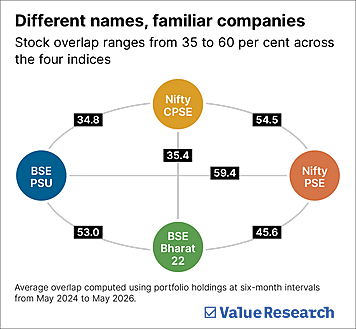
Index construction rules and stock weights still matter, but the choice between these four products is a narrower one than the different names suggest.
The allure of recent returns
On trailing five-year returns (as of July 8, 2026), the four PSU indices delivered annualised returns of roughly 20 to 26.5 per cent, with Nifty CPSE leading the pack. The broader Nifty 500 returned 11.2 per cent a year over the same period. The outperformance looks extraordinary, but there is a catch: almost all of it lacks a longer record.
PSU stocks spent much of the period before 2021 lagging the broader market. Their fortunes changed only after 2020, when a combination of rock-bottom starting valuations, rising government capital expenditure, improving balance sheets, and optimism around disinvestment triggered a sharp re-rating across the sector.
The result was one of the strongest thematic runs of the past decade.
The question for investors is whether this represents a lasting change in the economics of PSU businesses, or another powerful phase in a cycle that has historically been marked by long periods of underperformance followed by shorter bursts of exceptional returns.
Lacklustre long-term record
Looking at five-year rolling returns from 2011 to 2026 tells a different story. Unlike the Nifty 500, which rarely posted a negative five-year return, PSU indices spent a meaningful amount of time in negative territory. The average annualised five-year return was 11.5 per cent for the Nifty 500, against 8.1 per cent for Nifty CPSE, 5.7 per cent for Nifty PSE and 4.7 per cent for BSE PSU.
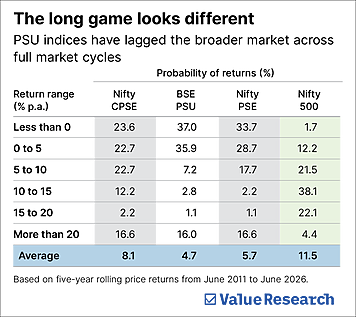
The way returns cluster together is just as telling. The Nifty 500 spent most of its time delivering annualised returns between 10 and 20 per cent, a steady middle band the PSU indices rarely occupied. Their returns swung instead between long periods of disappointment and shorter bursts of exceptional performance. That polarisation is the nature of the theme itself.
Should you own a PSU index fund?
There is nothing wrong with investing in PSUs if you hold a strong view on the theme. But their characteristics: government ownership, policy-driven decisions, a standing disinvestment overhang and heavy exposure to cyclical sectors make their returns far more volatile than those of a diversified equity fund. The recent performance has been exceptional, but the longer history has been far less forgiving.
That argues for treating the PSU theme as no more than a satellite holding around a core of broad, diversified funds, never the centre of your portfolio. And if you do decide to buy in, the overlap data carries its own lesson: there is little point in owning more than one of these indices, since you would mostly be buying the same companies twice.
This article was originally published on July 20, 2026.
Ask Value Research 












 New Process Alert
  Seems like you've uploaded a wrong QR code. Please upload the QR code downloaded from MF Central platform.


