




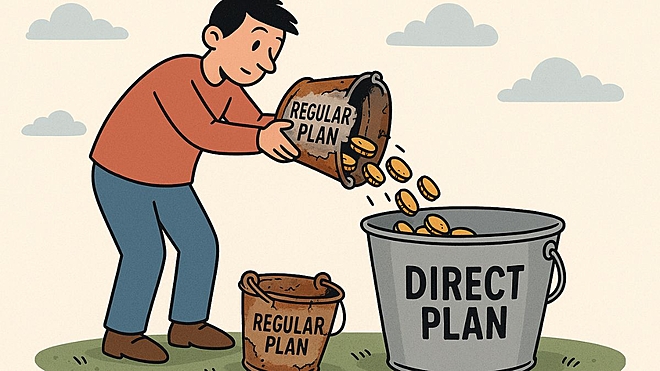
 Aditya Roy/AI-Generated Image
Summary: Investing in a fund’s regular plan can quietly eat into your returns. The good news? You can switch to its direct plan and keep more money working for you. Here’s how.
Aniket, 32, already knew the bitter truth. By investing in the regular plan of his flexi-cap fund instead of the cheaper direct plan, he had lost Rs 1.7 lakh over the years.
That figure stung.
Aniket was quite dejected. He felt that all his money and discipline had been wasted. However, his friend, Aman, assured him that not all was lost.
“Yes, you’ve lost some money because of a higher expense ratio, but there is still hope. You can move from the regular plan of your fund to its direct one and save going forward,” Aman said.
Aniket seemed hesitant, “Isn’t that complicated? Won’t I end up paying capital gains tax or trigger penalties?”
Aman smiled, “Yes, you will need to pay some tax, but the benefits of switching far outweigh the short-term costs.”
Making the move
Aman reassured Aniket that the process of moving from his existing fund’s regular to direct plan wasn’t as complicated as he had made it out to be.
“So, how do I shift from my fund’s regular plan to the direct plan? Will it take a lot of time? ”
Aman replied, “There are two ways by which you can move from the regular plan to the direct plan of your fund. Pick what is most convenient for you.”
#1 Withdraw and reinvest
One way to shift from the regular plan to the direct plan of your fund is by cancelling your SIPs in the regular plan, redeeming all the units and then reinvesting the entire amount in the direct plan.
Aniket frowns, “So I just pull out everything and put it back in again?”
“Yes,” Aman nods. “However, before doing so, keep in mind the capital gains tax you will incur.”
“How do I calculate that?” Aniket asked.
“If you have been holding the mutual fund units for over a year, you will need to pay a long-term capital gains tax (LTCG) of 12.5 per cent for gains exceeding Rs 1.25 lakh annually.
And if the units have been held for less than a year, a short-term capital gains tax (STCG) of 20 per cent will be applicable.”
#2 Use the switch option
The second route is to use the ‘switch’ feature, either through a broker’s platform or directly with the fund house (AMC).
Here’s how it works:
- First, the money from the regular plan is redeemed and credited to the bank account.
- Within 2-3 business days, the broker or AMC invests this amount into the direct plan of the same fund. However, not all AMCs provide this option. Hence, if you plan to make the switch through the fund house, don’t forget to check whether it offers this option.
“Sounds better than pulling all the money out myself,” Aniket says.
“Yes,” Aman replies, “it saves you the manual effort. But remember, the tax treatment remains the same as with the redemption option .”
Don’t overlook the exit load
Before switching to your fund’s direct plan, ensure you check its exit load.
“Now, what is an exit load?” Aniket quipped.
“It is a fee that funds charge when an investor makes either a complete or partial redemption of their investments in the initial days. An exit load can be considered a small penalty for redeeming your investments early, typically before a week or 10 days. Hence, it’s best to wait until that period ends before switching,” Aman replied.
The takeaway
Aniket’s case isn’t rare. Investors often stick with regular plans without realising the quiet drag on their returns. The good news is that moving to a direct plan isn’t as daunting as it sounds. With a little planning, factoring in capital gains tax, exit loads and the timing of your move, the long-term benefits of lower costs far outweigh the short-term hassle.
That said, direct plans are best suited for DIY investors who are comfortable selecting and monitoring funds on their own. If you’d rather rely on professional hand-holding, regular plans are ideal, since advisors and distributors manage the investments for you.
So, if you find yourself in Aniket’s shoes, remember, you can still make the switch. And every year you delay, you’re leaving money on the table.
Continue reading Value Research Online for more such insights.
Also read: Do 'direct' mutual funds build more wealth than 'regular' ones?
This article was originally published on August 25, 2025.
Ask Value Research 

 New episodes every Friday








 New Process Alert
  Seems like you've uploaded a wrong QR code. Please upload the QR code downloaded from MF Central platform.


