




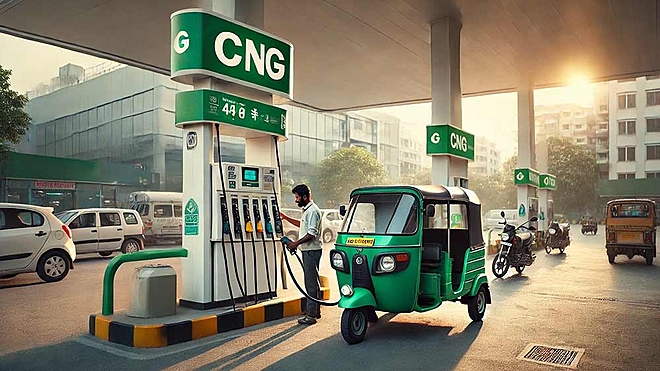
 AI-generated image

Indraprastha Gas (IGL) has been in the market ire for many years. Government-led regulatory changes are primarily to be blamed. And recently, the government cut its subsidised gas allocation to city gas distributors by another 20 per cent, the second time this year. What this means is that IGL, which gets a part of its gas supply from the government at lower prices, will now have to fill the gap by importing costlier liquefied natural gas (LNG). This will raise costs and shrink margins.
The stock, consequently, has extended losses and has lost 44 per cent from its September high. The market action seems overdone. IGL, despite these setbacks, remains a solid player that has grown its profit after tax by 17 per cent every year from FY19 to FY24. Even if you completely strip the company of its low-priced government supply, it remains in a comfortable spot. We have assessed this below.
What happens in the worst-case scenario?
Let's assume the worst. That the government completely ends its subsidised supply to IGL. Since it gets 33 per cent of its gas requirements met from the government's low-priced supply, the company would have to replace this with twice as expensive market-priced LNG (regassified LNG as it is known in the market) at $13 per MMBtu. The impact will be that retail CNG prices will increase from Rs 75.09 a kg to around Rs 100 a kg (if IGL passes on the cost increase).
This increase should ideally reduce CNG's appeal against auto fuels like petrol and diesel, impacting demand and IGL's business. But in practice, CNG would still remain the more economical option. Here's the math:
At Rs 100 per kg, the cost per km for a CNG vehicle (at an average mileage of 25 km per kg) would rise to Rs 4, still 24 per cent cheaper than petrol, which costs Rs 5.26 per (at an average mileage of 18 km a litre). CNG will, thus, maintain its cost advantage even after a substantial increase in IGL's input costs, keeping it a viable choice for consumers and sustaining demand.
The impact of the reduced subsidised supply is likely to be immaterial. Besides, the company has many growth levers in place that investors have overlooked, while only focussing on the regulatory snags.
IGL has a lot going for it
1. Resilient CNG growth: IGL's CNG sales are on a solid growth spree, driven by the auto industry, making up 75 per cent of its total revenue. The penetration of CNG vehicles as a percentage of total vehicles has been on a rise, growing from 4.2 per cent in FY24 to nearing 5 per cent so far in FY25. The trend will continue to play out as major auto makers like Maruti Suzuki, Hyundai, and Tata Motors are expanding their CNG offerings.
2. The PNG opportunity: Over 5.5 million LPG cylinder connections in Delhi households can be replaced by IGL's piped natural gas (PNG) connections. Its PNG segment contributes 25 per cent to total revenue. The government's push for a shift from LPG cylinders to PNG is helping improve the growth prospects. IGL's PNG connections currently stand at 2.7 million.
3. Securing more markets: IGL's Rs 1,700 crore capex for FY25 is focused on securing supply agreements in underpenetrated markets of Haryana, Rajasthan, and Uttar Pradesh. These regions offer untapped demand, with planned CNG stations and expanded pipeline networks ensuring long-term growth and diversification for the company. It currently dominates the Delhi region where 70 per cent of the business is concentrated.
Your takeaway
The hammering of the stock has brought its valuations to multiyear lows. At a P/E of just 14 times, it's way below the 10-year median P/E of 23 times. Add to this the strong financials and large room for growth and IGL makes a solid investment case. The company boasts ROEs exceeding 20 per cent, a healthy balance sheet with minimal debt, and consistent free cash flow that comfortably funds its expansion. IGL also rewards investors with high dividends (yields of up to 2.8 per cent), demonstrating its profit-generation prowess.
Importantly, it enjoys a unique moat that promises long-term growth. IGL's supply agreements that are awarded by the government promise it exclusive supply rights of 15 to 20 years across all locations. This cements its market dominance and the company virtually enjoys free rein in its geographies.
The only tangible risk to bear in mind is the government's increasing push for electric vehicles, which could impact CNG demand over time. But it will take a quick and substantial leap in EV penetration to materially impact IGL—something that remains a distant dream.
Disclaimer: This is not a stock recommendation. Investors must do their own research before making an investment decision.
Also read: Auto sales in slow lane. Can companies steer a turnaround in H2 FY25?
Ask Value Research 

 New episodes every Friday













 New Process Alert
  Seems like you've uploaded a wrong QR code. Please upload the QR code downloaded from MF Central platform.


