




 Anand Kumar/AI-Generated Image

Summary: Profit tells you what a company earned, but not how much cash its operations actually generated. The cash conversion cycle connects the two by showing how long money remains tied up in inventory and receivables after accounting for supplier credit.
Two companies can report identical profits yet require different amounts of capital to support the same level of business.
Does the difference in capital arise due to margins? No. It comes down to the number of days cash stays tied up between paying for raw materials and collecting payment from the customer who buys the finished product.
This gap is called ‘cash conversion cycle’ or CCC. And the formula to calculate is quite simple:
CCC = Inventory days + Receivable days - Payable days
Following the rupee
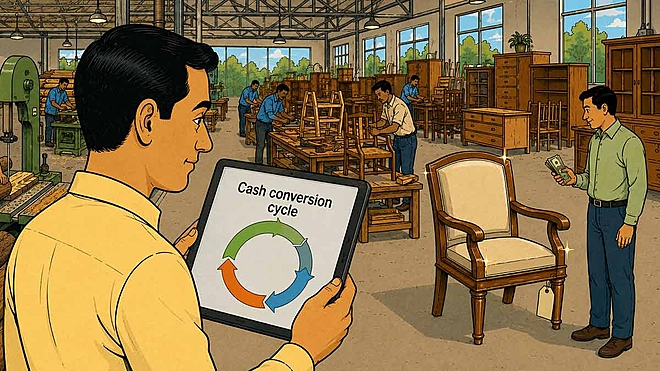
To understand cash conversion cycle better, let’s take the example of a mid-sized furniture maker. To make things easier, let’s call it ‘Furniture Mart’.
Assume that Furniture Mart sells dining tables worth Rs 30 lakh every month or Rs 1 lakh a day. The cost of the timber, hardware and labour behind each table, or its cost of goods sold, runs at 60 per cent of the selling price, or Rs 60,000 a day. It takes Furniture Mart 45 days to turn raw timber into a finished, sellable table (inventory days). It sells mostly to retail showrooms, who take 60 days to pay after the table leaves the factory (receivable days). It pays its own timber and hardware suppliers within 25 days of delivery (payable days).
Therefore, its cash conversion cycle will be:
CCC = 45 + 60 minus 25 = 80 days.
Inventory of Rs 27 lakh (45 days of Rs 60,000 a day in costs) and receivables of Rs 60 lakh (60 days of Rs 1 lakh a day in sales), less payables of Rs 15 lakh (25 days of Rs 60,000 a day in costs), leaves Furniture Mart with Rs 72 lakh of net operating working capital, the capital tied up in its operating cycle. That capital is not itself an expense in the profit and loss account. It sits on the balance sheet until the table is sold and the showroom pays up.
Now move the numbers in either direction and watch what happens to the business, without a single change to sales, margin or the reported P&L (profit and loss).
If the showrooms start demanding 90 days of credit instead of 60, because a competitor is offering easier terms, Furniture Mart's cycle stretches to 45 + 90 minus 25, or 110 days. Because receivables scale with the full selling price, the extra 30 days adds a full Rs 30 lakh to the capital tied up, taking it to Rs 1.02 crore.
If instead Furniture Mart negotiates better terms from its own timber supplier, stretching payable days from 25 to 55, its cycle shrinks to 50 days. Because payables scale with cost, not the selling price, the same 30-day move frees up only Rs 18 lakh, not Rs 30 lakh, taking capital tied up down to Rs 54 lakh. A day of extra credit from a customer costs a business more than a day of extra credit to a supplier is worth, because the customer is paying on the full price and the supplier is only owed the cost.
Reported profit tells you what a business earned. Cash flow tells you how much cash its operations generated. The cash conversion cycle is one of the key bridges between the two. A business whose cycle is sustainably falling generates cash faster than its profit and loss account lets on, funding dividends, debt repayment or expansion without needing outside help.
Real companies, same arithmetic
The mechanics above play out, at very different magnitudes, in listed companies. Three FY26 filings, from a toothpaste maker, a retail chain and a defence electronics manufacturer, sit at three different points on the same spectrum.
Cash conversion cycle, FY26
| Company | Sector | Inventory days | Receivable days | Payable days | Cash conversion cycle |
|---|---|---|---|---|---|
| Colgate-Palmolive | FMCG | 22.6 | 13.1 | 229.2 | -193.5 |
| Avenue Supermarts | Retailing | 26.8 | 0.7 | 7.5 | 20.1 |
| Bharat Electronics | Capital Goods | 127.5 | 145.4 | 90 | 182.9 |
Cash conversion cycle, FY22 to FY26 (days)
| Company | FY22 | FY23 | FY24 | FY25 | FY26 |
|---|---|---|---|---|---|
| Colgate-Palmolive | -130.8 | -118.6 | -143.5 | -148.9 | -193.5 |
| Avenue Supermarts | 19.4 | 16.9 | 16.8 | 18.5 | 20.1 |
| Bharat Electronics | 138.4 | 134.7 | 133.6 | 148.5 | 182.9 |
Colgate’s cash conversion cycle sits at minus 193.5 days. Its version of the corner showroom pays it in under two weeks, and its own suppliers wait close to eight months to be paid. The cycle has not just stayed negative; it has widened further, from minus 130.8 days in FY22 to minus 193.5 days in FY26.
Avenue Supermarts, which runs the D-Mart chain, sits far from Colgate in direction but not in health. Its FY26 cycle of 20.1 days has barely moved in five years, staying in a tight band. The stability is reassuring because it suggests D-Mart has maintained broadly consistent working capital economics even as the business has scaled.
Bharat Electronics is the one worth paying attention to. Its FY26 cycle of 182.9 days looks unremarkable for a defence electronics manufacturer building to long government specifications, but the direction is the story. The cycle stood at 138.4 days in FY22 and has widened for most of the years since, touching 182.9 days in FY26. Reported profit has climbed steadily through this window, but cash generated from operations has not kept pace.
The bottom line
A cash conversion cycle number is only useful once it is read as a capital requirement, not a trivia statistic, and even then it is a diagnostic, not a verdict. What moves a company's cash flow isn't the level of its CCC so much as the direction it's heading in, and how fast the underlying business is growing while it gets there.
A rising CCC that funds a high-return business is a very different story from one that funds a mediocre one. A low or negative CCC is not automatically good, and a high or rising one is not automatically bad; what matters is the capital a business needs to grow, whether that need is rising or falling, and what it earns on every additional rupee of it.
Also read: When 'cash rich' isn't 'rich': 5 companies show why
Ask Value Research 
 New episodes every Friday











 New Process Alert
  Seems like you've uploaded a wrong QR code. Please upload the QR code downloaded from MF Central platform.


