




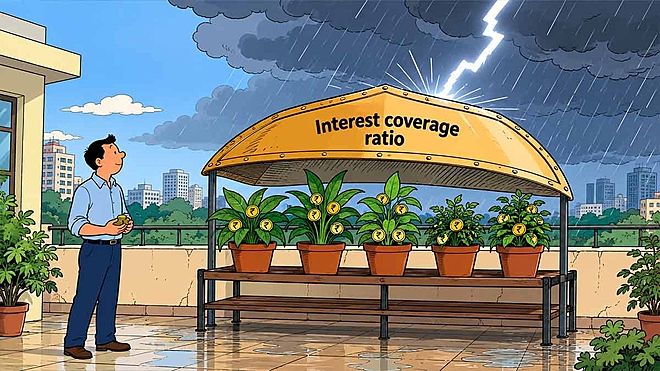
 Anand Kumar/AI-Generated Image

Summary: Interest coverage can reveal whether a company is becoming better at keeping its profits away from lenders. This screen highlights five companies where the ratio improved sharply and examines how the change came by.
While looking at a company’s income (profit and loss) statement, most of us zoom into its profit. However, there are times when the most interesting change happens one line below operating profit.
Let’s take the example of a company earning Rs 100 crore before interest and taxes (EBIT), and paying Rs 80 crore from it to lenders. A modest downturn could make its balance sheet uncomfortable.
Three years later, EBIT has doubled to Rs 200 crore while interest has fallen to Rs 20 crore. The amount left after paying lenders has grown from Rs 20 crore to Rs 180 crore, far more than profit alone.
For our screen, interest coverage is EBIT excluding other income (but not including any exceptional gain or loss), divided by interest expense, since treasury gains and one-off income say little about whether core operations are getting better at servicing debt.
We excluded banks and NBFCs, where interest is an operating input rather than a financing cost, and dropped one company whose coverage was already extreme: doubling from 30 times to 60 means far less than moving from one time to five.
5 companies where interest coverage improved the most
A sharp rise in interest coverage can come from better operations, lower borrowing costs or both
| Company | FY23 interest coverage ratio (times) | FY26 interest coverage ratio (times) | 5Y revenue CAGR (%) | 5Y PAT CAGR (%) | Stock Rating |
|---|---|---|---|---|---|
| Inox Green Energy | -0.01 | 2.44 | 10 | 21 | 2 |
| GE Vernova T&D | 0.83 | 106.69 | 12 | 86 | 3 |
| Force Motors | 4.35 | 432.02 | 35 | 66 | 3 |
| Chambal Fertilisers | 4.72 | 342.07 | 10 | 6 | 4 |
| Shilpa Medicare | 0.12 | 5.56 | 11 | 18 | 2 |
Note: This is not a list of stocks to buy. An improving ratio can come from many things. The interesting question is not how much it improved, but why.
Inox Green: The turnaround that wasn’t
In FY23, Inox Green's EBITDA was around Rs 57 crore, but Rs 65 crore of depreciation pushed EBIT negative even before Rs 71 crore of interest expense. By FY26, depreciation had fallen to Rs 2 crore and interest to Rs 9 crore; EBIT turned positive at Rs 21 crore, and coverage moved from negative to just above two times.
That looks like an operating turnaround. It isn't.
Revenue rose only from Rs 254 crore to Rs 281 crore, and operating profit before depreciation fell, from Rs 57 crore to Rs 23 crore, as margins dropped from 23 to 8 per cent.
What changed were the costs between EBITDA and profit before tax: the company demerged its evacuation-infrastructure business, removing roughly Rs 1,000 crore of gross block and Rs 50-55 crore of annual depreciation, with finance costs now expected to stay negligible. Other income also jumped, from Rs 40 crore to Rs 144 crore; letting that into EBIT would have made the improvement look far stronger than it deserves.
Inox Green's coverage is genuinely better, but it reflects a lighter balance sheet, not a more profitable business. Whether the surviving operations business can grow earnings fast enough to justify that cleaner structure is the open question the ratio cannot answer.
Force Motors: Both sides improve together
In FY23, Force earned Rs 313 crore of EBITDA on Rs 5,029 crore of revenue; after Rs 241 crore of depreciation, EBIT was Rs 72 crore against Rs 68 crore of interest, barely one-time covered. By FY26, revenue had climbed to Rs 9,057 crore and operating profit to Rs 1,483 crore; depreciation grew slowly to Rs 286 crore, EBIT reached roughly Rs 1,197 crore, and interest collapsed to Rs 3 crore.
At that point the multiple itself stops being useful; it runs into the hundreds. What matters is that interest stopped being a material claim on profit at all.
This was not an accounting effect: operating margin rose from 6 to 16 per cent, helped by better operating leverage and 20 per cent domestic wholesale growth. Borrowings fell from Rs 955 crore to nil, operating cash flow rose from Rs 532 crore to Rs 1,297 crore, and higher sales lifted margins, margins lifted EBIT, and stronger cash flow retired the debt that had been eating the profit.
The catch is that this benefit cannot repeat. Interest is already near zero. The question changes from “Can Force service its debt?” to “Can it hold the margins and growth that let it erase the debt?”
Chambal Fertilisers: The denominator does the work
Chambal's operating profit before depreciation rose from Rs 1,822 crore to Rs 2,694 crore. EBIT excluding other income rose from Rs 1,514 crore to Rs 2,345 crore, up 55 per cent. Respectable.
It is not what caused coverage to explode. Interest fell from Rs 320 crore to Rs 7 crore, a drop of nearly 98 per cent, taking coverage from below five times to several hundred. An industry report noted that Chambal prepaid its entire Gadepan-III term debt by March 2026, helped by strong cash accruals and timely subsidy receipts, leaving a net cash surplus of Rs 1,439 crore at December 2025.
A reader who saw only the ratio might assume operating earnings rose dozens of times over; they rose by half. The extraordinary change came from the financing side, and fertiliser companies with large subsidy receivables can see debt fall this way without the core business growing at the same pace. Borrowings, after nearly vanishing in FY25, stood at Rs 1,068 crore by March 2026, a reminder that the Rs 7 crore interest bill may not be permanent.
What this means for you
Interest coverage is usually read as a measure of solvency. Used dynamically, it reveals something more interesting: a shift in who gets to keep the economics of a business. As EBIT rises and debt falls, less of every incremental rupee goes to lenders, and more is left for shareholders and reinvestment.
The screen tells you where something changed. Whether that change is repeatable, whether the business is genuinely better, and whether the price already reflects it, is where screening ends and investing begins.
Also read: When 'cash rich' isn't 'rich': 5 companies show why
Ask Value Research 

 New episodes every Friday












 New Process Alert
  Seems like you've uploaded a wrong QR code. Please upload the QR code downloaded from MF Central platform.


