





A 'conglomerate' is much like a messy suitcase. It gets into multiple businesses, all unrelated to each other significantly. A great example? Reliance Industries - housing businesses all the way from retail to telecom.
However, despite their diversity, these businesses pose some significant challenges for management, market analysts as well as investors.
For management
They are difficult to run because each of these businesses has its unique demand factors in terms of resources, skills, and managerial expertise. Yet, all of them operate under the same roof.
For analysts
They are equally challenging to understand, analyse and evaluate, often resulting in their overall undervaluation. Because of their complexity, they may be perceived as lacking transparency. Also, different businesses perform differently, and some may be profitable while others struggle.
In other words, the conglomerate's overall financial performance may not accurately reflect the strong performance of individual businesses, again leading to undervaluation.
Diversified conglomerates may also struggle to allocate resources efficiently, diluting the potential for focused growth. As a result, the best-performing segment may not get sufficient capital or attention.
For investors
As a result of the business being a conglomerate, investors may have to take exposure to unrelated businesses they are not interested in. So, it may be difficult for an investor to determine whether they should invest in such businesses or not. This situation leads to the parent company trading at a discount and being unable to command true valuation.
How do conglomerates tackle this?
Sometimes, conglomerates use demerger as a strategic move to tackle this discount and unlock the real value of the business. They spin off a unit to form an independent entity. It allows the demerged business entity to benefit from focused capital allocation and efficient decision-making.
Such a move is generally well-received by investors, as it provides them with an opportunity to exit from specific segments and facilitates a more granular analysis of the demerged entity.
There have been many such examples in the past. For instance, currently, ITC is undertaking a demerger of its hotel division. Let's explore other famous demergers that have completely changed the fortunes of companies.
Case 1
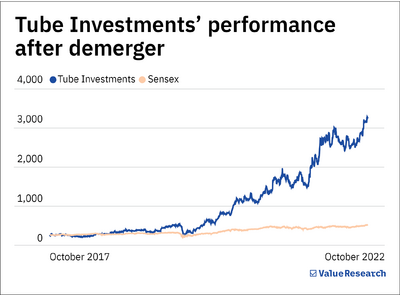
Tube Investment India
In 2017, TII Financial Holdings of the Murugappa group went through a demerger, resulting in two entities -Tube Investments and Cholamandalam Financial Holdings. The former would continue with manufacturing operations and would hold a stake in non-financial subsidiaries. The latter would house financial services and hold a stake in all financial subsidiaries.
The demerger was driven by the objective to separate financial operations and holdings from non-financial ones. It was expected to lead to better focus and decision-making. Given the performance of both entities post-demerger, it is safe to say that their objective has been fulfilled.
Not just that, since the demerger, Tube Investments has become one of the best wealth creators, giving returns of 49.8 per cent annually.
Case 2
Bajaj Auto
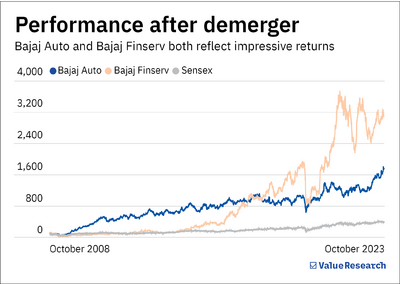
In 2008, the Bajaj Group underwent significant corporate restructuring, resulting in the demerger of Bajaj Auto and Bajaj Finserv from Bajaj Holdings and Investment Company. This move created three distinct wealth creators over the years.
While the initial listing of both Bajaj Auto and Bajaj Finserv may have been disappointing but, over the years, Bajaj Auto's stock price has surged over 18 times, reflecting its strong performance and growth in the automotive industry. Simultaneously, Bajaj Finserv has provided investors with an impressive return of over 24 times, showcasing its success in the diverse financial services sector.
Case 3
Transport Corporation of India
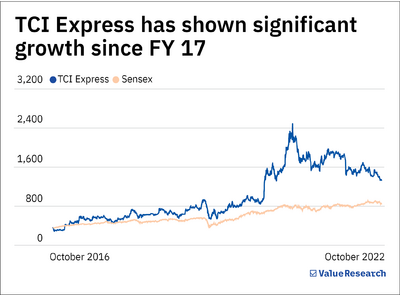
Similarly, after its demerger in 2015, TCI's express distribution business was listed as TCI Express was listed in December 2016. Since then, it has been a massive wealth creator with consistent growth in net profit. Since FY17, its net profits have grown by 24.1 per cent, and the share price has grown by 32.4 per cent annually.
All these case studies elucidate the transformative impact of demergers in the corporate landscape, underscoring their potential in resolving the issues of conglomerate discount and catalysing value creation.
Also read: Spinning profits
This article was originally published on November 06, 2023.
Ask Value Research 

 New episodes every Friday








 New Process Alert
  Seems like you've uploaded a wrong QR code. Please upload the QR code downloaded from MF Central platform.


