




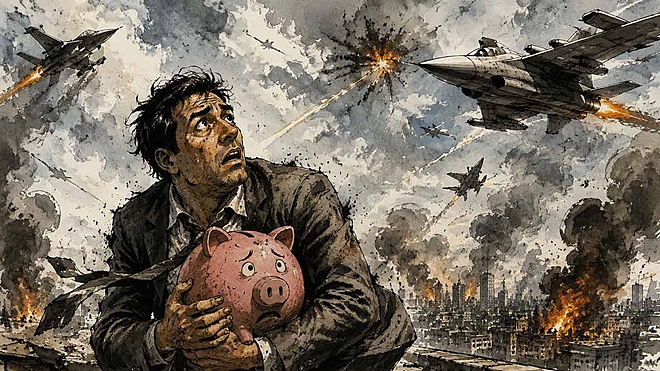
 Aditya Roy/AI-Generated Image


Summary: For three decades, the advice has been almost monotonously the same. Stay the course. This too shall pass. Today, I am stepping back from that template. And the reason is worth understanding before you decide what to do with your portfolio.
Through the dotcom bust, the 2008 crisis, demonetisation, the Covid crash, the Ukraine war, and every oil shock in between, my answer in this column has been almost monotonously the same. Stay the course. Don't react to the news. Downturns are opportunities. This too shall pass. Readers will recognise the refrain. The data has backed it, again and again, for three decades.
Today I am stepping back from that template.
The US-Iran war is a rare disruption for which my standard advice does not apply. The reason matters more than the news itself. Most crises that frighten markets are damage to sentiment. This one is damage to things. The distinction sounds small. It changes everything.
Consider what most market crises actually are. Companies stumble. A sector falls out of fashion. Valuations get ahead of earnings. Panic sets in. Prices fall. But the factories are still there. The workers are still there. The supply chains, the customers, the productive capacity of the economy, all of it remains intact. What has changed is mood, or liquidity, or the price someone is willing to pay for a future stream of cash. These are mood swings inside a body that is fundamentally healthy. They are, by their nature, cyclical. They pass.
The conflict in West Asia is the other kind.
The damage being inflicted is not to sentiment. It is two things. If a meaningful share of the world's crude refining capacity is being physically destroyed, and the figures being floated are 10-15 per cent, though no one can verify them, then we are not in a cycle. We are in a rebuilding phase that has not even begun, because the destruction has not stopped. Petrol, diesel, fertiliser, plastics, and the countless industrial inputs that flow from a barrel of oil will not be restored by a change of mood. They will be restored only when steel is welded, pipes are laid, and refineries are rebuilt. That takes years, not quarters.
What makes this harder is that the usual signals an investor relies on, production figures, capacity utilisation, and supply forecasts, are themselves casualties of the war. We cannot trust them. We cannot trust the parties' stated intentions either. The assumption that economic logic restrains nations from their worst behaviour is being tested in real time. Markets are not built to price decisions made for reasons unrelated to markets.
For the Indian investor, none of this is abstract. India imports more than 85 per cent of the crude it consumes. Every dollar the global price rises shows up, with a lag, at the petrol pump, in the fertiliser bill, in the cost of cement, in the household budget in Indore. Picture a Pune retiree who began a Rs 20,000 monthly SIP in 2008 and has held through every panic since. Her portfolio will be fine, in time. Her grocery bill will not wait. The same household feels the damage in two places at once. In the equity NAV that wobbles. The rupee buys less than it did last month.
There is a second-order effect that is easy to miss. The companies in her equity fund, the cement makers, the auto firms, the consumer goods companies, all face higher input costs that compress margins for as long as oil stays high. The real hit to her portfolio will not be this week's headline volatility. It will be the slower grind of next year's earnings.
I am not telling readers to sell their portfolios and flee. That would be exactly the kind of news-driven reaction I have spent decades arguing against. We should acknowledge that the usual reassurances may not apply in their usual form. The recovery, when it comes, will not be a sharp V on a chart. It will be slow and uneven. Crude may stay elevated for years, not weeks. Inflation will not fall on schedule. The rate cuts the market expects may not arrive on time. A lot of damage will have been done in the interim, to costs, to inflation, to growth, to the savings of people who had nothing to do with any of this.
The optimistic note I always try to land on is, this time, a quieter one. Every morning, a billion Indians get on with their lives. They produce. They consume. They save. They spend. That is the ultimate source of the India tailwind, and it does not depend on what happens in the Strait of Hormuz. It is not a complete answer to a war. It is the one foundation that, for the long-term Indian investor, still holds.
Also read: Read the signal, not the list
Ask Value Research 

 New episodes every Friday









 New Process Alert
  Seems like you've uploaded a wrong QR code. Please upload the QR code downloaded from MF Central platform.


