


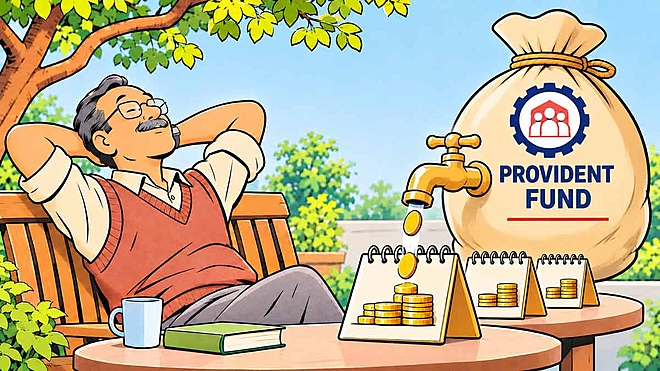
 Anand Kumar/AI-Generated Image
summary:Your PF no longer has to come out in one go when you retire. EPFO's new plan lets it pay you in instalments while the rest keeps earning. But a regular income is only as good as what it earns, how you reach it and how it is taxed. So how long can it really last?
Retiring EPF members will be able to draw their provident fund as a regular income. The board of the Employees' Provident Fund Organisation (EPFO) approved a systematic withdrawal plan (SWP) on November 19, 2026, according to the Labour Ministry's release. It starts once the ministry approves and notifies the new rules.
Until now, a retiree who withdrew PF took the whole balance in one go. With the SWP, you will be able to draw it in instalments, much like an SWP from a mutual fund.
Today, if you retire at 55 or later, your PF earns interest for three more years. After that, the account turns inoperative and earns nothing. The release says the money left under the SWP will keep earning. It does not name the rate. Since the money stays in EPF, it is likely to earn the EPF rate, but that is yet to be confirmed.
What does this mean for a retiree?
Three things matter when savings must pay a regular income: returns, access and tax.
Returns have been steady. EPF credited 8.25 per cent for 2025-26. The rate is reset every year, but over the past ten years it has stayed between 8.1 and 8.65 per cent. In May 2020, the RBI cut its policy rate to a record-low 4 per cent. EPF still paid 8.5 per cent for both 2019-20 and 2020-21. The rate for 2026-27 has not been announced yet.
You keep access to your money. The plan is voluntary, and you choose how often you are paid, such as monthly, quarterly or half-yearly. If you die during the payout period, your nominee or dependent can take the balance or keep the payments going. Reports of the proposal said you could also withdraw a lump sum or stop at any time. The release does not confirm this.
Tax is the open question. EPF interest is largely tax-free while you work, but interest earned after you retire is taxed like the rest of your income. Under the new tax regime, people living in India pay no tax on a total income of up to Rs 12 lakh a year. The release also says a matching change to the income tax law is being taken up with the Finance Ministry, without saying what it is. Any tax relief would be a bonus.
How long will it last?
If you take out only the interest, the money stays intact. At 8.25 per cent, Rs 50 lakh earns about Rs 4.1 lakh a year, roughly Rs 34,000 a month. But that income stays flat while your costs rise.
A rising withdrawal is more realistic. Say you take 5 per cent of Rs 50 lakh in the first year, which is Rs 2.5 lakh, or about Rs 20,800 a month. You raise it by 5 per cent every year. At EPF's ten-year average of about 8.4 per cent, the money could last about 33 years if you pay no tax on the interest. If the interest is taxed at the 30 per cent slab and the tax comes out of this money, it lasts about 22 years.
So what should a retiree do?
On what we know so far, the SWP makes your EPF money a strong contender among fixed-income options for a regular income. A government body runs it, and its return has been steady and among the highest available in fixed income.
But to keep up with inflation and rising costs, we believe it is important to have at least some part of your portfolio in equity.
Also read: EPFO 3.0: The ATM revolution that isn't
Ask Value Research 
 New episodes every Friday






 New Process Alert
 Seems like you've uploaded a wrong QR code. Please upload the QR code downloaded from MF Central platform.


