


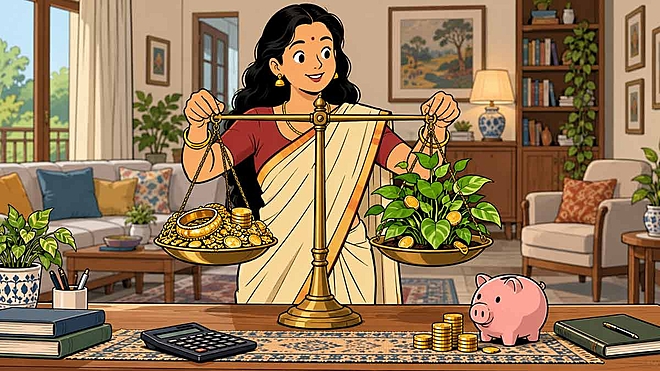
 Anand Kumar/AI-Generated Image

Summary: Every Dhanteras, crores buy gold on the same day believing they are investing. Most of it is jewellery with making charges that vanish at the shop door, or coins sitting in a rented locker. Enjoy the ritual, but count it as spending. Gold held as insurance belongs in a liquid, low-cost form.
Every year in the Diwali season, as Dhanteras comes around, people who have never bothered to invest in a planned way all step out to buy gold on the same day. Jewellers stay open late, many have queues at the entrances, and almost the entire nation performs in unison what most believe is an act of investment.
I’ll be careful here, because this column is about money and not culture. The Diwali season is wonderful, and Dhanteras is one of its best parts. The lamps, the cleaning of homes, the sense of a fresh beginning, the gathering of families. None of this needs improving, least of all by me. If your family welcomes prosperity by buying a little gold, buy it with all your heart. The ritual is not the problem. The problem begins when we mistake the ritual for a financial decision.
Consumption, not investment
Look at what is actually bought that day. For most families it’s jewellery, bought with a big markup of ‘making charges’ which vanish into thin air as soon as you leave the shop, or coins that will spend years in a bank locker that costs money to rent. Whatever else, this activity will not build wealth. It is consumption, often very enjoyable consumption, but it does not become investment because the day is auspicious.
So examine the behaviour itself. No other investment is made like this. No one wakes up on a specific day to buy mutual funds or stocks. Yet, with gold, crores buy on a date. Tell someone you plan to buy a stock on a particular day because it is auspicious, and they will tell you that you are not investing at all. The festival simply hides this absurdity under a warm glow so that behaviour we would laugh at anywhere else feels acceptable.
Gold as collateral
The tradition of holding ornaments as wealth has obvious historical roots and, let’s be honest, remains relevant today, though as collateral rather than as savings. For generations of Indian families, when cash ran out, the women’s gold was the ultimate reserve. It is still high-value, credible collateral, and over the last two decades a whole lending industry has grown up around it.
RBI data shows banks alone had about ₹5 lakh crore of gold jewellery loans outstanding in May 2026, roughly double a year earlier. Add the NBFCs, and the total crosses ₹8 lakh crore. The gold itself is worth far more because lenders keep a margin, lending no more than 75 to 85% of its value, usually less. That puts the jewellery behind these loans at well over ₹11 lakh crore. Compare that with the ₹37.5 lakh crore in India’s equity mutual funds, according to AMFI. The gold lying pledged in lenders’ vaults is worth close to a third of it. But a pledged ornament is a fallback, not an investment, and the Dhanteras reflex is best treated as a tradition, not as part of personal finance.
Insurance needs a different form
My regular readers know that over the last couple of years, I have softened on gold and written more than once that a small allocation is good. I think of it as insurance against a world where the monetary order looks less solid than it used to, and holding gold is no longer the irrational act I once believed it was. I stand by that. But the Dhanteras purchase sits far from that logic. Insurance is bought in a form you can sell when you need it, as a small part of an overall financial plan. Dhanteras gold is bought on impulse, in the least liquid and most expensive form. Gold can be a hedge, but what you carry home from a jeweller in a fancy bag can't play that role.
What to do this Diwali
So what should you do when Diwali is in the air, the jewellery shops are glittering, and everyone around you is buying? I would say, honour the ritual as a ritual. If you love Dhanteras, buy ornaments, enjoy them, gift them, and watch them being worn with pleasure. But in your head, account for them honestly in the expenditure column and not as part of your investment plan. If you want real gold holdings, keep them in a highly liquid form that costs little to hold. Bangles or necklaces do not qualify.
As I was finishing this column, most large fund houses stopped fresh money into their gold funds of funds from 16 October, reportedly at SEBI’s nudge, with the rupee weak and the festive import rush ahead. You can still buy gold ETFs on the exchange if you have a demat account. The jewellers, of course, are staying open late.
Also read: Only 7% of life insurance payouts are death claims
Ask Value Research 

 New episodes every Friday












 New Process Alert
 Seems like you've uploaded a wrong QR code. Please upload the QR code downloaded from MF Central platform.


