




 Anand Kumar/AI-Generated Image

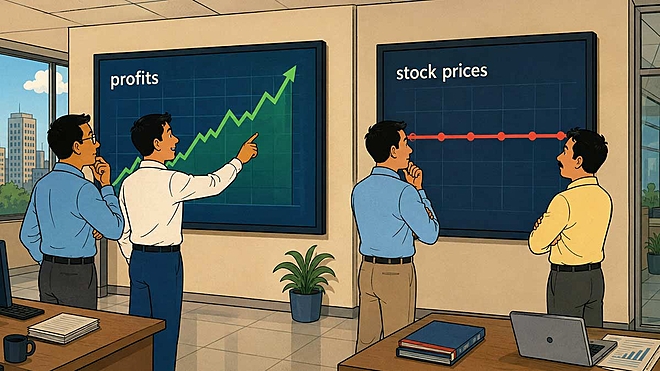
Summary: These three companies have delivered strong revenue and profit growth, healthy returns on capital and low debt, yet their stocks have lagged the BSE 500. The story shows why certain factors can cause share prices to diverge sharply from business performance.
You might have often come across companies that look great on paper: strong earnings, steady compounding, high profitability. However, their share prices say otherwise.
Such situations are less uncommon than you think. And the reasons share price and good businesses don’t often go hand in hand include the market’s unwillingness to pay high valuations, slowing growth, or deteriorating economics.
So we set out to find such companies: businesses that kept compounding while the stock fell out of favour with investors.
The process
We started by filtering for non-financial companies with a market capitalisation above Rs 1,000 crore.
We excluded BFSI companies because their return on capital employed (ROCE) and debt-to-equity ratio don't align with ordinary businesses.
For a company to qualify, it had to meet the below criteria:
- Five-year revenue and profit after tax (PAT) CAGR of at least 15 per cent
- Positive PAT every year in the period
- Latest annual revenue and PAT at a five-year high
- Five-year average ROCE above 15 per cent
- Cumulative operating cash flow at least 75 per cent of cumulative PAT over five years
- Latest debt-to-equity below 0.5 times
- Stock underperformed the BSE 500 by at least five percentage points annually over five years
Why so many filters? Revenue and profit growth show whether the business expanded; positive profits throughout remove loss-to-profit turnaround stories with misleading CAGRs. ROCE checks for a reasonable return on the capital growth required, cash conversion checks whether profits turned into cash and the leverage filter screens out growth built on excessive risk.
After applying the above filters, we were left with three companies, as summarised in the table below.
The three companies that made the cut
Despite steady growth, their share prices remain depressed
| Company | 5Y revenue growth (% pa) | 5Y PAT growth (% pa) | 5Y average ROCE (%) | Debt-to-equity (times) | 5Y returns vs BSE 500 (% points p.a.) |
|---|---|---|---|---|---|
| IRCTC | 46.4 | 49.4 | 51.8 | 0.02 | -11.6 |
| R Systems | 17.3 | 17.9 | 26.6 | 0.34 | -6.6 |
| Avenue Supermarts | 23.3 | 22 | 18 | 0.1 | -8.2 |
IRCTC: Growth is real, but the base exaggerates it
IRCTC appears as the strongest compounder, with five-year revenue and PAT growth of 46 and 49 per cent respectively, numbers that show exactly why screens need validation.
FY21 was the COVID year, when railway travel collapsed, revenue fell to about Rs 777 crore and PAT to Rs 187 crore. Starting from that depressed base exaggerates subsequent growth; comparing FY26 with pre-COVID FY20 instead brings annualised growth down to roughly 15 and 18 per cent.
Internet ticketing remains IRCTC's economic engine, but online migration is already advanced, leaving less room for the easy growth that came from passengers shifting from counters to digital booking. Catering can grow faster but at much lower margins. The monopoly hasn't disappeared, but the market increasingly views IRCTC as a more mature business than the hyper-growth digital-ticketing story it once priced in.
To read further on IRCTC's de-rating, click here.
R Systems: Acquisitions rise, yet organic growth stays low
R Systems offers a different case. Revenue and PAT have compounded at about 17 and 18 per cent, with five-year average ROCE around 27 per cent. Yet, the stock has lagged the BSE 500.
The distinguishing feature is acquisitions: Velotio in 2023, adding cloud, DevOps, data engineering and generative AI capabilities, and Novigo Solutions in November 2025.
This matters because the underlying IT-services environment is weak, so reported growth can increasingly come from acquisitions rather than organic demand. That does not automatically make it lower quality: buying businesses can sensibly add capabilities and scale, provided management does not overpay.
Leverage does not look alarming so far; debt-to-equity remains around 0.3-0.4 times. But two things are worth watching: acquisitions can conceal weak organic growth, and reported profit can be affected by one-offs; its 2025 profit benefited from a gain on the sale of assets.
The real question is whether acquisitions can generate attractive incremental returns. If ROCE and cash conversion stay healthy while acquired businesses add higher-value capabilities, the market may be too sceptical. If acquisitions merely mask sluggish organic growth while goodwill and debt accumulate, the derating would be understandable.
Avenue Supermarts: The business compounded, the valuation didn't
Avenue Supermarts, which runs the DMart stores, is perhaps the purest example of what the screen was designed to find.
Over five years, revenue compounded at 23 per cent and PAT at 22 per cent, while the company stayed lightly leveraged and converted profits into cash. Yet its stock lagged the BSE 500 by more than eight percentage points annually.
The explanation starts with expectations. The five-year numbers are strong, but recent growth has slowed: PAT growth over the latest three years has been much weaker than the five-year rate, while ROCE has moderated from around 20 per cent in FY23 to about 17 per cent in FY26.
DMart has kept investing aggressively in new stores, reaching 500 by FY26. But as the base grows larger, investors need to judge not just how many stores are added, but how productive they are and what returns they generate on the extra capital.
Competition has also intensified: quick-commerce has made convenience far more accessible in large cities, and pressure on mature metro stores makes the competitive question harder to ignore.
DMart's historical valuation reflected more than just opening more stores; investors paid for unusually strong store economics and a long runway for reinvestment. Even after years of underperformance, the stock still commands a demanding valuation, so a large derating does not automatically make it cheap.
The key question is whether same-store growth and returns on incremental capital can stabilise enough to justify the remaining premium. If they can, the market may have become too pessimistic.
What the screen tells us
Our exercise found companies where business and stock performance moved in very different directions, a useful hunting ground since valuation compression can leave a good business at a more reasonable price.
However, the screen has limitations too. Five-year CAGRs are sensitive to chosen endpoints, average ROCE can hide recent deterioration and price-return comparisons may not fully capture dividends. No quantitative screen can tell us whether an acquisition was sensible, competition has structurally changed or if today's valuation already discounts the risks.
That is why every screen should be treated as the beginning of research, not the end. Its job is not to tell us what to buy. It is to reduce thousands of companies to a handful that ask an interesting question.
Also read: The less profitable company grew faster. Here is why
Ask Value Research 
 New episodes every Friday










 New Process Alert
  Seems like you've uploaded a wrong QR code. Please upload the QR code downloaded from MF Central platform.


