




 VRO Team
Summary: Lalit Kumar rebuilt ICICI Prudential Multicap Fund around a business-cycle framework, swapping out FMCG and IT for a heavy Steel overweight, replacing 70 of 111 inherited stocks within a year. This interview covers how he times sector cycles, why he sizes bets the way he does2 and a broadcaster call where the cycle logic failed.
Within a year of taking charge, Lalit Kumar has rebuilt the ICICI Prudential Multicap Fund around one idea: find the sector before you find the stock. He explains why he is overweight on Steel and almost out of FMCG, why 164 stocks are not as many as they look and what a wrong call on broadcasters taught him.
THE FUND
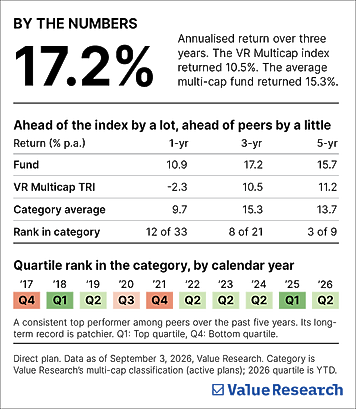
Launched in October 1994, the ICICI Prudential Multicap Fund is among the oldest equity schemes in India. It manages an AUM of around Rs 18,800 crore. The multi-cap mandate fixes at least 25 per cent of the portfolio each in large, mid and small caps, leaving 25 per cent to the manager. The benchmark is the Nifty 500 Multicap 50:25:25 index. Lalit Kumar took over in September 2025 and has since replaced most of the portfolio. Of the 111 stocks he inherited, only 41 remain today (as per the July 2026 portfolio disclosure), and they account for about a quarter of the fund by weight. In Kumar’s first year, the fund returned 12.5 per cent against 6.7 per cent for the benchmark.
THE FUND MANAGER
Lalit Kumar studied engineering at IIT Kanpur and began his career at Cypress Semiconductors before an MBA at IIM Calcutta. He spent five years in equity research at Nomura, where he covered media among other sectors, and two years at East Bridge Advisors. He joined ICICI Prudential AMC in May 2017 and has managed the ICICI Prudential Midcap Fund since August 2022, the Multicap Fund since September 2025 and the Large & Mid Cap Fund since June 2026. He describes himself as a business-cycle investor who buys sectors at the bottom of their cycle and sells them at the top.
Are you a top-down or a bottom-up investor?
Both, and in that order. When a sector is doing well, most companies in it beat the market. In a down cycle, you can debate whether company A or company B will do better, but both can lag. So the first filter is the sector: where we are in the business cycle, the macro, commodities, interest rates, liquidity, flows. That decides which sectors to be overweight and which to be underweight. Sector allocation matters as much for alpha as stock picking does.
Only then do I pick stocks, and that depends on the cycle, too. At the bottom of a cycle, I prefer small and mid caps in that sector. Late in the upcycle, or near the peak, one may not be in the sector at all, or only through large caps with good balance sheets.
How do you tell where a sector is in its cycle?
Look at financial metrics such as EBITDA per tonne, or ROE, ROC and ROIC, against history. At the bottom, ROIC is at its lowest, and EBITDA per tonne is at the bottom of its historical range. Ownership is another sign: at the bottom everyone is selling, at the peak everyone is buying. The balance sheet is a third. At the bottom, EBITDA is low, so net debt to EBITDA looks high, and leverage looks like a problem. At the peak, EBITDA rises sharply and the same balance sheet looks clean.
Take steel. It is a global cyclical, so I look at Chinese producers, the marginal suppliers. Their EBITDA per tonne is below mid-cycle, and some are making losses. The peak will come when even producers without their own iron ore or coking coal are making good profits. That is the time to exit. We are overweight steel. The cycle has much more room to run.
That framework suits commodities. Banks are 1.6 per cent of your multi-cap fund against a far larger benchmark weight. Does the sector not fit?
Every sector has cycles. Financials are a deep cyclical, domestic sector, but with a clear cycle. Loan growth follows the commodity cycle. In the last six months, as commodity prices rose, working capital rose and credit growth picked up. The same happened in 2022-23, when credit grew 16-17 per cent before normalising towards nominal GDP growth. Asset quality has cycles too: three or four years ago people were worried, but now it is benign. Net interest margin is a third cycle, expanding when rates rise and shrinking when they are cut.
When asset quality is a worry, banks with good underwriting and salaried customers outperform, because investors rotate into them. When asset quality is improving, the banks that see the most improvement do better. Banks and NBFCs that struggled over the last two to three years will do better from here. Those that did well over the last three to four years may lag. That is how the portfolio is positioned.
What does the multi-cap fund offer that your flexi-cap or large-and-midcap funds do not?
Three things matter to me in any fund: discipline, flexibility and liquidity. Multi cap has all three. Discipline is the mandatory 25 per cent each in large, mid and small caps, which was held even in 2020 and even at scale. The multi-cap index has beaten the Nifty 100 and the Nifty 500 over three, five, 10 and 20 years. Flexibility is the remaining 25 per cent, which can move to large caps when the market is expensive and to mid and small caps when it has bottomed. Liquidity comes from more than half the fund sitting in large and mid caps, and mid caps today run from about Rs 34,000 crore to over Rs 1 lakh crore market cap.
Of the 111 stocks you inherited, only 41 remain, a quarter of the fund by weight. Why?
Every fund manager has a style. ICICI Prudential has many kinds of fund managers focusing on growth, contrarian, earnings momentum or benchmark-aware. Mine is the business cycle, with structural stories layered on top. When the fund manager changes, the style changes and the portfolio follows. Normally, I build with a three-year horizon and churn little. A sector comes in or goes out only when its cycle has played out. A rebuild of this scale happens only when the manager changes.
Since you started managing the multi-cap fund, it has delivered nearly 12.5 per cent. It is a good outperformance over the benchmark, which delivered 6.7 per cent during this time. However, an average actively managed fund in the category delivered about 11.8 per cent returns, placing your fund 14th out of the peer set of 33. Was this the price of rebuilding your portfolio?
We judge performance over three years, because that is how the portfolio is built. The benchmark comes first, then peers. And it is hard to compare a Rs 20,000 crore fund with a Rs 1,000 crore fund. I have managed both. A small fund can load up on small and mid caps when they run, as they have since March, and do well for a while. That is hard to sustain. Compare funds of similar size. The objective is to beat the benchmark by a decent margin over the long term and the peer ranking takes care of itself.
You hold 164 stocks. Sixty per cent of them are under half a per cent each and add up to a fifth of the fund. Is the long tail real diversification?
I would not worry about the number of stocks. The top 10 or 15 active bets, overweight or underweight, decide the alpha. In a large fund, liquidity and diversification matter, especially in small caps, where we have 28-30 per cent. The tail is mostly positions in transit: a stock we are adding has rallied, so we wait for a better price; a stock we are exiting has corrected, so we wait for a better level. It keeps changing.
Consumer Staples have been cut from 6.8 per cent to nearly zero, technology from 6.9 per cent to about 2 per cent. Why?
FMCG had two moats: brand and distribution. Over the last decade, volumes drove the first half of earnings growth, and margins drove the second, driven by cheaper raw materials, premiumisation and efficiency. That resulted in a re-rating to a 50-55 times price-to-earnings multiple. Both moats are now under attack from D2C brands, e-commerce, quick commerce and modern trade. Volume growth is in low single digits. High margins, rising competition, single-digit volumes and multiples above 40 times do not add up for me. I would rather own companies growing volumes at 10-15 per cent on lower multiples.
IT is both cyclical and structural. Cyclically, growth is in a down phase. Structurally, large companies are losing share to GCCs and smaller IT firms; AI is disrupting them, and the base is now too large to grow at the old pace. When structural problems dominate, I would rather be underweight. That has helped the fund over the last year.
How do you separate a sector at the bottom of its cycle from one in permanent decline?
Every sector has a cyclical and a structural angle, and I weigh both. If a sector is in an upcycle and structurally improving, say consolidating with falling competition, we go significantly overweight. Upcycle with structural problems: overweight but less. Down cycle with structural problems: heavily underweight. Down cycle but structurally sound, only a little underweight.
Equity exposure is about 98 per cent, against 92 per cent under the previous manager.
For me it is a problem of plenty, not a lack of choice. In any year, at a peak, a bottom or mid-cycle, many companies return 50 per cent or more. We are relative investors, not absolute. The objective is to beat the benchmark. When the market corrects, as it did this March on due to geopolitics and oil, part of the portfolio holds up and part does not. We sell what held up and move into what fell. We did that in March 2026 and in 2020. We change the beta: reduce it when the market runs, raise it when it corrects. This March, we moved into oil-marketing companies and trimmed elsewhere.
Your mid-cap fund trailed its benchmark by 6.5 points on rolling one-year returns in 2023 and by 13 points in January 2024. Now it is second in its category over one year. What has changed?
Nothing changed. The fund manager changed in August 2022, and it took me a few months to rebuild the portfolio by November 2022 with a three-year view. Also, in 2023 or January 2024, 28 out of 30 mid-cap funds were underperforming the mid-cap benchmark, as few stocks in the benchmark went up like a rocket. And we don’t want to change such stocks. A counter-cyclical portfolio should not be expected to work in three or six months. You are buying what is falling or still at the bottom. The fund took six months to a year to turn, and once the cycle turned, the alpha came. You cannot time when a cycle turns. But if you buy a cyclical business at the bottom, it will turn.
Has a cycle call gone wrong?
Plenty have. Broadcasters are one. The cyclical case was that as FMCG gross margins recover, ad spend recovers and broadcasters’ revenue follows. I bought it on that basis. Ad spend did recover. But linear TV was being disrupted, non-sports advertising was declining and the multiple kept falling, from 35-40 times a decade ago to single digits. Structural factors beat cyclical ones.
That is why I think both ways. Most of the time the cycle dominates, but not always. It is also why we diversify across sectors, not just stocks. If one call fails, the alpha from the sectors that work offsets it.
Ask Value Research 



 New episodes every Friday











 New Process Alert
  Seems like you've uploaded a wrong QR code. Please upload the QR code downloaded from MF Central platform.


