




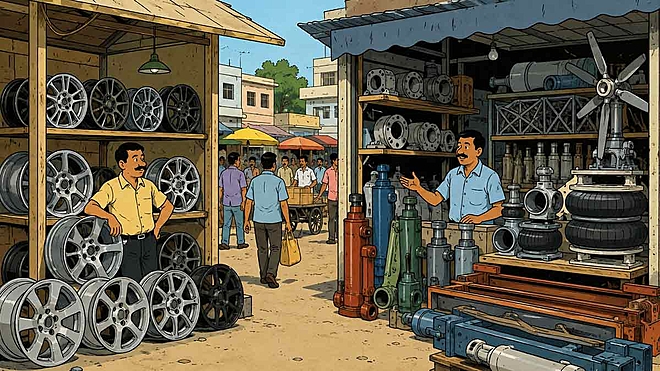
 Anand Kumar/AI-Generated Image

Put Wheels India and Steel Strips Wheels (SSWL) side by side and they look remarkably similar at first. Both generated a little over Rs 5,100 crore in revenue in FY26. Yet SSWL earned a net profit of Rs 202 crore, while Wheels India earned only Rs 139 crore.
So, SSWL is clearly the more profitable company.
But here is the surprise. Over the four years to FY26, Wheels India's profit grew at 17.2 per cent a year. SSWL's profit, by contrast, was almost flat.
How did the company earning less grow faster? The answer lies in where the two chose to invest.
Two different paths
SSWL stayed focused on wheels. It gradually shifted towards higher-value products such as alloy wheels and aluminium knuckles, using the same manufacturing skills to lift profitability. As alloy wheels became a bigger part of sales, the profit earned on each wheel improved: what the company calls EBITDA per wheel rose from Rs 262 in the June 2025 quarter to Rs 314 a year later, a 20 per cent gain.
Wheels India chose a different route. Instead of depending mainly on wheels, it expanded into hydraulic cylinders, windmill components, fabricated structures and air suspension systems. Today it looks more like a diversified engineering company than a pure wheel maker.
That difference shows up clearly in the operating margin, the share of sales a company keeps as operating profit. SSWL kept 10.1 per cent in FY26, against 7.9 per cent for Wheels India. A focused business with a richer product mix still earns more from every rupee of sales.
Why Wheels India's profits grew faster
At first glance, SSWL's higher margin should have meant faster profit growth. It did not.
The reason is that FY22 was an unusually strong year for SSWL. Exports had surged and alloy-wheel sales had jumped, pushing the operating margin to a record 13.1 per cent. Since then, exports have fallen from Rs 829 crore to Rs 454 crore. As those exceptional gains faded and new factories added costs before earning revenue, the margin slipped to 10.1 per cent.
Wheels India started from the opposite position. FY22 was a weak year, with a margin of just 7.1 per cent, so every improvement since has come from running the business better rather than from lucky conditions.
The difference is clearest in incremental profit, how much of each extra rupee of sales turns into profit. Between FY22 and FY26, every additional Rs 100 of revenue gave Wheels India about Rs 10 of extra operating profit. SSWL got only about Rs 3.50. That is why Wheels India's profit grew much faster even though its margin is lower.
Has diversification worked?
Not really, or at least not yet. The turnaround was driven mainly by Wheels India's original wheels business.
In FY26, the automotive wheels division grew operating profit by 23 per cent. The newer industrial businesses together managed only 15 per cent.
Those newer businesses also swallow a large share of the company's investment. They contributed just 17 per cent of segment revenue in FY26 but took 58 per cent of the capital spending and tied up 38 per cent of the capital employed. Their return on that capital was only 6.2 per cent, against nearly 26 per cent for the automotive business. In plain terms, Wheels India is investing most heavily in the businesses that have yet to prove they can earn a decent return.
Even so, the company overall has improved. Return on equity, the profit earned on shareholders' money, has risen from 9 per cent in FY23 to 15.5 per cent in FY26. SSWL's has slipped to 12.3 per cent. On the number that matters most to a shareholder, the two are moving in opposite directions.
The next challenge
Neither company can afford to slow down, and both are spending more than they currently earn. SSWL plans to invest about Rs 600 crore in FY27, mainly on a new alloy-wheel and knuckle plant at Bhuj, against FY26 operating profit of Rs 523 crore. Wheels India plans Rs 400 to 450 crore against operating profit of Rs 404 crore, and last year it was left with just Rs 83 crore of spare cash after funding its existing investment.
Neither balance sheet is quite as clean as its headline figure suggests, either. Count in the short-term borrowing companies use to fund day-to-day operations, such as bill discounting, and Wheels India's debt rises from a reported 1.68 times operating profit to 2.89 times.
The takeaway
Today, SSWL still looks like the stronger business: a higher margin, a simpler model and room to gain if exports recover. Wheels India tells a different story. Its recovery has been real and impressive, but it has come mainly from the old wheels business, not from the newer ventures soaking up most of the investment.
The broader lesson goes beyond these two. Expanding into new businesses does not automatically create value, just as staying focused does not guarantee faster growth. What matters is whether every new rupee a company invests earns a good return. That is the number to watch, not last year's profit growth.
Comparing two companies in the same industry rarely comes down to who earned more this year. The better investment is often the one allocating capital more intelligently and creating value that the market has yet to fully recognise. Value Research Stock Advisor looks beyond headline profits to identify businesses with durable strengths, disciplined capital allocation and the potential to compound shareholder wealth over time.
Find businesses built to create long-term value.
Ask Value Research 


 New episodes every Friday










 New Process Alert
  Seems like you've uploaded a wrong QR code. Please upload the QR code downloaded from MF Central platform.


