




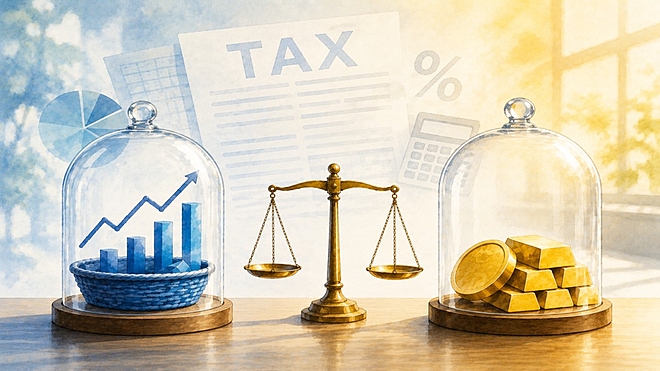
 Khyati Simran Nandrajog/AI-generated image

Summary: Index funds and ETFs both track a benchmark, but the taxman doesn't always treat them identically, particularly once you move beyond plain equity exposure. This piece breaks down how each is taxed across equity, debt and (for ETFs) gold and silver.
What is the difference in the taxation of index funds and ETFs? – Ramesh Krishnamurthy
Index funds and ETFs (exchange-traded funds) are often lumped together as ‘passive investing’. Both simply mirror an index rather than trying to beat it. Due to this similarity, many investors assume their tax treatment is identical too. It largely is, but not entirely, and the gaps show up in specific categories rather than across the board. Understanding these differences matters, because a mismatch in assumptions can lead to miscalculated returns or an unpleasant surprise at tax filing time.
How index funds are taxed
For equity index funds (those with at least 65 per cent in domestic equities), the rules mirror those for any other equity mutual fund.
If you sell within 12 months
Gains are treated as short-term capital gains and taxed at 20 per cent if you sell your index fund units less than a year after buying them.
If you sell after 12 months
Hold the units beyond 12 months, and long-term capital gains are taxed at 12.5 per cent, with the first Rs 1.25 lakh of such gains in a financial year exempt. This benefit applies only when securities transaction tax (STT) has been paid, which it typically is for equity mutual fund redemptions.
Debt index funds
Debt index funds are treated less favourably. Following changes effective from April 1, 2023, any debt-oriented fund (broadly, one investing over 65 per cent in debt and money-market instruments) sees all gains taxed at your income slab rate. There's no indexation benefit and no long-term concession, a change that significantly altered the appeal of debt funds for many investors.
How ETFs are taxed
Equity ETFs follow the same rules as equity index funds: 20 per cent tax on short-term gains and 12.5 per cent on long-term capital gains, with the Rs 1.25 lakh annual exemption applying. STT is paid on every exchange transaction, so the concessional rates generally apply without complication.
Debt ETFs, similarly, mirror debt index funds: gains are deemed short-term and taxed at slab rates for units bought on or after April 1, 2023, with no indexation.
Gold and silver ETFs
Where things diverge more visibly is gold and silver ETFs. Since these are listed on an exchange, they're treated as listed non-equity assets, which brings the long-term holding threshold down to just 12 months (rather than 24 months for their unlisted equivalents, such as gold fund-of-funds).
Gains held under 12 months are taxed at your applicable income tax slab rate; beyond that, long-term gains attract 12.5 per cent tax without indexation. Importantly, the Rs 1.25 lakh exemption available to equity assets does not extend to gold or silver ETFs, and STT is generally not levied on these transactions, though this doesn't affect the applicable tax rate.
In short, equity treatment is nearly a mirror image between index funds and ETFs, and debt treatment is now similarly aligned following the April 2023 reforms. The real distinction lies with gold and silver, where the listed status of ETFs shortens the holding period needed to qualify for long-term treatment, something FoF (fund of fund) investors in the same commodities don't get.
Also read: Index funds vs ETFs: What's the difference?
This article was originally published on August 03, 2026.
Ask Value Research 
 New episodes every Friday











 New Process Alert
  Seems like you've uploaded a wrong QR code. Please upload the QR code downloaded from MF Central platform.


