




 Anand Kumar/AI-Generated Image

Summary: Two companies warn of the same slow year and their shares fall just as hard. One is building. The other is quietly shrinking. On a results screen they look identical, and selling the wrong one at the wrong moment can be costly. The difference hides in places most investors never think to look.
The Nifty has fallen for eight straight weeks.
That is its longest losing run in 25 years, a fall of about 8.7 per cent. Now the results season begins. Some companies will report a weak quarter. A few will say the whole year ahead looks slow.
For many investors, that is the signal to sell. It should be the signal to look closer.
Share prices react fast to the next few quarters. They are slow to price what a business is building. So when a company says growth will slow, its stock often falls as though the slowdown is permanent. Sometimes it is. Often it is not. Knowing which one you are looking at decides whether you sell a future winner at a low price or leave a failing business in time.
Two companies, one number
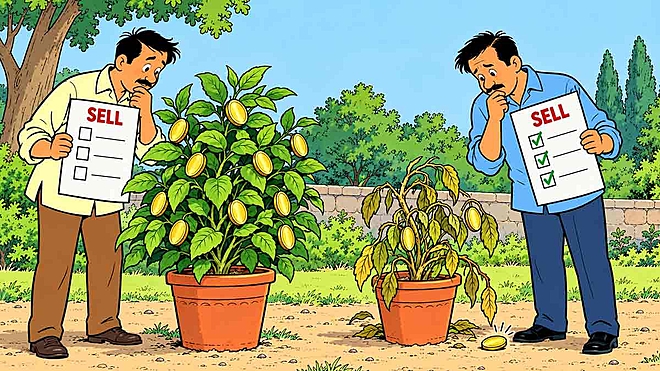
Consider two companies. Both tell shareholders to expect single digit growth next year, well below their recent pace.
The first is losing customers to a cheaper rival. It is spending heavily to defend what it has left. It has borrowed to do it.
The second is waiting for a new plant that will nearly double its capacity. It is paying for that plant from its own profits. Some customers have delayed orders. None have left.
On a results screen, the two look the same. They are not the same business. Three checks separate them, and each one uses the company's own reports.
Check 1: Where is the money going?
Open the cash flow statement and find the money spent on new assets. Compare it with depreciation, which is roughly what it costs a business just to stand still. Spending well above depreciation, on capacity for demand you can see, is building. Spending that only keeps the business running while sales shrink is defending.
Then read what the money is for. A new plant for a market that is short of supply is a very different bet from a price war to win back lost customers.
Check 2: Who is paying for it?
Growth can be paid for in three ways: from profits, with borrowed money, or by selling new shares. Only the first keeps your share of the business whole and the balance sheet clean.
Check three numbers over five years: total debt, the number of shares, and how many shares the promoters have pledged. Adjust the share count for bonus issues and splits, which add shares without adding money. A company that expands with no new debt and no new shares is funding its future from strength. One that borrows heavily in a slow year is adding risk exactly when it can least carry it.
Check 3: Has anything permanent changed?
This is the hardest check and the most important. Ask whether the slowdown has a temporary cause or a lasting one.
Read the management commentary and the transcript of the results call. Words like "deferred" and "postponed" describe orders that will arrive later. Words like "lost" and "pricing pressure" describe orders that may never arrive.
Then look at return on capital in the company's worst years. A business that kept earning well above its cost of capital in a bad year has shown you what it can survive. One whose returns collapsed at the first slowdown has shown you something too.
Putting them together
If the money is going into real capacity, the company is paying for it itself, and nothing permanent has changed, the slow year is the cost of building. Holding through it is patience, not stubbornness.
If any one of the three fails, the slow year may be the first sign of decline. Take it seriously, whatever the share price has already done.
One last step. Write down today what would have to change for you to sell. If your answer is "the price fell," you have not yet answered the question.
A share price tells you what the market thinks about this quarter. These three checks tell you what the business can become. Only the second is worth your money.
See the three checks applied, live
At Stock Analyst Live on Saturday, 10 October, at 12:30 PM our analysts will run all three checks on a company whose own management expects a slow year. It is our new recommendation for Value Research Stock Advisor subscribers.
Subscribers see the name, three scenarios for its profits, what today's price already assumes, and the exact conditions under which we would sell. You can register for the session here.
Ask Value Research 
 New episodes every Friday











 New Process Alert
  Seems like you've uploaded a wrong QR code. Please upload the QR code downloaded from MF Central platform.


