




 Sakshi/AI-Generated Image
Summary: Hospital stocks trade at some of the richest multiples in the market, and the demand behind them looks real, but new beds take years to build and ramp up to profitable occupancy. This piece lays out why an index that spans the sector sidesteps the operator-specific execution bet while still leaving investors exposed to that fixed timeline.
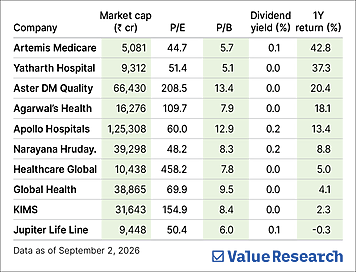
Hospital stocks trade at some of the richest multiples anywhere in the Indian market. Large, diversified chains like Max Healthcare and Apollo Hospitals change hands at 60 times earnings or more.
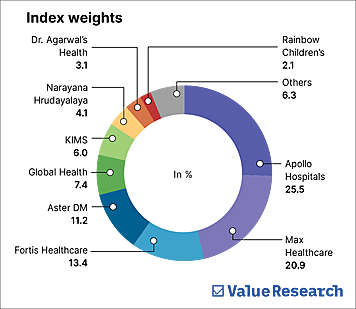
The BSE’s decision to carve out a dedicated Hospitals Index last year, separate from the broader Healthcare index that lumps in pharmaceuticals and diagnostics, is itself a sign of how distinct and how large this category has become. That optimism shows up in price too: the index trades at close to 66 times earnings and roughly 12 times book value, against the Sensex’s 20 times and 4 times respectively. Just three companies account for roughly 60 per cent of the index.

The question worth asking is not whether the demand behind these valuations is real. It is whether the sector can turn that demand into earnings.
A business measured in years, not quarters
Building hospital capacity is not like adding a product line or hiring more engineers. A single greenfield hospital set-up can cost crores in capital expenditure once land, construction, and medical equipment are accounted for.
A new facility typically takes over a year just to be built and commissioned, and then another three to five years to ramp up to the occupancy levels that make it profitable. Every rupee of expansion capital committed today shows up in earnings only after a multi-year lag, and that lag does not shorten just because demand is strong.
The demand is real, but the timeline is fixed
India genuinely has fewer hospital beds per person than comparable economies, and rising incomes, wider insurance coverage, and a growing flow of patients travelling from abroad for treatment are all pushing demand higher. Large listed chains are responding at scale, with the industry expected to add several thousand new beds over the next two years, backed by tens of thousands of crores in committed investment.

But government insurance schemes with fixed procedure pricing are also squeezing margins on a large share of patients, pushing hospitals to lean harder on high-acuity, high-margin specialties like cardiology and oncology to protect profitability.
Why the index does not need to pick a winner
Inside this one sector sit businesses with very different bets embedded in their price. Established, diversified chains with steady occupancy trade at a real but comparatively modest premium. Regional chains in the middle of aggressive, debt-funded expansion assume near-flawless execution of years of future bed additions. Getting that call right, judging which expansion plan lands on time and at the occupancy the market expects, is a genuinely difficult, operator-specific bet.


An index does not need to win that call. It only needs the sector’s underlying demand to keep showing up as beds get built, whichever operator ends up building them.
The honest trade-off
The case for the BSE Hospitals index is exposure to a demand story that looks durable, without having to judge which chain’s expansion plan executes best.

What it does not remove is time. Valuations across the sector already price in years of bed additions reaching maturity, and hospital capacity, unlike most businesses, cannot be accelerated simply because the market wants it sooner.
This article was originally published on October 01, 2026.
Ask Value Research 













 New Process Alert
  Seems like you've uploaded a wrong QR code. Please upload the QR code downloaded from MF Central platform.


