




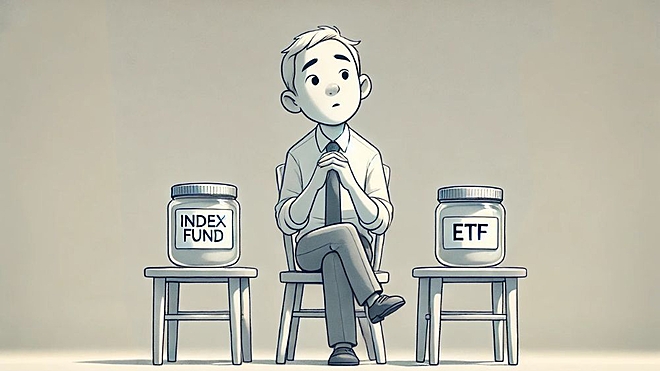
 AI-generated image

Both index funds and ETFs (Exchange-Traded Funds) help investors take a passive approach to investing. They allow you to invest in a diversified portfolio of stocks without having to pick individual winners. But which one is better for you?
While both track a stock market index, their structure, trading method, fees, and tax treatment differ. Understanding these differences can help you make an informed decision.
Let's break down how index funds and ETFs compare and which one suits your investment style.
What are index funds?
An index fund is a type of mutual fund that replicates a stock market index like the Nifty 50 or Sensex. Instead of selecting individual stocks, the fund buys all the stocks in the index in the same proportion, ensuring that the fund's returns closely match the index's performance.
Key characteristics of index funds
- Passive management : No stock picking, just tracking the index.
- Purchased at NAV (Net Asset Value) : Investors buy and sell at the NAV price, which is calculated at the end of each trading day.
- Ideal for long-term investors : No need to track daily price movements.
- SIP-friendly : You can invest through Systematic Investment Plans (SIPs) to benefit from rupee-cost averaging.
This is suitable for investors who want a simple, hands-off way to grow wealth over time.
What are ETFs?
An Exchange-Traded Fund (ETF) is also a passive investment that tracks an index, but unlike index funds, ETFs trade on stock exchanges like individual stocks. Instead of buying from a mutual fund company, investors buy and sell ETFs through a brokerage account at market prices.
Key characteristics of ETFs
- Traded like stocks : Prices fluctuate throughout the day.
- Real-time pricing : No need to wait for NAV; buy or sell instantly.
- Requires a brokerage and demat account : Unlike index funds, you need a trading account (broker) to invest in ETFs.
- Lower expense ratios : Generally cheaper than index funds due to lower fund management costs.
ETFs are suitable for investors who want the flexibility to trade like stocks and are comfortable with using a demat account.
Index funds vs ETFs
| Feature | Index funds | ETFs |
|---|---|---|
| Structure | Mutual funds tracking an index | Traded on stock exchanges like stocks |
| Buying/selling | Bought/sold at end-of-day NAV | Bought/sold at market price throughout the day |
| Pricing | NAV-based, same for all investors | Price fluctuates based on demand and supply |
| Liquidity | Processed once a day by AMC | High liquidity, instant trading on exchanges |
| Trading costs | No brokerage fees, only fund expenses | Requires demat account, brokerage fees apply |
| Expense ratio | Generally slightly higher | Lower due to passive management |
How to choose between index funds and ETFs?
Choose index funds if:
- You prefer a simple, hands-off investment approach.
- You don't want to open a brokerage or demat account.
- You invest through SIPs (Systematic Investment Plans).
Choose ETFs if:
- You want the ability to trade at real-time prices during market hours.
- You have a demat account and are comfortable placing stock-like orders.
- You want lower expense ratios and higher tax efficiency.
Conclusion
Both index funds and ETFs offer low-cost, passive investing, but the right choice depends on your needs. Index funds are best for long-term investors looking for simplicity and automated investing through SIPs, while ETFs offer more flexibility and lower costs for those comfortable with stock trading.
So, do you prefer a simple, long-term approach or the flexibility of real-time trading?
This article was originally published on March 10, 2025.
Ask Value Research 












 New Process Alert
  Seems like you've uploaded a wrong QR code. Please upload the QR code downloaded from MF Central platform.


