




 Anand Kumar/AI-Generated Image

Summary: A new PFRDA scheme sells big family health cover for less than many retail plans charge, and it will take you up to 70 with no medical tests. But it comes bolted to a savings account, and the two halves are not equally good. One of them may not do the job you would assume it does.
Join NPS Swasthya for its Rs 30 lakh health cover, and plan to pay the Rs 3 lakh deductible from somewhere other than its savings account.
The scheme charges Rs 1,732 a year for Rs 30 lakh of cover above a Rs 3 lakh deductible if you join at 40 or younger. Join between 41 and 60 and it costs Rs 2,523; between 61 and 70, Rs 4,953. These are prices for one adult, including GST. At 60, five comparable retail super top-ups charge Rs 6,981 to Rs 13,518 for smaller covers, and they carry no GST. At 70, two of the five will not take you at all.
The terms are as unusual as the price. Pre-existing diseases are covered after one year. There are no medical tests, no co-payment and no disease-wise limits. Renewal runs to age 85, and a claim cannot by itself raise your premium.
PFRDA launched the scheme on 1 October, two weeks after notifying its rules. Axis Pension Fund is the only provider so far, with Aditya Birla Health Insurance as insurer.
Two products in one wrapper, kept legally apart
NPS Swasthya is a mandatory super top-up health policy plus a separate NPS account for medical spending. A super top-up pays only after the year's admissible hospital bills cross a threshold, the deductible. The bills of every covered family member count towards it together.
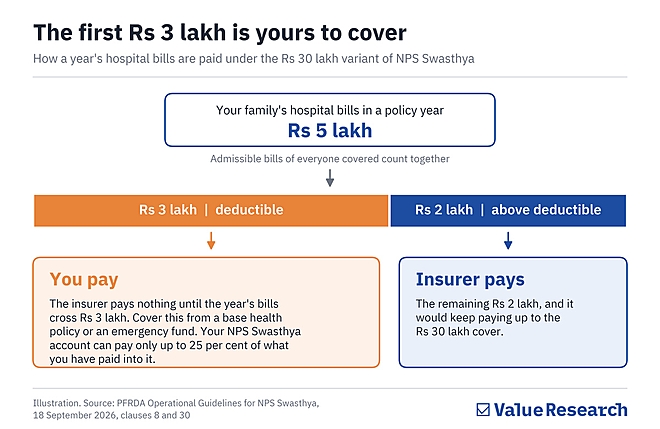
Say your family runs up Rs 5 lakh of hospital bills in a policy year. The first Rs 3 lakh is yours to cover. The insurer pays the remaining Rs 2 lakh, and would keep paying up to Rs 30 lakh.
| What you pay | Amount | When |
|---|---|---|
| Insurance premium | By variant and entry age (see below) | Upfront in year one; later years can come out of the account |
| Health Benefit Administrator fee | Rs 200 + GST | Every year |
| Opening investment | At least Rs 1,000; then any amount from Rs 10 | At enrolment |
| Fund management | Up to 0.08% of the balance a year, plus usual NPS charges | Every year |
The family floater covers you, your spouse and up to two dependent children. Parents are excluded. Anyone eligible for NPS can join between 18 and 70.
The Rs 30 lakh cover costs a fraction of retail, and the gap widens with age
At 60, the retail plans cost 2.8 to 5.4 times as much as NPS Swasthya, and every one of them offers less cover.

The policy wording, fixed by PFRDA for every insurer, is friendlier than most retail contracts.
|
Feature
|
NPS Swasthya standard policy |
|---|---|
| Pre-existing diseases | Covered after 12 months. IRDAI lets retail policies wait up to three years |
| Controlled diabetes, blood pressure, cholesterol, asthma | Covered after 12 months, no loading if the health declaration does not trigger one |
| Medical tests at entry | None. A 15-question health declaration; a positive answer adds premium, not reports |
| Co-payment, disease-wise limits | None |
| Room | Single private room; ICU at actual cost |
| Renewal | Up to 85. No fresh underwriting unless you raise cover; no premium rise just because you claimed |
| Insurer rejects a claim for non-disclosure | Your account can still pay a genuine bill |
One caution. This is a group policy, so the insurer reprices the whole pool at renewal, and a pool open to 70-year-olds on a self-declaration may see claims outrun premiums.
Only the Rs 3 lakh deductible variant is good value
The rules allow four variants, and PFRDA has published prices for three. In each, the deductible sets the price far more than the cover does. Rs 30 lakh of cover above Rs 3 lakh costs less than Rs 1 lakh of cover above Rs 10,000, at every age.
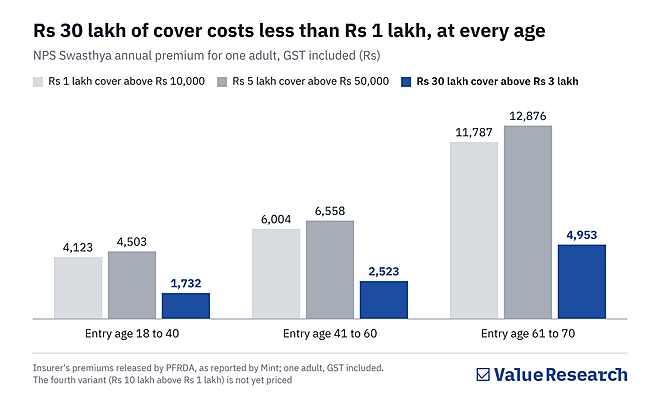
Per Rs 1 lakh of cover, a 40-year-old pays about Rs 58 in the Rs 30 lakh variant, Rs 900 in the Rs 5 lakh variant and Rs 4,123 in the Rs 1 lakh variant. A low deductible makes the insurer pay for routine admissions, which are frequent and costly to insure. A high one leaves it only the rare large bill. Buy a regular base policy and put the Rs 30 lakh variant on top of it.
The savings account will not cover the deductible for years
The withdrawal cap is 25% of what you have paid in, however much the balance has grown. You can withdraw as often as you like with no waiting period, and the money goes straight to the hospital or provider. To draw the full Rs 3 lakh deductible, you would need to have paid in Rs 12 lakh. Save Rs 5,000 a month and after three years you will have paid in Rs 1.8 lakh, of which you can draw Rs 45,000.
The balance is invested like central government employees' NPS money, mostly in bonds. Its real use is OPD bills and claims the insurer turns down.
|
How money leaves
|
When | How much | What happens to the account |
|---|---|---|---|
| Partial withdrawal | Any eligible OPD or in-patient bill | Up to 25% of your total contributions | Stays open |
| Premature exit | One in-patient bill larger than your withdrawal limit | The whole balance goes to that bill | Closes. Any balance moves to regular NPS. Cover lasts only to the end of the policy year |
| Renewal premium | Each year, by your mandate | The premium | Stays open |
| Lapse | Balance cannot pay the premium and the grace period passes | Nothing paid out | Closes. Balance moves to regular NPS |
Premature exit is the catch. It releases the whole balance for a big hospital bill, but it shuts the account, and the cheap cover ends with the policy year. The rules are silent on whether you can rejoin, or at what price after a serious illness.
Existing NPS subscribers can also move up to the deductible amount from their regular NPS account, though that turns retirement savings into a medical-only pot.
Who should sign up
The case is strongest for people in their late 50s and 60s who want large cover and find retail insurers expensive or unwilling. Entry closes at 70.
|
Your situation
|
What to do |
|---|---|
| 55 to 70, little or no cover, retail quotes high or refused | Join now, Rs 30 lakh variant. This is the scheme's best use |
| 30 to 55, employer or personal base cover of Rs 3 lakh or more | Join, Rs 30 lakh variant. Let the base cover absorb the deductible, and plan for employer cover ending when the job does |
| No base policy at any age | Buy a base policy first. Swasthya pays nothing on the first Rs 3 lakh |
| Already hold a large retail super top-up | Compare your next renewal premium. Waiting-period credit from a retail policy may not carry over, so do not drop it in a hurry |
| Want cover for your parents | Look elsewhere. Parents are excluded |
If you join, keep the Rs 3 lakh deductible covered by a base policy or an emergency fund, and use the account for OPD and smaller bills. Enrol through the NPS portal or a Point of Presence with your KYC.
This article was originally published on October 06, 2026.
Ask Value Research 
 New episodes every Friday












 New Process Alert
  Seems like you've uploaded a wrong QR code. Please upload the QR code downloaded from MF Central platform.


