




 Anand Kumar/AI-Generated Image

Summary: Kirloskar Pneumatic's margins have expanded from 14 per cent to over 20 per cent in five years. That kind of improvement doesn't come from a good quarter. Something structural changed inside this business and the market has already noticed. The question is whether the easy gains are largely behind it.
Five years ago, Kirloskar Pneumatic earned about Rs 14 for every Rs 100 of revenue it generated. Today it earns over Rs 20. That kind of margin expansion does not come from a good quarter or a commodity tailwind. Something structural changed inside this business.
The stock has returned over 40 per cent in the past year. The market has noticed. The question worth asking now is whether the improvement is durable or whether the easy gains are largely behind it.
What Kirloskar Pneumatic makes
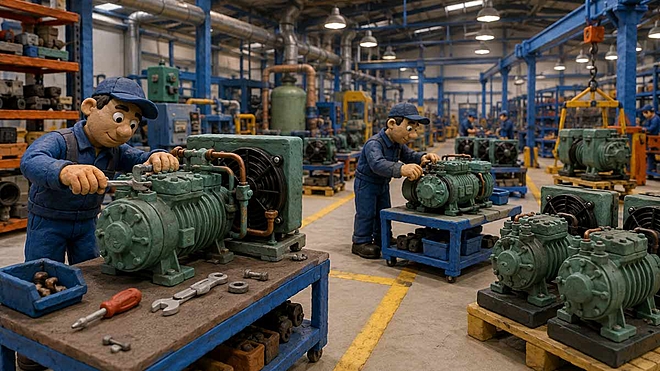
Kirloskar Pneumatic makes compressors, machines that pressurise air or gas to power industrial processes. The business runs across three segments: refrigeration and cooling for dairies, food processing and pharmaceutical facilities, now the largest at over 40 per cent of revenue; gas compression for oil and gas pipelines and CNG stations at 30 to 35 per cent; and air compressors for metal, cement and textile factories making up the rest.
The segment that built the company and then slowed
For most of its history, gas compression was the core. Kirloskar controlled 50 to 55 per cent of the large gas compression package market and operated as a near-duopoly in CNG mother stations, compressors that fill tankers which then supply smaller fuel stations. A standard CNG package costs Rs 12 crore to Rs 15 crore. The largest reach Rs 100 crore. New entrants need years of proven track record to compete. Kirloskar had it.
Then India's CNG rollout slowed. New commissionings dried up. A segment that had contributed 45 to 50 per cent of revenue started shrinking, and competitive strength alone could not change that.
From custom projects to standard products
This is where the business genuinely changed.
Kirloskar's revenue had long been dominated by large custom-built packages, entire systems constructed for a specific customer site. These took eight to 16 months to execute, revenue could only be booked after commissioning and margins were exposed to raw material swings throughout.
The company shifted toward standard equipment: standalone compressors built to designs that work across many customers. They ship when ready. Manufacturing cycles dropped to 4-16 weeks. Inventory days, the time materials sit inside the factory before becoming revenue, fell from 104 days in FY24 to 88 days in FY26. The cash conversion cycle, total time between spending on inputs and collecting from customers, improved from 103 days in FY25 to 90 days in FY26.
The revenue split was 60 per cent packages to 40 per cent equipment historically. By FY26, it reached 50:50, with management targeting 65 to 70 per cent equipment by FY27. Kirloskar also moved manufacturing in-house. Five years ago, nearly half the business involved importing core components. Today, the supply chain sits almost entirely within a 200-kilometre radius.
What the numbers show
|
|
FY26 | FY25 | FY24 | FY23 | FY22 |
|---|---|---|---|---|---|
| Revenue (Rs crore) | 1,759 | 1,629 | 1,323 | 1,239 | 1,021 |
| EBITDA margin (%) | 20.5 | 18 | 15.5 | 13.5 | 13.8 |
| Profit after tax (Rs crore) | 258 | 211 | 133 | 109 | 85 |
EBITDA margin, the percentage of revenue left after operating costs, has risen from 13.8 per cent in FY22 to 20.5 per cent in FY26. Each segment now independently delivers 18 per cent or more. Return on capital employed (ROCE) has risen to 30 per cent. Operating cash flows reached Rs 228 crore in FY26 at an 86 per cent conversion rate. The earnings are converting into cash, which validates the structural change rather than merely reporting it.
Kirloskar has also moved into product categories where multinationals once dominated. Centrifugal compressors, machines that compress air using high-speed rotating blades, crossed Rs 100 crore in order bookings in FY26 and now account for 15 to 18 per cent of the air compressor division's revenue against an addressable market of Rs 500 crore. A similar entry is underway in commercial air conditioning compressors, with a Rs 300 crore capital commitment pending approval under the government's production-linked incentive scheme.
Two risks the progress cannot paper over
The first is competitive pressure from both ends. Atlas Copco started manufacturing in Pune in FY24. Kirloskar competes on lifetime cost, but many customers prefer a premium brand regardless of price. From below, management acknowledged in the fourth quarter of FY26 that the company is losing oil and gas market share to smaller players offering lower prices.
The second is more structural. Packages are not going away. In FY26, large orders worth Rs 150 to 180 crore were ready but could not be dispatched because customer site approvals were delayed. Only 46 of the 88 compressors delivered were commissioned, with the rest awaiting clearances. Revenue grew just 8 per cent against a 20 per cent target. As long as packages remain significant, growth will depend on customer readiness. If projects are delayed, revenue will be too.
Where it stands
At 46 times earnings, Kirloskar trades between Elgi's 44 times and Ingersoll's 58 times. Its three-year profit growth of 36 per cent compounded annually outpaces both. Pending clearances are expected in the first half of FY27. If they arrive, the FY26 miss looks like a one-off. If they do not, the delays stop looking temporary.
The mix shift is the longer game. The more standard equipment outpaces packages, the less the business depends on a customer's site being ready. Kirloskar is a better business than it was five years ago. The market has priced in that story. Whether execution keeps pace will decide if the re-rating does too.
Whether a business is executing on its promise or quietly slipping behind it rarely shows up in a single headline. It shows up quarter by quarter, in order books, margin trends and cash conversion. That is the kind of tracking Value Research Stock Advisor is built for, so you know whether to hold conviction or reconsider it.
Ask Value Research 
 New episodes every Friday













 New Process Alert
  Seems like you've uploaded a wrong QR code. Please upload the QR code downloaded from MF Central platform.


